

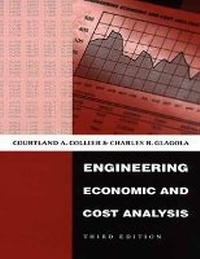
Engineering Economic and Cost Analysis
International Edition
3rd Edition
Published on 10. February 2000
Book
Paperback/Softback
712 pages
978-0-13-016328-8 (ISBN)
Description
Engineering Economic and Cost Analysis is especially written for those studying to become engineers. The third edition reflects the recent changes that have taken place in the field of engineering economy and continues to present the subject matter in a straightforward and practical manner. This book will help engineering students prepare for real-world situations and provide them with a valuable tool for how to implement cost analysis.
More details
Edition
3rd edition
Language
English
Place of publication
United States
Publishing group
Pearson Education (US)
Target group
Professional and scholarly
Dimensions
Height: 234 mm
Width: 161 mm
Thickness: 30 mm
Weight
938 gr
ISBN-13
978-0-13-016328-8 (9780130163288)
Copyright in bibliographic data and cover images is held by Nielsen Book Services Limited or by the publishers or by their respective licensors: all rights reserved.
Schweitzer Classification
Other editions
Previous edition
Courtland A. Collier | Charles R. Glagola
Engineering Economic and Cost Analysis
Book
10/1998
3rd Edition
Pearson
€181.35
Article exhausted; check for reprint
Persons
Dr. Glagola is currently an assistant professor in the Department of Civil Engineering, at the University of Florida in Gainesville, specializing in the area of Construction Engineering and Management. Research interests include: cost engineering, value engineering, total quality management, innovative contracting methods and engineering education. Dr. Glagola has been heavily involved in the curriculum innovation and renewal process at the local and national levels and has been working with the Southeast University and College Coalition for Engineering Education (SUCCEED). Other projects include innovative contracting methods and quality control for the Florida Department of Transportation (FDOT). He has published articles in the Journal of Construction of the American Society of Civil Engineers, Journal of Science and Engineering Ethics, and has presented papers at national meetings of the American Society of Engineering Education and the Transportation Research Board.
Dr. Glagola is a member of the American Society of Civil Engineers, the American Society for Quality Control, the American Society for Engineering Education as well as other professional organizations. He belongs to Chi Epsilon, the national civil engineering honorary, and Tau Beta Pi, the national engineering honorary. Dr. Glagola is actively involved with student organizations, serving as an advisor to the student chapter of the American Society of Civil Engineers. In his student related activities, Dr. Glagola teaches the engineering economy review course for the Fundamentals of Engineering (FE) exam which is a graduation requirement for civil engineering students at the University of Florida.
Dr. Glagola is a member of the American Society of Civil Engineers, the American Society for Quality Control, the American Society for Engineering Education as well as other professional organizations. He belongs to Chi Epsilon, the national civil engineering honorary, and Tau Beta Pi, the national engineering honorary. Dr. Glagola is actively involved with student organizations, serving as an advisor to the student chapter of the American Society of Civil Engineers. In his student related activities, Dr. Glagola teaches the engineering economy review course for the Fundamentals of Engineering (FE) exam which is a graduation requirement for civil engineering students at the University of Florida.
Content
I. BASIC PRINCIPLES.
1.Quantifying Alternatives for Easier Decision Making.
2. The Value of a Single Payment New Compared to a Single Payment in the Future.
3. The Value of One Future Payment Compared to a Uniform Series of Payments.
4. The Value of One Present Payment Compared to a Uniform Series of Payments.
5. Arithmetic Gradient, G: The Constant Increment to a Series of Periodic Payments.
6. Geometric Gradient: The Constant Percentage Increment.
II. COMPARING ALTERNATIVE PROPOSALS.
7. Present Worth Method of Comparing Alternatives.
8. Annual Payments Method for Comparing Alternatives.
9. Future Worth Method of Comparing Alternatives.
10. Rate of Return Method.
11. Incremental Rate of Return (ROR) on Required Investments.
12. Break-Even Comparisons.
13. Probability Evaluation.
14. Benefit/Cost Analysis.
III. EVALUATING ALTERNATIVE INVESTMENTS.
15. Taxes.
16. Depreciation.
17. Bond Financing for Public Works and Corporate Investment.
18. Home Ownership and Mortgage Financing: Owning Versus Renting.
19. Investment Property.
20. Equipment Replacement Analysis.
21. Double Gradients, Arithmetic and Geometric Introduction.
22. Utility Rate Studies.
23. Inflation.
1.Quantifying Alternatives for Easier Decision Making.
2. The Value of a Single Payment New Compared to a Single Payment in the Future.
3. The Value of One Future Payment Compared to a Uniform Series of Payments.
4. The Value of One Present Payment Compared to a Uniform Series of Payments.
5. Arithmetic Gradient, G: The Constant Increment to a Series of Periodic Payments.
6. Geometric Gradient: The Constant Percentage Increment.
II. COMPARING ALTERNATIVE PROPOSALS.
7. Present Worth Method of Comparing Alternatives.
8. Annual Payments Method for Comparing Alternatives.
9. Future Worth Method of Comparing Alternatives.
10. Rate of Return Method.
11. Incremental Rate of Return (ROR) on Required Investments.
12. Break-Even Comparisons.
13. Probability Evaluation.
14. Benefit/Cost Analysis.
III. EVALUATING ALTERNATIVE INVESTMENTS.
15. Taxes.
16. Depreciation.
17. Bond Financing for Public Works and Corporate Investment.
18. Home Ownership and Mortgage Financing: Owning Versus Renting.
19. Investment Property.
20. Equipment Replacement Analysis.
21. Double Gradients, Arithmetic and Geometric Introduction.
22. Utility Rate Studies.
23. Inflation.