

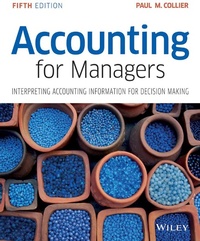
Accounting For Managers 5e
Interpreting Accounting Information for Decision Making
5th Edition
Published on 8. May 2015
Book
Paperback/Softback
544 pages
978-1-119-00294-9 (ISBN)
Description
This revised and updated fifth edition of Accounting for Managers builds on the international success of the previous editions in explaining how accounting is used by non-financial managers.
Emphasizing the interpretation as opposed to the construction of accounting information, Accounting for Managers encourages a critical rather than unthinking acceptance of accounting techniques. Whilst accounting information is immensely valuable for planning, decision making and control, users need to recognize the assumptions behind, and the limitations of, particular accounting techniques.
As in the previous editions, Accounting for Managers combines theory with practical examples and contemporary case studies drawn from real business situations across a wide range of manufacturing, retail and service industries.
Accounting for Managers is an ideal companion for postgraduate and undergraduate students, as well as non-financial managers in executive education courses seeking a better understanding of the role played by accounting and how it affects their organization and business unit.
More details
Other editions
Previous edition
Book
03/2012
4th Edition
Wiley
€65.90
Article exhausted; check for reprint
Person
Dr Paul M. Collier was Professor of Accounting at Monash University in Melbourne, Australia. He was previously at Aston Business School in Birmingham, UK. Paul is currently a consultant and investor in a hospitality business but retains an ongoing association in various academic projects with Monash University. Before becoming an academic, Paul was chief financial officer of a listed company and has worked in senior financial and general management positions in the UK and Australia. He has also conducted numerous executive education courses. Paul has been a board member of a large UK Housing Association and an Australian health service. This book is a result of his practical experience as a producer and user of accounting information as well as his teaching and training experience in the UK and Australia. A comprehensive package of supplementary material is available on the book companion website at www.wileyeurope.com/college/collier, including PowerPoint slides, multiple choice questions for each chapter, and additional questions and solutions.
Content
PART I: CONTEXT OF ACCOUNTING.
1. Introduction to Accounting.
2. Accounting and its Relationship to Shareholder Value and Corporate Governance.
3. Recording Financial Transactions and the Principles of Accounting.
4. Management Control, Management Accounting and its Rational-Economic Assumptions.
5. Interpretive and Critical Perspectives on Accounting and Decision-Making.
PART II: THE USE OF FINANCIAL REPORTS FOR DECISION-MAKING.
6. Constructing Financial Reports: IFRS and the Framework of Accounting.
7. Interpreting Financial Reports and Alternative Perspectives.
8. Accounting for Inventory.
PART III: USING ACCOUNTING INFORMATION FOR DECISION-MAKING, PLANNING AND CONTROL.
9. Accounting and Information Systems.
10. Marketing Decisions.
11. Operating Decisions.
12. Human Resource Decisions.
13. Accounting Decisions.
14. Strategic Investment Decisions.
15. Performance Evaluation of Business Units.
16. Budgeting.
17. Budgetary Control.
18. Strategic Management Accounting.
PART IV: SUPPORTING INFORMATION.
Readings
Glossary of Accounting Terms
Solutions to Questions
Index