

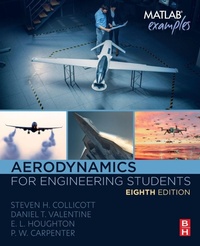
Aerodynamics for Engineering Students
8th Edition
Published on 27. November 2024
Book
Paperback/Softback
804 pages
978-0-323-99544-3 (ISBN)
Description
Aerodynamics for Engineering Students, Eight Edition provides concise explanations of basic concepts combined with an excellent introduction to aerodynamic theory. This updated edition has been revised with improved pedagogy and reorganized content to facilitate student learning. The book includes new examples in many chapters, expanded use of the "aerodynamics around us" boxes to help put the content into proper context for students, and more coverage and use of computational methods like MATLAB.
More details
Edition
8th edition
Language
English
Place of publication
Woburn
United States
Publishing group
Elsevier - Health Sciences Division
Target group
College/higher education
Dimensions
Height: 230 mm
Width: 192 mm
Thickness: 45 mm
Weight
1394 gr
ISBN-13
978-0-323-99544-3 (9780323995443)
Copyright in bibliographic data and cover images is held by Nielsen Book Services Limited or by the publishers or by their respective licensors: all rights reserved.
Schweitzer Classification
Other editions
Additional editions
Stanford University Collicott | Daniel T. Valentine | E. L. Houghton
Aerodynamics for Engineering Students
E-Book
11/2024
8th Edition
Butterworth-Heinemann
€82.99
Available for download
Previous edition
Steven H. Collicott | Daniel T. Valentine | E. L. Houghton
Aerodynamics for Engineering Students
Book
08/2016
7th Edition
Butterworth-Heinemann
€118.85
Shipment within 15-20 days
Persons
Steven Collicott is a Professor in the Department of Aeronautics and Astronautics at Purdue University. His research interests include experimental fluid mechanics, low-gravity fluid dynamics, optical diagnostics, and applied optics. He has led the proposing, design, and construction of 27 low-gravity NASA aircraft experiments, designed 2 of 6 tests in the successful Capillary Fluids Experiments (CFE) performed in the International Space Station in 2006/07, and advised on CFE modifications scheduled for launch in 2010. Professor Collicott is the president-elect of the American Society for Gravitational and Space Research (ASGSR). He was Inducted into Purdue's "Book of Great Teachers? in 2008, which "honors outstanding teaching faculty who have demonstrated sustained excellence in the classroom.? Daniel T. Valentine Ph.D. is Professor Emeritus and was Professor and Chair of the Department of Mechanical and Aeronautical Engineering, Clarkson University, Potsdam, New York. He was also Affiliate Director of the Clarkson Space Grant Program of the New York NASA Space Grant Consortium, a program that provided support for undergraduate and graduate research. His Ph.D. degree is in fluid Mechanics from the Catholic University of America. His BS and MS degrees in mechanical engineering are from Rutgers University. Dr. Valentine is also co-author of Aerodynamics for Engineering Students (Butterworth Heinemann).
Content
PART I: INTRODUCTION
1. Basic Concepts and Definitions
PART II: FUNDAMENTALS OF FLUID MECHANICS
2. Equations of Motion
3. Viscous Boundary Layers
4. Compressible Flow
PART III: AERODYNAMICS OF WINGS AND BODIES
5. Potential Flow
6. Two-Dimensional Wing Theory
7. Wing Theory
8. Airfoils and Wings in Compressible Flow
PART IV: APPLICATIONS OF AERODYNAMICS
9. Computational Fluid Dynamics
10. Flow Control, Planar and Rotating Wing Designs
Appendix
A. Symbols and Notation
B. Properties of Standard Atmosphere
C. A Solution of Glauert Type Integrals Appendix
D: Conversion of Imperial Units to Syst?eme International (SI) Units
1. Basic Concepts and Definitions
PART II: FUNDAMENTALS OF FLUID MECHANICS
2. Equations of Motion
3. Viscous Boundary Layers
4. Compressible Flow
PART III: AERODYNAMICS OF WINGS AND BODIES
5. Potential Flow
6. Two-Dimensional Wing Theory
7. Wing Theory
8. Airfoils and Wings in Compressible Flow
PART IV: APPLICATIONS OF AERODYNAMICS
9. Computational Fluid Dynamics
10. Flow Control, Planar and Rotating Wing Designs
Appendix
A. Symbols and Notation
B. Properties of Standard Atmosphere
C. A Solution of Glauert Type Integrals Appendix
D: Conversion of Imperial Units to Syst?eme International (SI) Units