

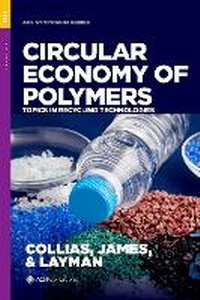
Circular Economy of Polymers
Topics in Recycling Technologies
Published on 18. November 2022
Book
Hardback
204 pages
978-0-8412-9816-3 (ISBN)
Description
Advancing technologies to deliver a circular economy for polymers
Over the last 70 years, plastic usage has spread into nearly every corner of modern life and all geographies. For much of this time, plastics have been disposed of at the end of their first life. While recycling and reuse have increased, these have been limited by the need for clean, single-material streams as feedstock for mechanical recycling and the development status of advanced recycling technologies. By enabling the use of more mixed-waste streams, technologies will not only cut down on
plastic waste landfilling, but also reduce greenhouse gas emissions. This work presents developing plastic recycling technologies, from feedstocks to final products, and various waste valorization vectors that will enable the eventual transition to a fully circular economy of polymers.
Over the last 70 years, plastic usage has spread into nearly every corner of modern life and all geographies. For much of this time, plastics have been disposed of at the end of their first life. While recycling and reuse have increased, these have been limited by the need for clean, single-material streams as feedstock for mechanical recycling and the development status of advanced recycling technologies. By enabling the use of more mixed-waste streams, technologies will not only cut down on
plastic waste landfilling, but also reduce greenhouse gas emissions. This work presents developing plastic recycling technologies, from feedstocks to final products, and various waste valorization vectors that will enable the eventual transition to a fully circular economy of polymers.
More details
Series
Language
English
Place of publication
New York
United States
Target group
Professional and scholarly
Dimensions
Height: 261 mm
Width: 182 mm
Thickness: 17 mm
Weight
648 gr
ISBN-13
978-0-8412-9816-3 (9780841298163)
Copyright in bibliographic data and cover images is held by Nielsen Book Services Limited or by the publishers or by their respective licensors: all rights reserved.
Schweitzer Classification
Persons
Dimitris I. Collias is Research Fellow in the Corporate R&D Department of P&G. Dr. Collias developed technologies in the bio and circular economy space, such as bio acrylic acid and surfactants, and recycled polyolefins and superabsorbent polymers. He co-authored the book Polymer Processing: Principles and Design (2nd Edition), published more than 35 articles in journals and conference proceedings, and holds more than 100 granted US patents.
Dr. Collias is the recipient of the 2020 ACS Affordable Green Chemistry Award. He earned his Diploma from the National Technical University of Athens, Greece, and Ph.D. from Princeton University, both in Chemical Engineering.
Martin I. James is a Principal Scientist in the Corporate R&D Department of P&G. Dr James has spent 34 years in the consumer goods industry, taking an analytical approach to problem solving and development of new technologies, holding patents in both formulated and assembled products. In recent years he has undertaken an
in-depth analysis of chemical recycling processes for PET, developed new processes for recycling of superabsorbent polymers from disposable hygiene products and explored alternative packaging forms to facilitate recycling. He earned his BSc and PhD in Polymer Chemistry, both from University of Lancaster, UK.
John M. Layman is currently a Senior Director in Procter & Gamble's Corporate R&D Department focused on helping develop more environmentally responsible product choices that help consumers and industry reduce overall environmental impact. Dr. Layman has developed and implemented technologies that will help enable the circular economy for polymers. He has authored 14 journal articles and holds 24 granted US patents. Dr. Layman received the John G. Smale Innovation Award
from P&G in 2016 and the 2021 ACS Colloid and Surface Technology Award. He earned his Ph.D. in Macromolecular Science and Engineering from Virginia Tech and his B.S. in Chemical Engineering from Virginia Commonwealth
University.
Dr. Collias is the recipient of the 2020 ACS Affordable Green Chemistry Award. He earned his Diploma from the National Technical University of Athens, Greece, and Ph.D. from Princeton University, both in Chemical Engineering.
Martin I. James is a Principal Scientist in the Corporate R&D Department of P&G. Dr James has spent 34 years in the consumer goods industry, taking an analytical approach to problem solving and development of new technologies, holding patents in both formulated and assembled products. In recent years he has undertaken an
in-depth analysis of chemical recycling processes for PET, developed new processes for recycling of superabsorbent polymers from disposable hygiene products and explored alternative packaging forms to facilitate recycling. He earned his BSc and PhD in Polymer Chemistry, both from University of Lancaster, UK.
John M. Layman is currently a Senior Director in Procter & Gamble's Corporate R&D Department focused on helping develop more environmentally responsible product choices that help consumers and industry reduce overall environmental impact. Dr. Layman has developed and implemented technologies that will help enable the circular economy for polymers. He has authored 14 journal articles and holds 24 granted US patents. Dr. Layman received the John G. Smale Innovation Award
from P&G in 2016 and the 2021 ACS Colloid and Surface Technology Award. He earned his Ph.D. in Macromolecular Science and Engineering from Virginia Tech and his B.S. in Chemical Engineering from Virginia Commonwealth
University.
Content
Preface
Chapter 1: Introduction-Circular Economy of Polymers and Recycling Technologies, Dimitris I. Collias, Martin I. James, and John M. Layman
Chapter 2: Plastic Waste as Feedstock: A Waste Management Perspective, Martin Champel
Chapter 3: Solvent-Based Recycling, Dominik Triebert, Hagen Hanel, Marlen Bundt, and Klaus Wohnig
Chapter 4: Chemical Recycling of PET, Robert D. Allen and Martin I. James
Chapter 5: Chemical Recycling-Pyrolysis, John Redshaw, Matthew O'Flaherty, Andrew Lake, and Pierre Moreau
Chapter 6: Monomer Recycling of Addition Polymers, Jean-Philippe Laviolette, Philippe Leclerc, Amir Enferadi Kerenkan, Ali Eslami, and Jocelyn Doucet
Chapter 7: Chemical Recycling-Gasification, William L. Trapp and Justin W. Murphy
Chapter 8: Life Cycle Assessment of Polymers and Their Recycling, Sabyasachi Das, Chao Liang, and Jennifer B. Dunn
Chapter 9: Mass Balance Accounting Approach, Holli Alexander, Travis Keever, and C. Jason Pierce
Editors' Biographies
Author Index
Subject Index
Chapter 1: Introduction-Circular Economy of Polymers and Recycling Technologies, Dimitris I. Collias, Martin I. James, and John M. Layman
Chapter 2: Plastic Waste as Feedstock: A Waste Management Perspective, Martin Champel
Chapter 3: Solvent-Based Recycling, Dominik Triebert, Hagen Hanel, Marlen Bundt, and Klaus Wohnig
Chapter 4: Chemical Recycling of PET, Robert D. Allen and Martin I. James
Chapter 5: Chemical Recycling-Pyrolysis, John Redshaw, Matthew O'Flaherty, Andrew Lake, and Pierre Moreau
Chapter 6: Monomer Recycling of Addition Polymers, Jean-Philippe Laviolette, Philippe Leclerc, Amir Enferadi Kerenkan, Ali Eslami, and Jocelyn Doucet
Chapter 7: Chemical Recycling-Gasification, William L. Trapp and Justin W. Murphy
Chapter 8: Life Cycle Assessment of Polymers and Their Recycling, Sabyasachi Das, Chao Liang, and Jennifer B. Dunn
Chapter 9: Mass Balance Accounting Approach, Holli Alexander, Travis Keever, and C. Jason Pierce
Editors' Biographies
Author Index
Subject Index