

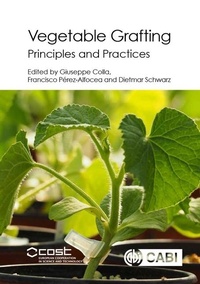
Vegetable Grafting
Principles and Practices
Published on 9. June 2017
Book
Hardback
298 pages
978-1-78064-897-2 (ISBN)
Description
This book provides comprehensive, current scientific and applied practical knowledge on vegetable grafting, a method gaining considerable interest that is used to protect crops from soil-borne diseases, abiotic stress and to enhance growth/yield. Though the benefits of using grafted transplants are now fully recognized worldwide, understanding the rootstock-scion interactions under variable environmental pressures remains vital for grafting-mediated crop improvement. In this book the authors attend to this need and explain the reasons for, and methods and applications of, grafting. Vegetable Grafting: Principles and Practices covers: ? rootstock breeding, signalling, and physiological and molecular mechanisms involved in grafting; ? beneficial effects of grafting including reducing disease damage and abiotic stress; ? side effects relating to the impact of grafting on fruit quality; and ? practical applications and speciality crops. Including high-quality colour images and written by an international team of expert authors, this book provides up-to-date scientific data and is also concerned with translating science to the field. It is an essential resource for researchers, advanced technicians, practitioners and extension workers.
More details
Language
English
Place of publication
Wallingford
United Kingdom
Target group
College/higher education
Product notice
sewn/stitched
Cloth over boards
Dimensions
Height: 246 mm
Width: 173 mm
Thickness: 23 mm
Weight
907 gr
ISBN-13
978-1-78064-897-2 (9781780648972)
Copyright in bibliographic data and cover images is held by Nielsen Book Services Limited or by the publishers or by their respective licensors: all rights reserved.
Schweitzer Classification
Other editions
Additional editions
Giuseppe Colla | Francisco Perez-Alfocea | Dietmar Schwarz
Vegetable Grafting
Principles and Practices
E-Book
06/2017
CABI Publishing
€0.00
Available for download
Persons
Editor
DAFNE, Italy
Consejo Superior de Investigaciones Cientificas (CSIC), Spain
Leibniz Institute of Vegetable and Ornamental Crops, Germany
Contributions
Campus Universitario de Espinardo, Spain
University of Sargodha, Pakistan
Agricultural Univerity of Athens, Greece
Institute of Soil, Water and Environmental Sciences, Israel
Huazhong Agricultural University/Key Laboratory of Horticultural Plant Biology, China
Instituto Valenciano de Investigaciones Agrarias (IVIA), Spain
Newe Ya'ar Research Center, Israel
Content
1: Introduction to vegetable grafting 1.1: Importance and use of vegetable grafting 1.2: The process of vegetable grafting 1.3: Problems associated with vegetable grafting 1.4: Conclusions 2: Genetic resources for rootstock breeding 2.1: Genetic diversity 2.2: Genebank collections 2.3: Current usage of genetic material in rootstocks 2.4: Germplasm collection of other plant families 2.5: Concluding remarks 3: Rootstock breeding: current practices and future technologies 3.1: Introduction 3.2: Stacking traits: meiosis or grafting or both? 3.3: Developing stable, core collections of germplasm for breeding 3.4: Deploying genetic diversity for rootstocks 3.5: Grafting as a tool for genetic hybridisation and chimera production 3.6: Selection of improved rootstocks 3.7: Transgenic rootstocks 3.8: Rootstock registration and commercialization 4: Rootstock-scion signalling: key factors mediating scion performance 4.1: Introduction 4.2: Current knowledge of ionic and chemical signalling between rootstock and scion 4.3: Conclusions 5: Physiological and molecular mechanisms underlying graft compatibility 5.1: Introduction 5.2: Anatomical and physiological steps during graft union development 5.3: Role of secondary metabolites at the interface in graft incompatibility 5.4: Cell-to-cell communication between graft partners 5.5: Understanding the molecular mechanisms involved in graft union formation and compatibility. 5.6: Methods for examining graft union development and compatibility 5.7: Conclusions and future perspectives 6: Grafting as agro-technology for reducing disease damage 6.1: Introduction 6.2: The first step: Managing diseases in the nursery 6.3: Disease spread from the nursery to the field, the example of powdery mildew of watermelons 6.4: Intra- and interspecific grafting and their relations to diseases 6.5: Biotic or abiotic stress? Different responses of grafted plants to environmental conditions, the case of "physiological wilt", and germplasm selection for rational breeding 6.6: Grafted plants' response to nematodes 6.7: Commercial rootstocks and unknown genetics 6.8: Different mechanisms involved in disease resistance induced by grafting 6.9: Conclusions 7: Grafting as a tool to tolerate abiotic stress 7.1: Introduction 7.2: Temperature stress 7.3: Salinity stress 7.4: Nutrient stress 7.5: Stress induced by heavy metals and metalloids 7.6: Stress by adverse soil pH 7.7: Drought and flood stress 7.8: Conclusions 8: Quality of grafted vegetables 8.1: What is quality? 8.2: Rootstock effects on fruit quality 8.3: Effects of grafting on ripening and postharvest behaviour 8.4: Bio-physiological processes affecting fruit quality 8.5: Conclusion and perspectives 9: Practical applications and speciality crops 9.1: Establishment of grafted transplant under Mediterranean climate conditions 9.2: Recommendations for the use of grafted plants in greenhouses. The case of the Netherlands 9.3: Role of grafting in speciality crops 9.4: Conclusions and future perspective of vegetable grafting 10: Index