

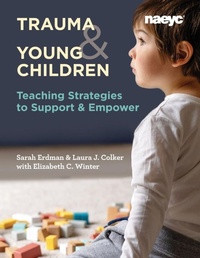
Trauma and Young Children
Teaching Strategies to Support and Empower
Published on 29. October 2020
Book
Paperback/Softback
144 pages
978-1-938113-67-3 (ISBN)
Description
Educators need access to accurate and useful guidance on helping children and families who have been exposed to trauma. Learn the basics of what trauma is, what the effects can look like, and specific types of trauma that may be experienced as well as targeted suggestions for creating trauma-informed classrooms and practices that support children and families. This book brings together how educators can incorporate the community into trauma-aware practices, acknowledges and addresses the needs of educators, and offers solutions for caring for themselves as well as the populations they serve.
Reviews / Votes
Early childhood educators are seeking to better understand the effects of trauma on the development of children and asking for concrete strategies to support them. This wonderfully written book addresses that need in a clear and compassionate way.-Whitcomb Hayslip, Early Childhood Education Consultant and former Assistant Superintendent for ECE, Los Angeles Unified School District -- Whitcomb Hayslip This comprehensive resource could not be more timely. Increasingly, early childhood educators must understand and know how to address the effects of traumatic experiences on young children's well-being and ability to learn. The authors have given us the what, why, and how of trauma-informed teaching to empower us to respond in positive, constructive ways to help all children thrive.
-Diane Trister Dodge, Early Childhood Curriculum Specialist and Founder, Teaching Strategies, LLC -- Diane Trister Dodge Trauma-informed care is now an absolutely essential component of developmentally appropriate practice for all children, teachers, and early education programs. Grounded in the science of child development, this important book provides effective strategies for supporting the healthy development of every child and teacher during the most challenging and stressful times in recent history.
-Sue Bredekamp, Early Childhood Education Consultant and Author -- Sue Bredekamp The power of Trauma and Young Children: Teaching Strategies to Support and Empower comes from its strength-centered principles and the hundreds of practical activities that translate these principles into action. This book can be your go-to source on using a healing-centered approach to trauma for years to come.
-Ellen Galinsky, Author of Mind in the Making: The Seven Essential Life Skills Every Child Needs -- Ellen Galinsky Early childhood educators are not therapists, so what specifically can we do to implement trauma-informed care? Start by reading this excellent presentation of strategies that support and empower children. This book is a useful blend of the field's foundational developmentally appropriate practice principles applied to the best of what we know about trauma-informed care.
-Valora Washington, CEO, The CAYL Institute -- Valora Washington Trauma and Young Children clearly lays out why and, more important, how all early learning programs can benefit from incorporating a trauma-informed approach. It offers an important set of tools for early educators to meet children where they are.
-Meredith Downing, Manager of Learning, Wonderschool -- Meredith Downing The authors provide specific strategies to mitigate and buffer the effects of toxic stress on young children. These practical application techniques are precisely what teachers need.
-Christine Schull, Professor of Early Childhood Development, Northern Virginia Community College Alexandria -- Christine Schull An invaluable resource for all who work with young children and their families, this book offers detailed guidance on how to recognize the impact of childhood trauma, work with experts to turn fearful situations into hopeful outcomes, and maintain your own health, sense of well-being, and optimism.
-E. Dollie Wolverton, Retired Chief of Education, Head Start Bureau -- E. Dollie Wolverton
More details
Language
English
Place of publication
Washington DC
United States
Product notice
Paperback (trade)
Illustrations
line drawings, figures, and tables
Dimensions
Height: 274 mm
Width: 213 mm
Thickness: 10 mm
Weight
476 gr
ISBN-13
978-1-938113-67-3 (9781938113673)
Copyright in bibliographic data and cover images is held by Nielsen Book Services Limited or by the publishers or by their respective licensors: all rights reserved.
Schweitzer Classification
Other editions
Additional editions
Laura J. Colker | Sarah Erdman | Elizabeth C. Winter
Trauma and Young Children
Teaching Strategies to Support and Empower
E-Book
09/2020
The National Association for the Education of Young Children
€30.99
Available for download
Persons
Sarah Erdman is an experienced early childhood educator and museum professional in Northern Virginia. Her research and professional practice explore how museums and educators can connect to make meaningful experiences for young children. Sarah teaches at FB Meekins Cooperative Preschool and serves on the board of the Northern Virginia Association for the Education of Young Children. She brings her experience as a mother and educator to all the work she does and is a committed advocate for educators and young children.
She is a graduate of the University of Maine and earned a MAT in Museum Education from The George Washington University and an AAS in Early Childhood Development from the Northern Virginia Community College. Sarah founded Cabinet of Curiosities LLC and has served as the early childhood consultant for institutions such as the National Museum of American History, the LBJ Presidential Library and Museum and The Phillips Collection. She is also a skilled trainer working with both early childhood educators and museum professionals.
Sarah was the creator and editor of The Care and Keeping of Museum Professionals, a collection of reflective essays on the state of the museum field. She has also published extensively in NAEYC's Young Children and Teaching Young Children as well as contributing to publications of the American Alliance of Museums, the National Museum of American History and the National Science Teachers Association.
Laura J. Colker , EdD, is the President of L.J. Colker & Associates in Washington, DC. She is an author, lecturer, and trainer in early childhood education with 40 years of experience. She has written or co-authored over 150 publications and contributed to the development of 45 educational videos and PBS programs. Dr. Colker is most widely known as a co-author of The Creative Curriculum for Preschool, now in its 6th edition. She is also a co-author of The Creative Curriculum for Family Child Care and the first edition of The Creative Curriculum for Infants, Toddlers, and Twos. Her two most recent books are High-Quality Early Childhood Programs: The What, Why, and How and Making Lemonade: Teaching Young Children How to Think Optimistically. Both books are co-authored with Derry Koralek.
For nine years, Colker was a contributing editor to Teaching Young Children, NAEYC's journal for preschool teachers. She has also been a consultant to Reading Is Fundamental (RIF), The Council for Professional Development, Zero to Three, WestEd, the Head Start Bureau, NACCRA (now Child Care Aware), the University of Minnesota, Sonoma State University, the Los Angeles Unified School District, all of the military services' child development programs, the Department of Defense Education Activity, and numerous other education-related institutions and organizations.
Elizabeth C. Winter, MD, is a board-certified psychiatrist living in Baltimore, MD. She is a Senior Physician with the Department of Veterans Affairs, Office of the Inspector General and a faculty member of the Johns Hopkins Hospital Department of Psychiatry and Behavioral Sciences. Dr. Winter began her career in private practice, providing medication management and psychotherapy. While in private practice, she became the co-director of the Johns Hopkins Anxiety Disorders Clinic, a tertiary consultation service providing in depth evaluations, formulations, and treatment recommendations. After leaving private practice, Dr. Winter was the medical director of a dual diagnosis facility in Maryland before joining the faculty of University of Maryland as an inpatient hospitalist. She joined the VA OIG in 2018.
Dr. Winter has worked in medical student and resident education for over 10 years at Johns Hopkins and the University of Maryland. In addition to individual mentoring, clerkship lectures, and seminars, Dr. Winter developed a 6-month long curriculum on the diagnosis and management of anxiety disorders for third year psychiatry residents in the subspecialty clinic rotation. She has published extensively in academic journals, book chapters, and articles for the general public on issues related to psychiatry.
She is a graduate of the University of Maine and earned a MAT in Museum Education from The George Washington University and an AAS in Early Childhood Development from the Northern Virginia Community College. Sarah founded Cabinet of Curiosities LLC and has served as the early childhood consultant for institutions such as the National Museum of American History, the LBJ Presidential Library and Museum and The Phillips Collection. She is also a skilled trainer working with both early childhood educators and museum professionals.
Sarah was the creator and editor of The Care and Keeping of Museum Professionals, a collection of reflective essays on the state of the museum field. She has also published extensively in NAEYC's Young Children and Teaching Young Children as well as contributing to publications of the American Alliance of Museums, the National Museum of American History and the National Science Teachers Association.
Laura J. Colker , EdD, is the President of L.J. Colker & Associates in Washington, DC. She is an author, lecturer, and trainer in early childhood education with 40 years of experience. She has written or co-authored over 150 publications and contributed to the development of 45 educational videos and PBS programs. Dr. Colker is most widely known as a co-author of The Creative Curriculum for Preschool, now in its 6th edition. She is also a co-author of The Creative Curriculum for Family Child Care and the first edition of The Creative Curriculum for Infants, Toddlers, and Twos. Her two most recent books are High-Quality Early Childhood Programs: The What, Why, and How and Making Lemonade: Teaching Young Children How to Think Optimistically. Both books are co-authored with Derry Koralek.
For nine years, Colker was a contributing editor to Teaching Young Children, NAEYC's journal for preschool teachers. She has also been a consultant to Reading Is Fundamental (RIF), The Council for Professional Development, Zero to Three, WestEd, the Head Start Bureau, NACCRA (now Child Care Aware), the University of Minnesota, Sonoma State University, the Los Angeles Unified School District, all of the military services' child development programs, the Department of Defense Education Activity, and numerous other education-related institutions and organizations.
Elizabeth C. Winter, MD, is a board-certified psychiatrist living in Baltimore, MD. She is a Senior Physician with the Department of Veterans Affairs, Office of the Inspector General and a faculty member of the Johns Hopkins Hospital Department of Psychiatry and Behavioral Sciences. Dr. Winter began her career in private practice, providing medication management and psychotherapy. While in private practice, she became the co-director of the Johns Hopkins Anxiety Disorders Clinic, a tertiary consultation service providing in depth evaluations, formulations, and treatment recommendations. After leaving private practice, Dr. Winter was the medical director of a dual diagnosis facility in Maryland before joining the faculty of University of Maryland as an inpatient hospitalist. She joined the VA OIG in 2018.
Dr. Winter has worked in medical student and resident education for over 10 years at Johns Hopkins and the University of Maryland. In addition to individual mentoring, clerkship lectures, and seminars, Dr. Winter developed a 6-month long curriculum on the diagnosis and management of anxiety disorders for third year psychiatry residents in the subspecialty clinic rotation. She has published extensively in academic journals, book chapters, and articles for the general public on issues related to psychiatry.
Content
Preface
Chapter 1: Introduction
Why It Is Important to Understand Trauma
Prevalence of Trauma
Trauma-Informed Care
Early Childhood Educators Matter
A Path Forward
Chapter 2: Types of Trauma Experienced by Young Children
What Is Trauma?
Key Concepts Related to Trauma
Adverse Childhood Experiences
Causes of Trauma
Category 1: Household and Family
Category 2: Loss
Category 3: Family Separations
Category 4: Violence and Disasters
Post-Traumatic Stress Disorder
Role of Racism in Trauma and Child Well-Being
The Influence of Other Factors on Children's Experiences of Trauma
Responses to Trauma Are Individual
A Path Forward
Chapter 3: How Trauma Impacts Young Children's Brains and Their Ability to Learn
Brain Circuits and Connections
Experience and Brain Connections
Responding to Stress
The Impact of Trauma on Development and Learning
What Toxic Stress Looks Like in Early Childhood Programs
A Path Forward
Chapter 4: Guiding Principles for Teaching Children with Trauma
Principle 1: Recognize that All Children Will Benefit from a Trauma-Informed Approach
Principle 2: Use a Strengths-Based Approach to Teaching
Principle 3: Recognize, Appreciate, and Address Differing Influences on Children's Experiences with Trauma
Principle 4: Embrace Resilience as a Goal for Every Child
Principle 5: Help Children Learn to Regulate Their Emotions
Principle 6: Use Positive Guidance When Dealing with Children's Challenging Behaviors
Principle 7: Be a Role Model to Children on How to Act and Approach Learning
Principle 8: Help Children Turn Negative Thinking Around
Principle 9: Enrich the Children's Lives with Art, Music, and Dance
Principle 10: Look Beyond Children's Traumas and Celebrate the Joys in Life
Principle 11: Remember that You Don't Have to Have All the Answers
A Path Forward
Chapter 5: Establishing a Safe and Inviting Environment for Learning
Design a Physical Environment that Supports Children's Emotional, Social, Physical, and Learning Needs
Provide Materials that Support Learning and Healing
Bring Structure to the Environment Through the Daily Schedule
Tips for the Physical Environment
A Path Forward
Chapter 6: Connecting with Children
How to Foster Relationships When Children Have Experienced Trauma
Help Children Form Strong Friendships with Their Peers
Mindfulness As a Tool For Building Relationships and Other Needed Skills
Tips for Interacting with Children
A Path Forward
Chapter 7: The Healing Power of Play
Benefits of Play When There Is Trauma
A Right to Play?
The Impact of Trauma on Play
Using Play to Address Trauma's Negative Effects
Using Playful Learning with Children Who Are Distressed
When Violence Is a Part of Play
Tips for Using Children's Play as a Healing Agent
A Path Forward
Chapter 8: Partnering with Families
What Is a Family?
What Is Engagement?
Special Considerations in Working with Families of Children Who Have Experienced Trauma
Connecting with Families to Benefit Children
A Path Forward
Chapter 9: Trauma-Informed Care in Schools and Communities
TIC and the School Community
The Four Rs Framework and Six Principles of TIC
What TIC Looks Like in Action
Working with Your Administrator
Advocacy
A Path Forward
Chapter 10: Caring for Yourself
Your Own Compounding Stress
Defining Teaching-Related Stress
Using Self-Care to Overcome Secondary Trauma
A Path Forward
Appendix One: Resources for Educators
Appendix Two: Picture Books About Trauma
Appendix Three: Handouts for Families
References
Index
Acknowledgments
About the Authors
Chapter 1: Introduction
Why It Is Important to Understand Trauma
Prevalence of Trauma
Trauma-Informed Care
Early Childhood Educators Matter
A Path Forward
Chapter 2: Types of Trauma Experienced by Young Children
What Is Trauma?
Key Concepts Related to Trauma
Adverse Childhood Experiences
Causes of Trauma
Category 1: Household and Family
Category 2: Loss
Category 3: Family Separations
Category 4: Violence and Disasters
Post-Traumatic Stress Disorder
Role of Racism in Trauma and Child Well-Being
The Influence of Other Factors on Children's Experiences of Trauma
Responses to Trauma Are Individual
A Path Forward
Chapter 3: How Trauma Impacts Young Children's Brains and Their Ability to Learn
Brain Circuits and Connections
Experience and Brain Connections
Responding to Stress
The Impact of Trauma on Development and Learning
What Toxic Stress Looks Like in Early Childhood Programs
A Path Forward
Chapter 4: Guiding Principles for Teaching Children with Trauma
Principle 1: Recognize that All Children Will Benefit from a Trauma-Informed Approach
Principle 2: Use a Strengths-Based Approach to Teaching
Principle 3: Recognize, Appreciate, and Address Differing Influences on Children's Experiences with Trauma
Principle 4: Embrace Resilience as a Goal for Every Child
Principle 5: Help Children Learn to Regulate Their Emotions
Principle 6: Use Positive Guidance When Dealing with Children's Challenging Behaviors
Principle 7: Be a Role Model to Children on How to Act and Approach Learning
Principle 8: Help Children Turn Negative Thinking Around
Principle 9: Enrich the Children's Lives with Art, Music, and Dance
Principle 10: Look Beyond Children's Traumas and Celebrate the Joys in Life
Principle 11: Remember that You Don't Have to Have All the Answers
A Path Forward
Chapter 5: Establishing a Safe and Inviting Environment for Learning
Design a Physical Environment that Supports Children's Emotional, Social, Physical, and Learning Needs
Provide Materials that Support Learning and Healing
Bring Structure to the Environment Through the Daily Schedule
Tips for the Physical Environment
A Path Forward
Chapter 6: Connecting with Children
How to Foster Relationships When Children Have Experienced Trauma
Help Children Form Strong Friendships with Their Peers
Mindfulness As a Tool For Building Relationships and Other Needed Skills
Tips for Interacting with Children
A Path Forward
Chapter 7: The Healing Power of Play
Benefits of Play When There Is Trauma
A Right to Play?
The Impact of Trauma on Play
Using Play to Address Trauma's Negative Effects
Using Playful Learning with Children Who Are Distressed
When Violence Is a Part of Play
Tips for Using Children's Play as a Healing Agent
A Path Forward
Chapter 8: Partnering with Families
What Is a Family?
What Is Engagement?
Special Considerations in Working with Families of Children Who Have Experienced Trauma
Connecting with Families to Benefit Children
A Path Forward
Chapter 9: Trauma-Informed Care in Schools and Communities
TIC and the School Community
The Four Rs Framework and Six Principles of TIC
What TIC Looks Like in Action
Working with Your Administrator
Advocacy
A Path Forward
Chapter 10: Caring for Yourself
Your Own Compounding Stress
Defining Teaching-Related Stress
Using Self-Care to Overcome Secondary Trauma
A Path Forward
Appendix One: Resources for Educators
Appendix Two: Picture Books About Trauma
Appendix Three: Handouts for Families
References
Index
Acknowledgments
About the Authors