

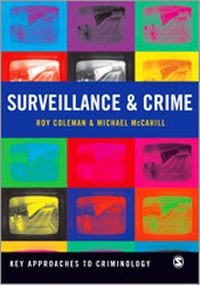
Surveillance and Crime
1st Edition
Published on 15. October 2010
Book
Hardback
224 pages
978-1-84787-352-1 (ISBN)
Description
Surveillance has a long-standing relationship with crime and its identification, prevention, detection and punishment. With information on each citizen spanning up to 700 databases, and over 4 million CCTV cameras in the United Kingdom alone, this book explores how new technologies have given rise to new forms of monitoring and control.
Offering a comprehensive understanding of the relationship between surveillance, crime and criminal justice, this book explores:
the development of surveillance technologies within a broad historical context
how new surveillance technologies are shaped by existing social relations, political practices, cultural traditions and organizational contexts
the implications of the use of surveillance in responding to crime (including biometrics, DNA samples and electronic monitoring)
how 'new' surveillance technologies reinforce 'old' social divisions - particularly along the lines of class, race, gender and age.
The book draws upon theoretical debates from a range of disciplines to shed light on this topical subject. Engaging and authoritative, this is an important read for advanced students and academics in criminology, criminal justice, social policy and sociology.
The Key Approaches to Criminology series celebrates the removal of traditional barriers between disciplines and, specifically, reflects criminology's interdisciplinary nature and focus. It brings together some of the leading scholars working at the intersections of criminology and related subjects. Each book in the series helps readers to make intellectual connections between criminology and other discourses, and to understand the importance of studying crime and criminal justice within the context of broader debates.
The series is intended to have appeal across the entire range of undergraduate and postgraduate studies and beyond, comprising books which offer introductions to the fields as well as advancing ideas and knowledge in their subject areas.
Offering a comprehensive understanding of the relationship between surveillance, crime and criminal justice, this book explores:
the development of surveillance technologies within a broad historical context
how new surveillance technologies are shaped by existing social relations, political practices, cultural traditions and organizational contexts
the implications of the use of surveillance in responding to crime (including biometrics, DNA samples and electronic monitoring)
how 'new' surveillance technologies reinforce 'old' social divisions - particularly along the lines of class, race, gender and age.
The book draws upon theoretical debates from a range of disciplines to shed light on this topical subject. Engaging and authoritative, this is an important read for advanced students and academics in criminology, criminal justice, social policy and sociology.
The Key Approaches to Criminology series celebrates the removal of traditional barriers between disciplines and, specifically, reflects criminology's interdisciplinary nature and focus. It brings together some of the leading scholars working at the intersections of criminology and related subjects. Each book in the series helps readers to make intellectual connections between criminology and other discourses, and to understand the importance of studying crime and criminal justice within the context of broader debates.
The series is intended to have appeal across the entire range of undergraduate and postgraduate studies and beyond, comprising books which offer introductions to the fields as well as advancing ideas and knowledge in their subject areas.
Reviews / Votes
'This is a book about surveillance - a theoretical and empirical analysis of its historical emergence through to its contemporary uses and abuses - but it is much, much more than that. The authors skilfully lead us, via the idea and practices of surveillance, to core issues of 'crime', power and the state. Whether you have read every or no book about surveillance, you must read this one.'Steve Tombs
Professor of Sociology, Liverpool John Moores University
'This is an excellent book, well-argued, well-referenced and important. The authors' analysis of how 'crime' and surveillance intersect with relations of power is superb. A significant and original contribution to both surveillance and corporate crime literatures'
Laureen Snider
Professor of Sociology, Queen's University, Canada
More details
Series
Language
English
Place of publication
London
United Kingdom
Target group
College/higher education
Professional and scholarly
Dimensions
Height: 242 mm
Width: 170 mm
Weight
527 gr
ISBN-13
978-1-84787-352-1 (9781847873521)
Copyright in bibliographic data and cover images is held by Nielsen Book Services Limited or by the publishers or by their respective licensors: all rights reserved.
Schweitzer Classification
Other editions
Additional editions
Roy Coleman | Mike McCahill
Surveillance and Crime
Book
10/2010
1st Edition
SAGE Publications Ltd
€97.20
Shipment within 15-20 days
Roy Coleman | Mike McCahill
Surveillance and Crime
E-Book
10/2010
1st Edition
SAGE Publications Ltd
from
€74.99
Available for download
Content
Introduction
Surveillance, Crime and Controversy
Understanding Surveillance
The Historical Foundations of Surveillance
New Policing and New Surveillance
Globalization, Surveillance and the 'War' on Terror
Surveillance, Power and Social Impacts
'Contesting' and 'Resisting' Surveillance
The Politics of Visibility and Invisibility
Deconstructing Surveillance, Crime and Power
Surveillance, Crime and Controversy
Understanding Surveillance
The Historical Foundations of Surveillance
New Policing and New Surveillance
Globalization, Surveillance and the 'War' on Terror
Surveillance, Power and Social Impacts
'Contesting' and 'Resisting' Surveillance
The Politics of Visibility and Invisibility
Deconstructing Surveillance, Crime and Power