

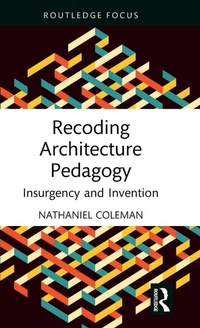
Recoding Architecture Pedagogy
Insurgency and Invention
1st Edition
Published on 25. March 2025
Book
Hardback
140 pages
978-1-032-80005-9 (ISBN)
Description
Disabled by chasing curricular criteria (required for accreditation and professional registration), architecture schools are mostly compliance and reproduction machines serving the building industry. As a corrective, Recoding Architecture Pedagogy: Insurgency and Invention asserts disciplinary knowledge over professional skills as the proper aim and focus of architecture education. The insurgent pedagogy introduced subverts architecture and its teaching's capture by capitalism's dominant modes of production and consumption to reveal unexpected tactics for enlarging possibilities.
Grounded in architecture histories and theories, philosophy, and anarchism's emphasis on use and dissensus, combined with PUNK's DIY ethos, design studio emphasis on technicity is upended to reveal the subversive aim of intensifying tensions between (doomed) desires for artistic autonomy and (intrinsic) burdens of use constituting architecture as a discipline, instead of seeking resolution, some neutral middle ground, or escape into banal practice or paper palaces.
By concentrating on what architecture education suppresses (tensions), disavows (its capture within the building industry), or affirms (commercial practice over disciplinary knowledge), Recoding Architecture Pedagogy: Insurgency and Invention cracks open horizons of possibility by showing how intensifying agonistic relationships between the myriad binaries that characterize architecture and its teaching is generative, in ways conciliatory synthesis, cathartic resolution, and uncritical affirmation are not.
Grounded in architecture histories and theories, philosophy, and anarchism's emphasis on use and dissensus, combined with PUNK's DIY ethos, design studio emphasis on technicity is upended to reveal the subversive aim of intensifying tensions between (doomed) desires for artistic autonomy and (intrinsic) burdens of use constituting architecture as a discipline, instead of seeking resolution, some neutral middle ground, or escape into banal practice or paper palaces.
By concentrating on what architecture education suppresses (tensions), disavows (its capture within the building industry), or affirms (commercial practice over disciplinary knowledge), Recoding Architecture Pedagogy: Insurgency and Invention cracks open horizons of possibility by showing how intensifying agonistic relationships between the myriad binaries that characterize architecture and its teaching is generative, in ways conciliatory synthesis, cathartic resolution, and uncritical affirmation are not.
Reviews / Votes
"At a time when higher education is increasingly commodified and professional accreditation serves as currency, Coleman, in his characteristically deep and observant analysis, examines the erosive consequences of academia's dependence on professional practice in the field of Architecture. Yet, despite acknowledging a period of disciplinary decline, the book remains optimistic-seeing new possibilities emerging from the cracks and inviting a recoding of architectural pedagogies, which Coleman explores through a rich historical arsenal of ideas and precedents."Orit Sarfatti, Senior Lecturer in Architecture, Subject Coordinator UG Interior Architecture, Faculty of Technology, Design & Environment, Oxford Brookes University.
"Recoding Architecture Pedagogy ignites a radical rethinking of Architectural Education. A call against complacency, it redefines utopia as a disruptive force and a tool of insurgency, not escape. With unflinching critique and insurgent vision, Nathaniel Coleman dismantles complicity with capitalism, embracing tension and dissent as generative. A manifesto for those daring to disrupt and rebuild."
Ines Nascimento, ISCTE - University Institute of Lisbon, Department of Architecture and Urbanism, DINAMIA'CET Research Center.
"While the university hysterically turns into a global techno-bureaucratic corporation, and, in parallel, architecture education silently complies with the free play of late capitalism, Nathaniel Coleman offers insurgent tactics to resist. Recoding Architecture Pedagogy: Insurgency and Invention is a fiercely intellectual polemic. This book is indispensable not only for architecture pedagogues but for all who understand architectural design as an exploration of justice rather than a simple outcome of professional skills and technical knowledge."
Ufuk Ersoy, PhD, Associate Professor, DBE PhD Program Codirector, Clemson School of Architecture.
"Recoding Architecture Pedagogy: Insurgency and Invention is a bold and necessary challenge to the constraints of contemporary architectural education. This book is an invitation for anyone believing that the transformative potential in architectural thought is not only possible, but necessary."
Carolina Crijns, TU Vienna.
"A compelling meditation on the significance of tension, openness, and the everyday as tools for subverting criterial constraints. Architectural education is recoded by valuing investigation over image, embracing complexity over claims of completeness, and inviting iteration through continual making and doing."
Dora Farrelly, Architect, CPMG Architects, Nottingham.
"This book is a riveting exposure of the flaws in architecture education. Coleman describes with keen insight what an architecture student must learn - how to subvert and transcend architecture school."
Robert Lloyd, Part 3 Architectural Assistant, Grimshaw Architects, London.
"Recoding Architecture Pedagogy is a poetic and bold manifesto for rethinking architectural education. Championing anarchistic creativity, it reveals how insurgent pedagogies can dismantle systemic constraints and reimagine the discipline through creative resistance and critical thinking. Essential reading for those shaping the future of architecture."
Amos Bar-Eli, Architect, Senior Lecturer, Faculty of Design, HIT - Holon Institute of Technology, Israel.
More details
Series
Language
English
Place of publication
London
United Kingdom
Publishing group
Taylor & Francis Ltd
Target group
College/higher education
Professional and scholarly
Academic, Postgraduate, and Undergraduate Advanced
Dimensions
Height: 222 mm
Width: 145 mm
Thickness: 12 mm
Weight
329 gr
ISBN-13
978-1-032-80005-9 (9781032800059)
Copyright in bibliographic data and cover images is held by Nielsen Book Services Limited or by the publishers or by their respective licensors: all rights reserved.
Schweitzer Classification
Other editions
Additional editions
Book
approx. 06/2026
1st Edition
Routledge
€31.00
Not yet published
E-Book
03/2025
1st Edition
Routledge
€31.49
Available for download
E-Book
03/2025
1st Edition
Routledge
€31.49
Available for download
Person
Nathaniel Coleman is Reader in History and Theory of Architecture at Newcastle University, UK. He previously taught in the US, worked as an architect in NY and Rome, and studied architecture at the IAUS and RISD, and Urban Design at CCNY. He researched his PhD at UPenn. A world-leading scholar on architecture and utopias, Nathaniel leads design studios and theory seminars, focusing on reconstructing architecture through inventing anarchist spatial practices, concentrating on the limits and possibilities of architectural neo-avant-gardes. His books include Materials and Meaning in Architecture: Essays on the Bodily Experience of Buildings (2020); Lefebvre for Architects (Routledge, 2015); Utopias and Architecture (Routledge, 2005); and as editor, Imagining and Making the World: Reconsidering Architecture and Utopia (2011). Recent book chapters include 'Making Sense of Fragments: Utopian Prospects for Architecture and Cities Now' (2024) and 'Rehabilitating Operative Criticism: The Return of Theory against Entrepreneurialism' (Routledge, 2022).
Content
Acknowledgements
Introduction. The Good Enough Architect (Redux)
Chapter 01. Firmness, Commodity, Delight?
Chapter 02 Becoming Operative
Chapter 03. Imagining and (Re)Making
Chapter 04. Playing with Negative Dialectics
Chapter 05. (Re)Mapping the Neo-Avant-Garde
Chapter 06. Cognitive Mapping
Chapter 07. Reconstructing Architecture
Chapter 08. Recapitulations
Index
Introduction. The Good Enough Architect (Redux)
Chapter 01. Firmness, Commodity, Delight?
Chapter 02 Becoming Operative
Chapter 03. Imagining and (Re)Making
Chapter 04. Playing with Negative Dialectics
Chapter 05. (Re)Mapping the Neo-Avant-Garde
Chapter 06. Cognitive Mapping
Chapter 07. Reconstructing Architecture
Chapter 08. Recapitulations
Index