

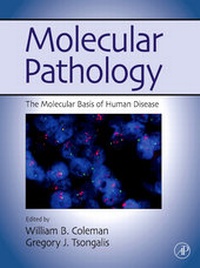
Molecular Pathology
The Molecular Basis of Human Disease
Published on 10. February 2009
Book
Hardback
664 pages
978-0-12-374419-7 (ISBN)
Description
Molecular Pathology: The Molecular Basis of Human Disease provides a current and comprehensive view of the molecular basis and mechanisms of human disease. Combining accepted principles with broader theoretical concepts and with contributions from a group of experts, the book looks into disease processes in the context of traditional pathology and their implications for translational molecular medicine. It also discusses concepts in molecular biology and genetics, recent scientific and technological advances in modern pathology, the concept of ""molecular pathogenesis"" of disease, and how disease evolves from normal cells and tissues due to perturbations in molecular pathways.
The book describes the integration of molecular and cellular pathogenesis using a bioinformatics approach and a systems biology approach to disease pathogenesis. It also discusses current and future strategies in molecular diagnosis of human disease, and the impact of molecular diagnosis on treatment decisions and the practice of personalized medicine.
This book is a valuable resource for students, biomedical researchers, practicing physician-scientists who undertake disease-related basic science and translational research, and pathology residents and other postdoctoral fellows.
The book describes the integration of molecular and cellular pathogenesis using a bioinformatics approach and a systems biology approach to disease pathogenesis. It also discusses current and future strategies in molecular diagnosis of human disease, and the impact of molecular diagnosis on treatment decisions and the practice of personalized medicine.
This book is a valuable resource for students, biomedical researchers, practicing physician-scientists who undertake disease-related basic science and translational research, and pathology residents and other postdoctoral fellows.
Reviews / Votes
"The editors of Molecular Pathology have produced a comprehensive compendium of the state-of-the-art in molecular pathogenesis, an impressive accomplishment given the diverse cells and organ systems involved in human disease. An established cadre of experts has contributed to this first, well-designed edition. As a result, essential topics ranging from cell injury/death, the molecular basis of cardiovascular diseases and disorders of the nervous system, and modern molecular diagnostics are amply addressed. In a rapidly emerging discipline, it is challenging to capture the details that define the field. Molecular Pathology has accomplished this goal in an outstanding manner and will serve as an excellent resource for those already established in clinical care and biomedical research, for those who seek to maintain competency in molecular pathology, as well as for all students involved in interdisciplinary studies related to human disease or modern clinical investigations." --Linda M. McManus, PhD, Professor, University of Texas Health Science Center at San Antonio"The focus of Molecular Pathology is genetic and molecular but it has been written to enhance the work of an active pathologist, clearly describing the basics as well as providing ample sampling of the molecular complexities of disease. Gladly the editors did not assemble an exhaustive compendium of facts and details that would inevitably become obsolete in short order. Instead, the contributors concentrated on clarity of explanation supported by selected examples so that the reader may grasp the fundamentals better. In fact, this may be one medical textbook that can be read cover-to-cover without being lost in details. The figures are clear, helpful, and plentiful which is important when dealing with so many complex technologies and concepts. I highly recommend this book." --Edison T. Liu, M.D, Executive Director, Genome Institute of Singapore
More details
Language
English
Place of publication
San Diego
United States
Publishing group
Elsevier Science Publishing Co Inc
Target group
College/higher education
Medical students, pathology graduate students, biomedical graduate students, and some allied health students.
Dimensions
Height: 276 mm
Width: 216 mm
Weight
2110 gr
ISBN-13
978-0-12-374419-7 (9780123744197)
Copyright in bibliographic data and cover images is held by Nielsen Book Services Limited or by the publishers or by their respective licensors: all rights reserved.
Schweitzer Classification
Other editions
New editions
Book
12/2017
2nd Edition
Academic Press
€138.50
Shipment within 15-20 days
Additional editions
E-Book
02/2009
1st Edition
Academic Press
€57.95
Available for download
Persons
William B. Coleman, PhD is the Executive Officer for the American Society for Investigative Pathology (Rockville, MD). Prior to taking this position with the American Society for Investigative Pathology, Dr. Coleman spent 28 years at the University of North Carolina School of Medicine (Chapel Hill, NC), first as a postdoctoral fellow (1990-1995) and then as a faculty member (1995-2018) in the Department of Pathology and Laboratory Medicine. During his time at the UNC School of Medicine, Dr. Coleman served as Director of Graduate Studies for the Molecular and Cellular Pathology Ph.D. Program (2006-2012; now the Pathobiology and Translational Medicine Ph.D. Program), was a co-founder of the UNC Program in Translational Medicine and served as its Co-Director (2006-2015) and then its Director (2015-2018), was affiliated with the Curriculum in Toxicology, the Cancer Biology Training Program, and was a member of the UNC Lineberger Comprehensive Cancer Center. Dr. Coleman was active in teaching biomedical graduate students and is a four-time recipient of the Joe W. Grisham Award for Excellence in Graduate Student Teaching from the Molecular and Cellular Pathology graduate students at the UNC School of Medicine. Prior to becoming an employee, Dr. Coleman was active in the leadership of the American Society for Investigative Pathology, serving in various roles including President (2015-2016). Dr. Coleman was honored with the ASIP Outstanding Investigator Award in 2013 from the American Society for Investigative Pathology. He is also a long-time member of the American Association for Cancer Research. He serves as Senior Associate Editor for The American Journal of Pathology, and is an Associate Editor for BMC Cancer, and PLoS One, and serves on the editorial boards of Clinica Chimica Acta, Experimental and Molecular Pathology, Archives of Pathology and Laboratory Medicine, Laboratory Investigation, and Current Pathobiology Reports, and has served as an ad hoc reviewer for 99 other journals. Dr. Coleman's major research interests are in the molecular pathogenesis of human cancers, with a specific interest in breast cancer epigenetics, liver carcinogenesis, and lung cancer biology. His research was funded by the NIH/NCI, The Susan G. Komen Breast Cancer Foundation, Friends for an Earlier Breast Cancer Test, and the UNC Lineberger Comprehensive Cancer Center. Dr. Coleman is the author of over 140 original research articles, reviews, and book chapters. In addition, Dr. Coleman has co-edited or co-authored ten books on topics related to molecular pathology, molecular diagnostics, and the molecular pathogenesis of human cancer. Gregory J. Tsongalis, PhD, HCLD, CC, FNACB., is the Vice Chair for Research and the Director of the Laboratory for Clinical Genomics and Advanced Technology (CGAT) in the Department of Pathology and Laboratory Medicine at the Dartmouth-Hitchcock Medical Center and Norris Cotton Cancer Center (NCCC) in Lebanon, NH. He is a Professor of Pathology and Laboratory Medicine at the Audrey and Theodor Geisel School of Medicine at Dartmouth in Hanover, NH and a member of the NCCC Molecular Therapeutics Program and the gastrointestinal and breast cancer clinical oncology groups. In 2016 he became a member of Dartmouth College's Program in Experimental and Molecular Medicine (PEMM), and he has served on the advisory board of the Health Care Genetics Professional Science Master's Degree Program and Diagnostic Genetic Sciences Program at the University of Connecticut (Storrs, CT). His area of expertise is in the development and implementation of clinical molecular diagnostic technologies. His research interests are in the pathogenesis of human cancers, personalized medicine and disruptive technologies. He has authored/edited twelve textbooks in the field of molecular pathology, published more than 230 peer reviewed manuscripts, and has been an invited speaker at both national and international meetings. He has served on numerous committees of the American Association for Clinical Chemistry, the American Society for Investigative Pathology, the Federation for American Societies for Experimental Biology, and the Association for Molecular Pathology (where he is a past President). He is active in the Alliance for Clinical Trials in Oncology, the Association for Molecular Pathology, the American Association for Clinical Chemistry, the American Association of Bioanalysts, and the American Society for Investigative Pathology. He serves on the editorial boards of 8 journals including Clinical Chemistry, Experimental and Molecular Pathology, and the Journal of Molecular Diagnostics. In 2016, Dr. Tsongalis received the Norris Cotton Cancer Center Award for Excellence, in 2017 the Association for Molecular Pathology (AMP) Jeffrey A. Kant Leadership Award, and in 2019 the American Society for Investigative Pathology Robbins Distinguished Educator Award. He also serves on numerous corporate scientific advisory boards.
Editor
Executive Officer, American Society for Investigative Pathology, Rockville, MD, USA
Laboratory for Clinical Genomics and Advanced Technology (CGAT), Department of Pathology and Laboratory Medicine, Dartmouth, Hitchcock Medical Center and Dartmouth Cancer Center, Lebanon, NH, United States and the Geisel School of Medicine at Dartmouth, Hanover, NH, USA
Content
PART I: Essential Pathology - Mechanisms of Disease
Molecular Mechanisms of Cell Death
Acute and Chronic Inflammation
Infection and Host Response
Neoplasia
PART II: Concepts in Molecular Biology and Genetics
Basic Concepts in Human Molecular Genetics
The Human Genome: Implications for the Understanding of Human Disease
The Human Transcriptome: Implications for the Understanding of Human Disease
The Human Epigenome: Implications for the Understanding of Human Disease
The Human Proteome: Implications for the Understanding of Human Disease
Integrative Systems Biology: Implications for the Understanding of Human Disease
PART III:Principles and Practice of Molecular Pathology
Pathology: The Clinical Description of Human Disease
Molecular Pathogenesis: The Biological Basis of Human Disease
Integration of Molecular and Cellular Pathogenesis
PART IV: Molecular Pathology of Human Disease
Molecular Basis of Cardiovascular Disease
Molecular Basis of Hemostatic and Thrombotic Diseases
Molecular Basis of Lymphoid and Myeloid Diseases
Molecular Basis of Diseases of Immunity
Molecular Basis of Pulmonary Disease
Molecular Basis of Diseases of the Gastrointestinal Tract
Molecular Basis of Liver Disease
Molecular Basis of Diseases of the Exocrine Pancreas
Molecular Basis of Diseases of the Endocrine System
Molecular Basis of Gynecologic Diseases
Molecular Basis of Prostate Disease
Molecular Basis of Breast Disease
Molecular Basis of Skin Disease
Molecular Basis of Diseases of the Nervous System
PART V: Practice of Molecular Medicine
Molecular Diagnosis of Human Disease
Molecular Assessment of Human Disease in the Clinical Laboratory
Pharmacogenomics and Personalized Medicine in the Treatment of Human Disease
Molecular Mechanisms of Cell Death
Acute and Chronic Inflammation
Infection and Host Response
Neoplasia
PART II: Concepts in Molecular Biology and Genetics
Basic Concepts in Human Molecular Genetics
The Human Genome: Implications for the Understanding of Human Disease
The Human Transcriptome: Implications for the Understanding of Human Disease
The Human Epigenome: Implications for the Understanding of Human Disease
The Human Proteome: Implications for the Understanding of Human Disease
Integrative Systems Biology: Implications for the Understanding of Human Disease
PART III:Principles and Practice of Molecular Pathology
Pathology: The Clinical Description of Human Disease
Molecular Pathogenesis: The Biological Basis of Human Disease
Integration of Molecular and Cellular Pathogenesis
PART IV: Molecular Pathology of Human Disease
Molecular Basis of Cardiovascular Disease
Molecular Basis of Hemostatic and Thrombotic Diseases
Molecular Basis of Lymphoid and Myeloid Diseases
Molecular Basis of Diseases of Immunity
Molecular Basis of Pulmonary Disease
Molecular Basis of Diseases of the Gastrointestinal Tract
Molecular Basis of Liver Disease
Molecular Basis of Diseases of the Exocrine Pancreas
Molecular Basis of Diseases of the Endocrine System
Molecular Basis of Gynecologic Diseases
Molecular Basis of Prostate Disease
Molecular Basis of Breast Disease
Molecular Basis of Skin Disease
Molecular Basis of Diseases of the Nervous System
PART V: Practice of Molecular Medicine
Molecular Diagnosis of Human Disease
Molecular Assessment of Human Disease in the Clinical Laboratory
Pharmacogenomics and Personalized Medicine in the Treatment of Human Disease