

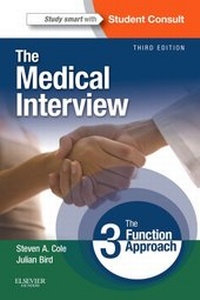
The Medical Interview
The Three Function Approach with STUDENT CONSULT Online Access
3rd Edition
Published on 24. January 2014
Book
Paperback/Softback
338 pages
978-0-323-05221-4 (ISBN)
Description
The Medical Interview by Drs. Steven A. Cole and Julian Bird equips you to communicate effectively with your patients so you can provide optimal care! This best-selling, widely adopted resource presents a practical, systematic approach to honing your basic interviewing skills and managing common challenging communicating situations. Its Three-Function Approach - "Build the Relationship," "Assess and Understand," and Collaborative Management" offers straightforward tasks, behaviors, and skills that can be easily mastered, making this an ideal learning tool for beginners and a valuable reference for experienced healthcare professionals.
Effectively meet a full range of communication challenges including language and cultural barriers, sexual issues, elderly patients, breaking bad news, and non-adherence.
Easily apply proven techniques with help from supportive case examples and actual interview questions.
Get the skills you need now with new chapters covering advanced topics and applications including "Presentation and Documentation," nonverbal communication, using psychological principles in medical practice, and integrating structure and function.
Quickly review information with summary tables, boxes and bulleted lists.
Get access on the go with the fully searchable text online at Student Consult, including cost-free access to a specially customized, interactive web-based Module on Brief Action Planning (BAP), a key component of the web-based, interactive Comprehensive Motivational Interventions (CMI)T e-learning platform.
Effectively meet a full range of communication challenges including language and cultural barriers, sexual issues, elderly patients, breaking bad news, and non-adherence.
Easily apply proven techniques with help from supportive case examples and actual interview questions.
Get the skills you need now with new chapters covering advanced topics and applications including "Presentation and Documentation," nonverbal communication, using psychological principles in medical practice, and integrating structure and function.
Quickly review information with summary tables, boxes and bulleted lists.
Get access on the go with the fully searchable text online at Student Consult, including cost-free access to a specially customized, interactive web-based Module on Brief Action Planning (BAP), a key component of the web-based, interactive Comprehensive Motivational Interventions (CMI)T e-learning platform.
Reviews / Votes
"The three function model is a profound bedrock to provide footing for a medical communication course. It is simple at its most basic level and applicable to any discipline or subspecialty a young trainee would decide to pursue. Thus, it is widely applicable to medical school educators.the model is equally applicable to graduate and post graduate level educators and clinicians who want to advance their skills. There are few medical texts out there that can have such wide appeal and effectiveness. I would wholeheartedly recommend this book to any medical educator who has a need to both learn and teach patient-physician communication."-Joseph S. Weiner, MD, PhD, Associate Professor of Clinical Psychiatry and Medicine, Hofstra North Shore LIJ School of Medicine
"In over 20 years of teaching interviewing skills to medical students I have consistently relied on The Medical Interview: The Three Function Approach as a key resource. The combination of humanism, intellectually rigorous biopsychosocial perspective, and clinical pragmatism makes it a uniquely relevant and accessible text. Students have no trouble grasping and applying the three-function structure as a tool for observing, critiquing and improving interview skills in themselves and their peers during our observed interview sessions. The introduction of motivational interviewing concepts in the third edition is a welcome addition."
-Roy M. Stein, M.D., Associate Professor, Duke University School of Medicine
More details
Edition
3rd edition
Language
English
Place of publication
Philadelphia
United States
Publishing group
Elsevier - Health Sciences Division
Target group
College/higher education
Professional and scholarly
Illustrations
Illustrated; Illustrations
Dimensions
Height: 229 mm
Width: 152 mm
Weight
520 gr
ISBN-13
978-0-323-05221-4 (9780323052214)
Copyright in bibliographic data and cover images is held by Nielsen Book Services Limited or by the publishers or by their respective licensors: all rights reserved.
Schweitzer Classification
Other editions
New editions
Steven A. Cole | Richard M. Frankel | Kelley M. Skeff
The Clinical Interview for Relationship-Centered Care: The Three Function Approach
The Three Function Approach
Book
approx. 06/2026
4th Edition
Elsevier
€41.00
Not yet published
Additional editions
E-Book
12/2013
3rd Edition
Saunders
€24.99
Available for download
Previous edition

Book
05/2000
2nd Edition
Mosby
€58.37
Article exhausted; check for reprint
Persons
Steven Cole, MD is Professor of Clinical Psychiatry, Emeritus at S.U.N.Y. Stony Brook Health Sciences Center. He has been awarded grants from the National Institute of Mental Health and the John D. and Catherine T. MacArthur Foundation for clinical, disease management and educational work on depression in general medical settings. He has published more than 40 peer-reviewed journal articles and 30 book chapters, mostly related to psychiatric disorders in medical patients. https://webcampus.drexelmed.edu/doccom/db/assets/authors/StevenCole.htm;
Author
Professor of Psychiatry - Emeritus, Stony Brook University School of Medicine, and Clinical Professor of Scientific Education and Psychiatry, Donald and Barbara Zucker School of Medicine at Hofstra/Northwell, Stony Brook, New York
Lately Senior Lecturer in Psychiatry; Guy's, Kings and St. Thomas' School of Medicine; University of London; London, United Kingdom
Content
Table of Contents
I. Three Functions Of The Medical Interview
Learning to Interview Using the Three Function Approach
Why Three Functions?
Function 1: Build The Relationship
Function 2: Assess and Understand
Function 3: Collaborative Management
II.Meeting the Patient
6. Ten Common Concerns
III. Structure of the Interview
7. Opening The Interview
8. Chief Complaint, Problem Survey, Patient Perspective, And Agenda Setting
9. History Of Present Illness
10, Past Medical History
Family History
Patient Profile And Social History
Review Of Systems
Mental Status
IV. Presentation and Documentation
15. Presentation and Documentation
V. Understanding Patients' Emotional Responses to Chronic Illness
16. Understanding Chronic Illness: Normal Reactions
17. Understanding Chronic Illness: Maladaptive Reactions
VI Advanced Applications
18. Stepped-Care Advanced Skills for Action Planning
19. Chronic Illness
20. Health Literacy and Communicating Complex Information for Decision-
Making
21. Sexual Issues in the Interview
22. Interviewing Elderly Patients
23. Culturally Competent Medical Interviewing
24. Family Interviewing
25.Troubling Personality Styles and Somatization
26. Communicating with the Psychotic Patient
27. Breaking Bad News
27 (a). Sharing Difficult or "Bad" News: A Nine-Step Transactional Process of Transformation
28. Disclosure of Medical Errors and Apology
29. Alcohol And Risky Drinking
VII. HIGHER ORDER SKILLS
30. Nonverbal Communication
31. Use of the Self in Medical Care
32. Using Psychological Principles in the Medical Interview
33. Integrating Structure and Function
Appendix 1: Table of skills
Appendix 2: BAP Guide
I. Three Functions Of The Medical Interview
Learning to Interview Using the Three Function Approach
Why Three Functions?
Function 1: Build The Relationship
Function 2: Assess and Understand
Function 3: Collaborative Management
II.Meeting the Patient
6. Ten Common Concerns
III. Structure of the Interview
7. Opening The Interview
8. Chief Complaint, Problem Survey, Patient Perspective, And Agenda Setting
9. History Of Present Illness
10, Past Medical History
Family History
Patient Profile And Social History
Review Of Systems
Mental Status
IV. Presentation and Documentation
15. Presentation and Documentation
V. Understanding Patients' Emotional Responses to Chronic Illness
16. Understanding Chronic Illness: Normal Reactions
17. Understanding Chronic Illness: Maladaptive Reactions
VI Advanced Applications
18. Stepped-Care Advanced Skills for Action Planning
19. Chronic Illness
20. Health Literacy and Communicating Complex Information for Decision-
Making
21. Sexual Issues in the Interview
22. Interviewing Elderly Patients
23. Culturally Competent Medical Interviewing
24. Family Interviewing
25.Troubling Personality Styles and Somatization
26. Communicating with the Psychotic Patient
27. Breaking Bad News
27 (a). Sharing Difficult or "Bad" News: A Nine-Step Transactional Process of Transformation
28. Disclosure of Medical Errors and Apology
29. Alcohol And Risky Drinking
VII. HIGHER ORDER SKILLS
30. Nonverbal Communication
31. Use of the Self in Medical Care
32. Using Psychological Principles in the Medical Interview
33. Integrating Structure and Function
Appendix 1: Table of skills
Appendix 2: BAP Guide