

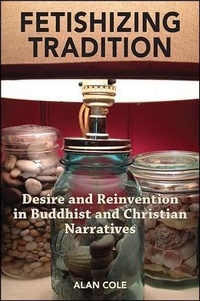
Fetishizing Tradition
Desire and Reinvention in Buddhist and Christian Narratives
Published on 1. October 2015
Book
Hardback
298 pages
978-1-4384-5745-1 (ISBN)
Description
Describes how religious tradition is established as available within a text, free from ritual and observance, in Buddhism and Christianity.
This innovative work documents the literary gesture that "fetishizes tradition," making long-standing religious traditions appear present and available through the reading experience. Taking as examples Paul's Letter to the Romans, the Gospel of Mark, the Sutra on the Land of Bliss (Sukhavativyuha), and the Platform Sutra of the Sixth Patriarch (Liuzu tanjing), Alan Cole shows how these texts invite readers into the fantasy that they can leave behind tradition's established rites, rituals, sacrifices, institutions, and festivals in order to take up just the text and its narrative as the key to salvation. Ironically, then, one's salvation is determined by how one receives the (new) message of salvation. Crucial to making these more virtual forms of tradition appear plausible is the reconstruction of tradition's "truth-fathers"-God or the Buddha, as the case may be-so that they appear to endorse the legitimacy of these new ways of being traditional. Relying on a wide body of critical theory, this book presents an intriguing way to rethink key elements in Christian and Buddhist thought.
This innovative work documents the literary gesture that "fetishizes tradition," making long-standing religious traditions appear present and available through the reading experience. Taking as examples Paul's Letter to the Romans, the Gospel of Mark, the Sutra on the Land of Bliss (Sukhavativyuha), and the Platform Sutra of the Sixth Patriarch (Liuzu tanjing), Alan Cole shows how these texts invite readers into the fantasy that they can leave behind tradition's established rites, rituals, sacrifices, institutions, and festivals in order to take up just the text and its narrative as the key to salvation. Ironically, then, one's salvation is determined by how one receives the (new) message of salvation. Crucial to making these more virtual forms of tradition appear plausible is the reconstruction of tradition's "truth-fathers"-God or the Buddha, as the case may be-so that they appear to endorse the legitimacy of these new ways of being traditional. Relying on a wide body of critical theory, this book presents an intriguing way to rethink key elements in Christian and Buddhist thought.
More details
Language
English
Place of publication
Albany, NY
United States
Target group
US School Grade: College Graduate Student and over
Product notice
sewn/stitched
Cloth over boards
Dimensions
Height: 236 mm
Width: 160 mm
Thickness: 25 mm
Weight
635 gr
ISBN-13
978-1-4384-5745-1 (9781438457451)
Copyright in bibliographic data and cover images is held by Nielsen Book Services Limited or by the publishers or by their respective licensors: all rights reserved.
Schweitzer Classification
Other editions
Additional editions
E-Book
09/2015
1st Edition
De Gruyter
from
€84.99
Available for download
Person
Alan Cole is an independent scholar and the author of Fathering Your Father: The Zen of Fabrication in Tang Buddhism; Text as Father: Paternal Seductions in Early Mahayana Buddhist Literature; and Mothers and Sons in Chinese Buddhism.
Content
Preface
Acknowledgments
Introduction: Fetishes and the Spirit of Religious Studies
1. Methodology and a World of Commentary
2. Paul's Letters, or How God Became a Jewish Priest
3. The Gospel of Mark, or Narrative as Floating Patriarchy
4. The Sutra on the Land of Bliss, or That Place between Tongues and Texts
5. The Platform Sutra of the Sixth Patriarch, or Paternal Truth for the Masses
Conclusions: The Limits of Fetishizing Tradition
Notes
Bibliography
Index
Acknowledgments
Introduction: Fetishes and the Spirit of Religious Studies
1. Methodology and a World of Commentary
2. Paul's Letters, or How God Became a Jewish Priest
3. The Gospel of Mark, or Narrative as Floating Patriarchy
4. The Sutra on the Land of Bliss, or That Place between Tongues and Texts
5. The Platform Sutra of the Sixth Patriarch, or Paternal Truth for the Masses
Conclusions: The Limits of Fetishizing Tradition
Notes
Bibliography
Index