

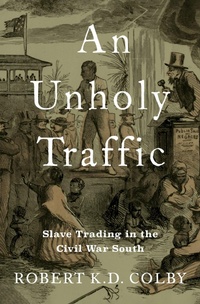
An Unholy Traffic
Slave Trading in the Civil War South
Published on 19. June 2024
Book
Hardback
360 pages
978-0-19-757826-1 (ISBN)
Description
The Confederate States of America was born in defense of slavery and, after a four-year struggle to become an independent slaveholding republic, died as emancipation dawned. Between Fort Sumter to Appomattox, Confederates bought and sold thousands African American men, women, and children. These transactions in humanity made the internal slave trade a cornerstone of Confederate society, a bulwark of the Rebel economy, and a central part of the experience of the Civil War for all inhabiting the American South.
As An Unholy Traffic shows, slave trading helped Southerners survive and fight the Civil War, as well as to build the future for which they fought. They mitigated the crises the war spawned by buying and selling enslaved people, using this commerce to navigate food shortages, unsettled gender roles, the demands of military service, and other hardships on the homefront. Some Rebels speculated wildly in human property, investing in slaves to ward off inflation and to buy shares in the slaveholding nation they hoped to create. Others traded people to counter the advance of emancipation. Given its centrality to their nationhood, Confederates went to great lengths to prolong the slave trade, which, in turn, supported the Confederacy. For those held in slavery, the surviving slave trade dramatically shaped their pursuit of freedom, inserting a retrograde movement into some people's journeys toward liberty while inspiring others to make the risky decision to escape.
Offering an original perspective on the intersections of slavery, capitalism, the Civil War, and emancipation, Robert K.D. Colby illuminates the place of the peculiar institution within the Confederate mind, the ways in which it underpinned the CSA's war effort, and its impact on those attempting to seize their freedom.
As An Unholy Traffic shows, slave trading helped Southerners survive and fight the Civil War, as well as to build the future for which they fought. They mitigated the crises the war spawned by buying and selling enslaved people, using this commerce to navigate food shortages, unsettled gender roles, the demands of military service, and other hardships on the homefront. Some Rebels speculated wildly in human property, investing in slaves to ward off inflation and to buy shares in the slaveholding nation they hoped to create. Others traded people to counter the advance of emancipation. Given its centrality to their nationhood, Confederates went to great lengths to prolong the slave trade, which, in turn, supported the Confederacy. For those held in slavery, the surviving slave trade dramatically shaped their pursuit of freedom, inserting a retrograde movement into some people's journeys toward liberty while inspiring others to make the risky decision to escape.
Offering an original perspective on the intersections of slavery, capitalism, the Civil War, and emancipation, Robert K.D. Colby illuminates the place of the peculiar institution within the Confederate mind, the ways in which it underpinned the CSA's war effort, and its impact on those attempting to seize their freedom.
Reviews / Votes
In beautiful and moving prose, An Unholy Traffic uncovers a new story centered on the persistence of the slave trade during the Civil War. Never believing that their cornerstone institution might be imperiled, both individual enslavers and the Confederate state continued to buy and sell the flesh of men and women up to and sometimes after the moment of defeat. This is essential reading for anyone wanting to understand both the grip slaveholding held on Confederacy and vice versa. * Caroline E. Janney, Author of Ends of War: The Unfinished Fight of Lee's Army after Appomattox * Robert Colby's sparkling new history of Confederate slave trading during the Civil War shows us just how far some American enslavers would go to perpetuate their so-called right to hold property in people. It reveals, too, the central role of the Confederate state in enabling these wartime dealers in human flesh, as well as the undaunted courage of those they traded to try to free themselves any way they could. This is the book we've been waiting for! * Richard Bell, Author of Stolen: Five Free Boys Kidnapped into Slavery and Their Astonishing Odyssey Home * With great precision and detail, Colby presents an excellent history of slavery and prices during the Civil War. He does a fine job balancing the perspectives of the enslaved against the backdrop of those who sought to profit off of them. This book is a gem. * Daina Ramey Berry, University of California, Santa Barbara * Brilliantly examines the last years of the slave trade....Colby demonstrates that the end of slavery and the slave trade was not inevitably between 1861 and 1865....An Unholy Traffic is an important book that excavates an unfamiliar, but critically important, story and in doing so places the internal slave trade at the heart, as a 'cornerstone,' of the Confederacy. * Kevin M. Levin, A Civil War Monitor Best Book of the Year * Colby's exhaustively researched and lucid book fills that void and provides fresh detail on and interpretation of the meaning of the domestic exchange of enslaved persons in the Confederate state. The author pays special attention to the importance of slave trading and slavery to Confederate nationalism. The ongoing domestic slave trade labor signified white Southerners' confidence in their cause and the active support of the state in preserving and expanding slaveholding. * Choice * Colby's skill as a historian is complimented by his talent as a storyteller. Using primary sources and data to explore the heartbreaking stories of the enslaved and the institution of slavery itself in the war years, Colby paints a picture that not many historians have delved into. For those interested in the study of American slavery, An Unholy Trafficis a book that should be among the essentials on your reading list. * Jack Fryar, Carolina Chronicles *More details
Language
English
Place of publication
New York
United States
Target group
Professional and scholarly
Illustrations
21 black and white halftones
Dimensions
Height: 242 mm
Width: 167 mm
Thickness: 32 mm
Weight
630 gr
ISBN-13
978-0-19-757826-1 (9780197578261)
Copyright in bibliographic data and cover images is held by Nielsen Book Services Limited or by the publishers or by their respective licensors: all rights reserved.
Schweitzer Classification
Other editions
Additional editions
E-Book
03/2024
OUP eBook
€24.99
Available for download
E-Book
03/2024
OUP eBook
€24.99
Available for download
Person
Robert K.D. Colby is an Assistant Professor of History at the University of Mississippi. His research on the domestic slave trade has won multiple awards, including the Allan Nevins Prize of the Society of American Historians.
Content
Acknowledgments
Introduction
Chapter 1: "No Money, and No Confidence": Slave Commerce, Secession, and the Panic of 1860
Chapter 2: The "Uncongenial Air of Freedom": Union Occupation and the Slave Trade
Chapter 3: "Old Abe Is Not Feared in this Region": The Revival of Confederate Slave Commerce
Chapter 4: "Negroes Will Bear Fabulous Prices": Inflation, Speculation, and the Confederate Future
Chapter 5: "Liable to Be Sold at Any Moment": State-Making, Continuity, and the Slave Trade
Chapter 6: Sold "Far Out of the Way of Lincoln": Emancipation and Counterrevolutionary Slave Commerce
Chapter 7: "Broke...All Up": The Ends and Afterlives of the Wartime Slave Trade
Epilogue
Notes
Select Bibliography
Index
Introduction
Chapter 1: "No Money, and No Confidence": Slave Commerce, Secession, and the Panic of 1860
Chapter 2: The "Uncongenial Air of Freedom": Union Occupation and the Slave Trade
Chapter 3: "Old Abe Is Not Feared in this Region": The Revival of Confederate Slave Commerce
Chapter 4: "Negroes Will Bear Fabulous Prices": Inflation, Speculation, and the Confederate Future
Chapter 5: "Liable to Be Sold at Any Moment": State-Making, Continuity, and the Slave Trade
Chapter 6: Sold "Far Out of the Way of Lincoln": Emancipation and Counterrevolutionary Slave Commerce
Chapter 7: "Broke...All Up": The Ends and Afterlives of the Wartime Slave Trade
Epilogue
Notes
Select Bibliography
Index