

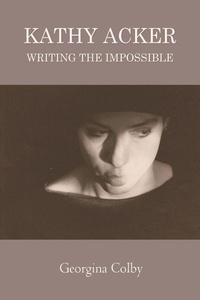
Kathy Acker
Writing the Impossible
Published on 22. February 2018
Book
Paperback/Softback
312 pages
978-1-4744-3154-5 (ISBN)
Description
An in-depth analysis of the work of one of the twentieth century's most innovative writers
Kathy Acker's body of work is one of the most significant collections of experimental writing in English. In Kathy Acker: Writing the Impossible, Georgina Colby explores Acker's compositional processes and intricate experimental practices, from early poetic exercises written in the 1970s to her final writings in 1997. Through original archival research, Colby traces the stages in Acker's writing and draws on her knowledge of unpublished manuscripts, notebooks, essays, illustrations, and correspondence to produce new ways of reading Acker's works. Rather than treating Acker as a postmodern writer this book argues that Acker continued a radical modernist engagement with the crisis of language, and carried out a series of experiments in composition and writing that are comparable in scope and rigor to her modernist predecessors Stein and Joyce. Each chapter focuses on a particular compositional method and insists on the importance of avant-garde experiment to the process of making new non-conventional modes of meaning. Combining close attention to the form of Acker's experimental writings with a consideration of the literary cultures from which she emerged, Colby positions Acker as a key figure in the American avant-garde, and a pioneer of contemporary experimental women's writing.
Key Features
Examines unpublished manuscripts, notebooks, lecture notes, letters and manuscripts from the Kathy Acker PapersFeatures eleven previously unpublished images of original manuscripts, correspondence, and colour illustrations from the Kathy Acker PapersUtilises major archival study of Acker's experimental compositional practicesSituates Acker as a late modernist writer and a key figure in the American Avant-Garde
Kathy Acker's body of work is one of the most significant collections of experimental writing in English. In Kathy Acker: Writing the Impossible, Georgina Colby explores Acker's compositional processes and intricate experimental practices, from early poetic exercises written in the 1970s to her final writings in 1997. Through original archival research, Colby traces the stages in Acker's writing and draws on her knowledge of unpublished manuscripts, notebooks, essays, illustrations, and correspondence to produce new ways of reading Acker's works. Rather than treating Acker as a postmodern writer this book argues that Acker continued a radical modernist engagement with the crisis of language, and carried out a series of experiments in composition and writing that are comparable in scope and rigor to her modernist predecessors Stein and Joyce. Each chapter focuses on a particular compositional method and insists on the importance of avant-garde experiment to the process of making new non-conventional modes of meaning. Combining close attention to the form of Acker's experimental writings with a consideration of the literary cultures from which she emerged, Colby positions Acker as a key figure in the American avant-garde, and a pioneer of contemporary experimental women's writing.
Key Features
Examines unpublished manuscripts, notebooks, lecture notes, letters and manuscripts from the Kathy Acker PapersFeatures eleven previously unpublished images of original manuscripts, correspondence, and colour illustrations from the Kathy Acker PapersUtilises major archival study of Acker's experimental compositional practicesSituates Acker as a late modernist writer and a key figure in the American Avant-Garde
Reviews / Votes
Georgina Colby's Kathy Acker: Writing the Impossible is a meticulous study, unparalleled in its sustained attention to the published and unpublished writings of 'punk' novelist Kathy Acker. -- Diarmuid Hester, University of Cambridge * Critical Quarterly, 59:4 * Georgina Colby started up the Acker collection at Duke University. Alongside Kraus and Martin, Colby has written one of the best books on Acker, her Kathy Acker: Writing the Impossible (Edinburgh University Press). -- McKenzie Wark * The Brooklyn Rail * Georgina Colby provides the fullest account available of the wild and wily work of the great Kathy Acker, relying not just on her published work but also unpublished poems, journals, manuscripts, and correspondence. Contextualizing Acker's work among her contemporaries and precursors in poetry, fiction, performance, philosophy, and feminism, Colby traces her lineages and, as importantly, the resistances that made her so inimitable. -- Charles Bernstein, University of PennsylvaniaMore details
Language
English
Place of publication
Edinburgh
United Kingdom
Target group
College/higher education
Illustrations
12 colour illustrations
Dimensions
Height: 233 mm
Width: 157 mm
Thickness: 25 mm
Weight
718 gr
ISBN-13
978-1-4744-3154-5 (9781474431545)
Copyright in bibliographic data and cover images is held by Nielsen Book Services Limited or by the publishers or by their respective licensors: all rights reserved.
Schweitzer Classification
Other editions
Additional editions
E-Book
08/2016
1st Edition
Edinburgh University Press
€22.49
Available for download
E-Book
08/2016
1st Edition
Edinburgh University Press
€0.00
Available for download
Person
Georgina Colby is Reader in Modern and Contemporary Literature at the University of Westminster. She has published widely in the field of avant-garde writing and feminisms. Her books include Kathy Acker: Writing the Impossible (2016), and the collections Reading Experimental Writing (2019) and, as co-editor, The Contemporary Small Press: Making Publishing Visible (2020). She is the series editor (with Eric White) of Edinburgh Critical Studies in Avant-Garde Writing and Edinburgh Foundations in Avant-Garde Writing.
Content
Introduction: Kathy Acker and the Avant-Garde; 1.Writing Asystematically: Early Experimental Writings 1970-1979; 2. Collage and the Anxiety of Self-Description, Blood and Guts in High School; 3. Writing-Through: Don Quixote: Which Was a Dream; 4. Intertextuality and Constructive Non-Identity: In Memoriam To Identity; 5. Montage and Creative Cutting: My Mother: Demonology; 6. Ekphrasis, Abstraction, and Myth: 'From Psyche's Journal', Eurydice in the Underworld; Conclusion.