

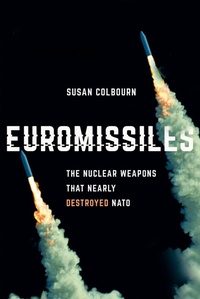
Euromissiles
The Nuclear Weapons That Nearly Destroyed NATO
Published on 15. November 2022
Book
Hardback
408 pages
978-1-5017-6602-2 (ISBN)
Description
In Euromissiles, Susan Colbourn tells the story of the height of nuclear crisis and the remarkable waning of the fear that gripped the globe.
In the Cold War conflict that pitted nuclear superpowers against one another, Europe was the principal battleground. Washington and Moscow had troops on the ground and missiles in the fields of their respective allies, the NATO nations and the states of the Warsaw Pact. Euromissiles-intermediate-range nuclear weapons to be used exclusively in the regional theater of war-highlighted how the peoples of Europe were dangerously placed between hammer and anvil. That made European leaders uncomfortable and pushed fearful masses into the streets demanding peace in their time.
At the center of the story is NATO. Colbourn highlights the weakness of the alliance seen by many as the most effective bulwark against Soviet aggression. Divided among themselves and uncertain about the depth of US support, the member states were riven by the missile issue. This strategic crisis was, as much as any summit meeting between US president Ronald Reagan and Soviet general secretary Mikhail Gorbachev, the hinge on which the Cold War turned.
Euromissiles is a history of diplomacy and alliances, social movements and strategy, nuclear weapons and nagging fears, and politics. To tell that history, Colbourn takes a long view of the strategic crisis-from the emerging dilemmas of allied defense in the early 1950s through the aftermath of the INF Treaty thirty-five years later. The result is a dramatic and sweeping tale that changes the way we think about the Cold War and its culmination.
In the Cold War conflict that pitted nuclear superpowers against one another, Europe was the principal battleground. Washington and Moscow had troops on the ground and missiles in the fields of their respective allies, the NATO nations and the states of the Warsaw Pact. Euromissiles-intermediate-range nuclear weapons to be used exclusively in the regional theater of war-highlighted how the peoples of Europe were dangerously placed between hammer and anvil. That made European leaders uncomfortable and pushed fearful masses into the streets demanding peace in their time.
At the center of the story is NATO. Colbourn highlights the weakness of the alliance seen by many as the most effective bulwark against Soviet aggression. Divided among themselves and uncertain about the depth of US support, the member states were riven by the missile issue. This strategic crisis was, as much as any summit meeting between US president Ronald Reagan and Soviet general secretary Mikhail Gorbachev, the hinge on which the Cold War turned.
Euromissiles is a history of diplomacy and alliances, social movements and strategy, nuclear weapons and nagging fears, and politics. To tell that history, Colbourn takes a long view of the strategic crisis-from the emerging dilemmas of allied defense in the early 1950s through the aftermath of the INF Treaty thirty-five years later. The result is a dramatic and sweeping tale that changes the way we think about the Cold War and its culmination.
Reviews / Votes
Susan Colbourn has written a truly international history of what has become known as "the Euromissile crisis" to explain why NATO did not collapse under the weight of these events. Colbourn's book is an exemplary study of contemporary history. Reading Colbourn's book offers a useful analytical antidote.(Current History) Euromissiles is an exemplary study that makes original contributions to the revolutionized historiography of the Cold War created by the transnational turn.
More details
Language
English
Place of publication
Ithaca
United States
Product notice
Paper over boards
Illustrations
7 b&w halftones - 7 Halftones, black and white
Dimensions
Height: 236 mm
Width: 159 mm
Thickness: 39 mm
Weight
648 gr
ISBN-13
978-1-5017-6602-2 (9781501766022)
Copyright in bibliographic data and cover images is held by Nielsen Book Services Limited or by the publishers or by their respective licensors: all rights reserved.
Schweitzer Classification
Other editions
Additional editions
E-Book
11/2022
Cornell University Press
€25.49
Available for download
Person
Susan Colbourn is Associate Director of the Triangle Institute for Security Studies at Sanford School of Public Policy at Duke University. She is the coeditor of The Nuclear North. Follow her on X @secolbourn.
Content
Introduction: Security and Survival
Part One: Decide
1. The Sixties Stalemate
2. Parity's Problem
3. Shades of Gray
4. Fiasco!
5. It Takes Two
Part Two: Deploy
6. End the Arms Race, Not the Human Race
7. Moons and Green Cheese
8. First Principles
9. The Year of the Missile
Part Three: Destroy
10. The Empty Chair
11. Who's Afraid of Gorbachev?
12. Blast from the Past
Conclusion: Time and Chance
Notes
Bibliography
Index
Part One: Decide
1. The Sixties Stalemate
2. Parity's Problem
3. Shades of Gray
4. Fiasco!
5. It Takes Two
Part Two: Deploy
6. End the Arms Race, Not the Human Race
7. Moons and Green Cheese
8. First Principles
9. The Year of the Missile
Part Three: Destroy
10. The Empty Chair
11. Who's Afraid of Gorbachev?
12. Blast from the Past
Conclusion: Time and Chance
Notes
Bibliography
Index