

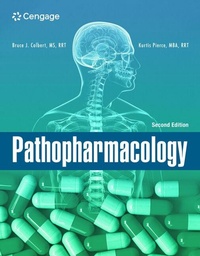
Pathopharmacology
2nd Edition
Published on 27. March 2023
Book
Paperback/Softback
608 pages
978-0-357-61816-5 (ISBN)
Description
Instead of relying on mass memorization, Colbert/Pierce's PATHOPHARMACOLOGY, Second Edition, helps you truly learn and internalize pharmacology and pathophysiology concepts -- for long-term professional success. An engaging writing style makes even complex topics easy to understand, while real clinical connections highlight the interrelatedness and relevancy of what you are learning. Analogies and learning hints are integrated throughout. For example, Chapter 13 uses a snarling dog illustration to show the sympathetic responses of the nervous system. Now you "know" that when the sympathetic nervous system is stimulated, pupils dilate to get more light in to see the situation and heart rate and breathing increase to get more oxygen to ready muscles for fight or flight. Reading this story makes understanding the autonomic responses easier than memorizing a list. Also available: MindTap.
More details
Edition
2nd edition
Language
English
Place of publication
Clifton Park
United States
Publishing group
Cengage Learning, Inc
Target group
College/higher education
Product notice
Paperback (trade)
Unsewn / adhesive bound
Dimensions
Height: 275 mm
Width: 218 mm
Thickness: 25 mm
Weight
1397 gr
ISBN-13
978-0-357-61816-5 (9780357618165)
Copyright in bibliographic data and cover images is held by Nielsen Book Services Limited or by the publishers or by their respective licensors: all rights reserved.
Schweitzer Classification
Other editions
Previous edition
Bruce Colbert | Kurtis Pierce
Pathopharmacology
Book
07/2018
Delmar Cengage Learning
€94.08
Article not available at the moment
Persons
Bruce Colbert is faculty emeritus and retired director of the Allied Health Care Department at the University of Pittsburgh at Johnstown. The author of 12 traditional books and several electronic projects, he has also developed an interactive worktext and program on student success in the health care professions. Focusing on such topics as stress and time management, he has presented more than 300 regional and national lectures and workshops devoted to professional skills, enhancing critical and creative thinking and effective decision-making. In addition, he consults with educational programs to improve teaching effectiveness as well as presents active teaching workshops. Kurtis Pierce is the director of Clinical Education for Respiratory Therapy, assistant director of Allied Health and an instructor at the University of Pittsburgh at Johnstown. He was working as a health care provider when he was first afforded the opportunity to teach students. He found the experiences so enjoyable that he eventually pursued health care education as a career. He is most proud of the successes of his students who graduate to become leaders in their chosen field.
Content
Module 1: Core Concepts of Disease.
Module 2: Mechanism of Disease.
Module 3: Core Concepts of Pharmacology.
Module 4: Drug Administration and Dosage Forms.
Module 5: Cancer and Antineoplastic Pharmacology.
Module 6: Pathopharmacology of the Musculoskeletal System.
Module 7: Pathopharmacology of the Integumentary System.
Module 8: Gastrointestinal Diseases and Medications.
Module 9: Pathopharmacology of the Endocrine System.
Module 10: Pathopharmacology of the Urinary System.
Module 11: Pathopharmacology of the Respiratory System.
Module 12: Pathopharmacology of the Cardiovascular System.
Module 13: Pathopharmacology of the Nervous System.
Module 14: Pathopharmacology of the Eyes and Ears.
Module 15: Pathopharmacology of the Reproductive System.
Module 2: Mechanism of Disease.
Module 3: Core Concepts of Pharmacology.
Module 4: Drug Administration and Dosage Forms.
Module 5: Cancer and Antineoplastic Pharmacology.
Module 6: Pathopharmacology of the Musculoskeletal System.
Module 7: Pathopharmacology of the Integumentary System.
Module 8: Gastrointestinal Diseases and Medications.
Module 9: Pathopharmacology of the Endocrine System.
Module 10: Pathopharmacology of the Urinary System.
Module 11: Pathopharmacology of the Respiratory System.
Module 12: Pathopharmacology of the Cardiovascular System.
Module 13: Pathopharmacology of the Nervous System.
Module 14: Pathopharmacology of the Eyes and Ears.
Module 15: Pathopharmacology of the Reproductive System.