

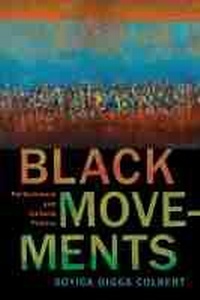
Black Movements
Performance and Cultural Politics
Published on 28. April 2017
Book
Hardback
232 pages
978-0-8135-8852-0 (ISBN)
Description
Received the 2018 Honorable Mention for the Joe A. Callaway Prize for the Best Book on Drama or Theatre?
Black Movements analyzes how artists and activists of recent decades reference earlier freedom movements in order to imagine and produce a more expansive and inclusive democracy. The post-Jim Crow, post-apartheid, postcolonial era has ushered in a purportedly color blind society and along with it an assault on race-based forms of knowledge production and coalition formation. Soyica Diggs Colbert argues that in the late twentieth century race went "underground," and by the twenty-first century race no longer functioned as an explicit marker of second-class citizenship.
The subterranean nature of race manifests itself in discussions of the Trayvon Martin shooting that focus on his hoodie, an object of clothing that anyone can choose to wear, rather than focusing on structural racism; in discussions of the epidemic proportions of incarcerated black and brown people that highlight the individual's poor decision making rather than the criminalization of blackness; in evaluations of black independence struggles in the Caribbean and Africa that allege these movements have accomplished little more than creating a black ruling class that mirrors the politics of its former white counterpart. Black Movements intervenes in these discussions by highlighting the ways in which artists draw from the past to create coherence about blackness in present and future worlds.
Through an exploration of the way that black movements create circuits connecting people across space and time, Black Movements offers important interventions into performance, literary, diaspora, and African American studies.
Black Movements analyzes how artists and activists of recent decades reference earlier freedom movements in order to imagine and produce a more expansive and inclusive democracy. The post-Jim Crow, post-apartheid, postcolonial era has ushered in a purportedly color blind society and along with it an assault on race-based forms of knowledge production and coalition formation. Soyica Diggs Colbert argues that in the late twentieth century race went "underground," and by the twenty-first century race no longer functioned as an explicit marker of second-class citizenship.
The subterranean nature of race manifests itself in discussions of the Trayvon Martin shooting that focus on his hoodie, an object of clothing that anyone can choose to wear, rather than focusing on structural racism; in discussions of the epidemic proportions of incarcerated black and brown people that highlight the individual's poor decision making rather than the criminalization of blackness; in evaluations of black independence struggles in the Caribbean and Africa that allege these movements have accomplished little more than creating a black ruling class that mirrors the politics of its former white counterpart. Black Movements intervenes in these discussions by highlighting the ways in which artists draw from the past to create coherence about blackness in present and future worlds.
Through an exploration of the way that black movements create circuits connecting people across space and time, Black Movements offers important interventions into performance, literary, diaspora, and African American studies.
Reviews / Votes
"Colbert engages with cultural narratives that cross disciplinary boundaries; Black Movements will influence the field because it offers a unique way to think about processes and products of black artistic thought." - Anita Gonzalez (University of Michigan-Ann Arbor and co-author of Black Performance Theory) "With rigor and creativity, Soyica Diggs Colbert weaves together debates in performance studies, black studies, and American studies. Black Movements offers a new way to think about race, time, history, and performance in the contemporary moment and will have a lasting influence." - Shane Vogel (author of The Scene of Harlem Cabaret: Race, Sexuality, Performance) "It is a significant book, one that should be read alongside the scholarship of Saidiya Hartman, Daphne Brooks, Amber Jamilla Musser and other black feminist thinkers. Like BeyoncE reflecting back on Josephine Baker, Black Movements's looks to the legacies of black performance in order to imagine and build black futures." (Journal of American Drama and Theatre) "Colbert's 2017 book is especially exigent because it challenges the fixity of black death in a contemporary moment where black life is continuously expected to end abruptly. Whether this anticipation comes from video circulations of encounters with police or the Sate's neglect of a predominantly black city's contaminated water system, Colbert challenges this anticipated permanence to black death in Black Movements via analyses of literature, popular culture, and history. In doing so, she presents freedom as a multimodal phenomenon - through performance, film, literature, music, and prophecy." (Women's Studies: An Interdisciplinary Journal)More details
Language
English
Place of publication
New Brunswick NJ
United States
Target group
College/higher education
Professional and scholarly
Illustrations
19 photographs
Dimensions
Height: 229 mm
Width: 152 mm
Thickness: 20 mm
Weight
513 gr
ISBN-13
978-0-8135-8852-0 (9780813588520)
Copyright in bibliographic data and cover images is held by Nielsen Book Services Limited or by the publishers or by their respective licensors: all rights reserved.
Schweitzer Classification
Other editions
Additional editions
E-Book
04/2017
1st Edition
Rutgers University Press
€96.99
Available for download
Person
SOYICA DIGGS COLBERT is an associate professor of African American studies at Georgetown University in Washington, D.C. She is the coeditor of The Psychic Hold of Slavery: Legacies in American Expressive Culture (Rutgers University Press).
Content
Acknowledgments
Introduction: Webs of Affiliation
1 Flying Africans in Spaceships
2 Entrapping and Ensnaring Entanglements
3 Prophesying in Octavia Butler's Parable Series
4 Marching
Epilogue: "Why do you look for the living among the dead?": Locating the Future of Black Studies
Notes
Bibliography
Index
Introduction: Webs of Affiliation
1 Flying Africans in Spaceships
2 Entrapping and Ensnaring Entanglements
3 Prophesying in Octavia Butler's Parable Series
4 Marching
Epilogue: "Why do you look for the living among the dead?": Locating the Future of Black Studies
Notes
Bibliography
Index