

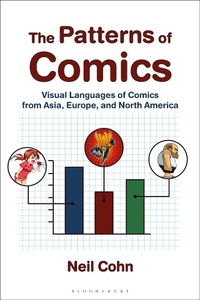
The Patterns of Comics
Visual Languages of Comics from Asia, Europe, and North America
Published on 28. December 2023
Book
Paperback/Softback
296 pages
978-1-350-38164-3 (ISBN)
Description
Comics are a global phenomenon, and yet it's easy to distinguish the visual styles of comics from Asia, Europe, or the United States. But, do the structures of these visual narratives differ in more subtle ways? Might these comics actually be drawn in different visual languages that vary in their structures across cultures?
To address these questions, The Patterns of Comics seeks evidence through a sustained analysis of an annotated corpus of over 36,000 panels from more than 350 comics from Asia, Europe, and the United States. This data-driven approach reveals the cross-cultural variation in symbology, layout, and storytelling between various visual languages, and shows how comics have changed across 80 years. It compares, for example, the subtypes within American comics and Japanese manga, and analyzes the formal properties of Bill Watterson's Calvin and Hobbes across its entire 10-year run. Throughout, it not only uncovers the patterns in and across the panels of comics, but shows how these regularities in the visual languages of comics connect to the organizing principles of all languages.
To address these questions, The Patterns of Comics seeks evidence through a sustained analysis of an annotated corpus of over 36,000 panels from more than 350 comics from Asia, Europe, and the United States. This data-driven approach reveals the cross-cultural variation in symbology, layout, and storytelling between various visual languages, and shows how comics have changed across 80 years. It compares, for example, the subtypes within American comics and Japanese manga, and analyzes the formal properties of Bill Watterson's Calvin and Hobbes across its entire 10-year run. Throughout, it not only uncovers the patterns in and across the panels of comics, but shows how these regularities in the visual languages of comics connect to the organizing principles of all languages.
Reviews / Votes
In previous innovative publications, Neil Cohn has provided a framework for understanding the visual language of comics across languages and cultures. In this magisterial volume he provides readers with tools for continued research. In essence, this is a carefully constructed handbook for in-depth exploration of visual narrative. -- Dan I. Slobin, Emeritus Professor of Psychology and Linguistics, UC Berkeley, USAMore details
Language
English
Place of publication
London
United Kingdom
Publishing group
Bloomsbury Publishing PLC
Target group
Professional and scholarly
College/higher education
Illustrations
80 bw illus
Dimensions
Height: 156 mm
Width: 234 mm
Thickness: 19 mm
Weight
462 gr
ISBN-13
978-1-350-38164-3 (9781350381643)
Copyright in bibliographic data and cover images is held by Nielsen Book Services Limited or by the publishers or by their respective licensors: all rights reserved.
Schweitzer Classification
Other editions
Additional editions
E-Book
11/2023
1st Edition
Bloomsbury Academic
€28.49
Available for download
E-Book
11/2023
1st Edition
Bloomsbury Academic
€28.49
Available for download
Person
Neil Cohn is an award-winning cognitive scientist known for pioneering research on language, graphics, multimodality, and cognition, and Associate Professor at Tilburg University, the Netherlands. His books The Visual Language of Comics (Bloomsbury, 2013) and the 2021 Eisner-nominated Who Understands Comics? (Bloomsbury, 2020), establish the linguistic and cognitive study of graphic communication.
Content
List of Figures and Tables
Preface
1. Visual Language
2. Corpus-Driven Comics Research
3. Morphology
4. Page Layout
5. Situational Coherence
6. Framing Structure
7. Narrative Structure
8. Visual Languages across Time
9. Cross-Cultural Visual Languages?
10. The Visual Language of Calvin and Hobbes
11. Towards a Visual Language Typology
Notes
References
Index
Preface
1. Visual Language
2. Corpus-Driven Comics Research
3. Morphology
4. Page Layout
5. Situational Coherence
6. Framing Structure
7. Narrative Structure
8. Visual Languages across Time
9. Cross-Cultural Visual Languages?
10. The Visual Language of Calvin and Hobbes
11. Towards a Visual Language Typology
Notes
References
Index