

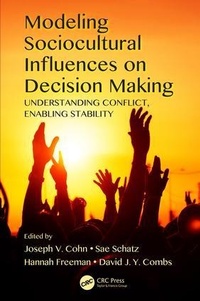
Modeling Sociocultural Influences on Decision Making
Understanding Conflict, Enabling Stability
1st Edition
Published on 27. September 2016
Book
Hardback
576 pages
978-1-4987-3669-5 (ISBN)
Description
In our increasingly globally interconnected world, understanding and appreciating the sociocultural context within which individuals make their decisions is critical to developing successful partnerships. The collection of chapters in this volume illustrates how advances in information and social media technologies, as well as modeling and simulation tools, combined with the social sciences, can be leveraged to better understand how sociocultural context influences decision making.
The chapters in this volume were contributed by leading experts from academia, industry, and government and provide:
Insights into cross-cultural decision making based on recent international events, with grounding in an historical context
Discussions of cutting-edge modeling techniques used today by professionals across multiple organizations and agencies
Descriptions of specific cross-cultural decision making tools designed for use by laypeople and professionals
Case studies on the role of cross-cultural decision making grounded in current events and (in many cases) military applications.
The chapters in this volume were contributed by leading experts from academia, industry, and government and provide:
Insights into cross-cultural decision making based on recent international events, with grounding in an historical context
Discussions of cutting-edge modeling techniques used today by professionals across multiple organizations and agencies
Descriptions of specific cross-cultural decision making tools designed for use by laypeople and professionals
Case studies on the role of cross-cultural decision making grounded in current events and (in many cases) military applications.
Reviews / Votes
"The structure of the book is excellent and gives a framework for organizing ideas in this complex area. Hopefully books like this will by a catalyst for more work in the area and a further maturation of the models and what we can use them for."- Rudolph Darken, Naval Postgraduate School, USA
"I think this book will impact current and future work in the areas that form the intersection of applied social science, computer science, and sociocultural methods. It provides an integrated stance on very complex social and computational issues while retaining a sense for practical application. The book offers a nice blend of theoretical, methodological, and application-focused chapters that will aid a reader in learning about sociocultural topics and applying cutting-edge methods to the real-world issues. The editors have successfully compiled a diverse set of experts to explore very challenging issues that have very real implications for the military, and more broadly, the global business and social domains."
- Joseph B. Lyons, Air Force Research Laboratory, USA
More details
Series
Language
English
Place of publication
Bosa Roca
United States
Publishing group
Taylor & Francis Inc
Target group
College/higher education
Professional and scholarly
Product notice
sewn/stitched
Cloth over boards
Illustrations
139 s/w Abbildungen, 57 s/w Tabellen
57 Tables, black and white; 139 Illustrations, black and white
Dimensions
Height: 254 mm
Width: 185 mm
Thickness: 38 mm
Weight
1157 gr
ISBN-13
978-1-4987-3669-5 (9781498736695)
Copyright in bibliographic data and cover images is held by Nielsen Book Services Limited or by the publishers or by their respective licensors: all rights reserved.
Schweitzer Classification
Other editions
Additional editions
Joseph V. Cohn | Sae Schatz | Hannah Freeman
Modeling Sociocultural Influences on Decision Making
Understanding Conflict, Enabling Stability
Book
12/2019
1st Edition
CRC Press
€78.00
Shipment within 15-20 days
Joseph V. Cohn | Sae Schatz | Hannah Freeman
Modeling Sociocultural Influences on Decision Making
Understanding Conflict, Enabling Stability
E-Book
09/2016
CRC Press
€73.99
Available for download
Joseph V. Cohn | Sae Schatz | Hannah Freeman
Modeling Sociocultural Influences on Decision Making
Understanding Conflict, Enabling Stability
E-Book
09/2016
CRC Press
€73.99
Available for download
Persons
Joseph V. Cohn, PhD, earned his BS in biology from the University of Illinois-Urbana
Champaign in 1993. He earned his PhD in neuroscience from Brandeis University in 1998.
He has coauthored more than 100 publications and presented talks to national and international
professional conferences on a host of topics, ranging from foundational neuroscience
to the nature of technical innovation. He has coedited a three-volume book series
focusing on all aspects of training system development and a single-volume book on
enhancing human performance in high-risk environments. He has received industry and
professional society awards for his research across the spectrum of the human performance
and biomedical sciences. He cochaired the Applied Human Factors and Ergonomics
Association's Cross-Cultural Decision Making Conference from 2013 to 2015 and is a fellow
of the American Psychological Association and the Society of Military Psychologists,
as well as an associate fellow of the Aerospace Medical Association.
Sae Schatz, PhD, is an applied human-systems researcher, learning science professional,
and cognitive scientist. She has headed an array of applied research efforts, authored more
than 50 peer-reviewed scholarly publications, led the development of three military textbooks,
and received industry awards for both her publications and her research efforts.
Schatz cochairs the Applied Human Factors and Ergonomics Association's Cross-Cultural
Decision Making Conference (2013-), is a service principal for the Interservice/Industry
Training, Simulation and Education Conference (2015-), and supports international science
and technology working groups associated with the North Atlantic Treaty Organization,
Partnership for Peace, and The Technical Cooperation Program. Schatz also maintains
close ties with her alma mater, the University of Central Florida, where she earned her
PhD in human systems in modeling and simulation in 2008.
Hannah Freeman earned her Bachelor of Arts degrees in international studies (Russian
and Eastern European studies) and Hispanic studies from Illinois Wesleyan University,
where she was awarded Phi Beta Kappa, in 2012. Freeman earned her Master of Science
degree in comparative politics (conflict studies) from The London School of Economics
and Political Science in 2013, where she also received a Russian Language Certificate. Her
research interests include the former Soviet Union and Soviet bloc, post-Soviet Russia,
human rights, national and ethnic conflict, radicalization, political violence, and terrorism.
David J. Y. Combs, PhD, earned his BA in psychology from Simpson University in 2003.
He earned his PhD in experimental social psychology from the University of Kentucky in
2010. He has also completed certifications in political psychology (Stanford University),
analysis of incomplete data sets (University of Michigan), and Afghanistan-Pakistan
regional expertise. He has completed additional coursework (applied survey sampling)
with The George Washington University. He has coauthored dozens of papers, conference
presentations, and book chapters on social psychological topics such as trust, attitude
change, experience of humiliation, and emotions resulting from political events. He is
especially interested in applying social psychological theory and methods to understanding
cross-cultural interactions within the irregular warfare context.
Champaign in 1993. He earned his PhD in neuroscience from Brandeis University in 1998.
He has coauthored more than 100 publications and presented talks to national and international
professional conferences on a host of topics, ranging from foundational neuroscience
to the nature of technical innovation. He has coedited a three-volume book series
focusing on all aspects of training system development and a single-volume book on
enhancing human performance in high-risk environments. He has received industry and
professional society awards for his research across the spectrum of the human performance
and biomedical sciences. He cochaired the Applied Human Factors and Ergonomics
Association's Cross-Cultural Decision Making Conference from 2013 to 2015 and is a fellow
of the American Psychological Association and the Society of Military Psychologists,
as well as an associate fellow of the Aerospace Medical Association.
Sae Schatz, PhD, is an applied human-systems researcher, learning science professional,
and cognitive scientist. She has headed an array of applied research efforts, authored more
than 50 peer-reviewed scholarly publications, led the development of three military textbooks,
and received industry awards for both her publications and her research efforts.
Schatz cochairs the Applied Human Factors and Ergonomics Association's Cross-Cultural
Decision Making Conference (2013-), is a service principal for the Interservice/Industry
Training, Simulation and Education Conference (2015-), and supports international science
and technology working groups associated with the North Atlantic Treaty Organization,
Partnership for Peace, and The Technical Cooperation Program. Schatz also maintains
close ties with her alma mater, the University of Central Florida, where she earned her
PhD in human systems in modeling and simulation in 2008.
Hannah Freeman earned her Bachelor of Arts degrees in international studies (Russian
and Eastern European studies) and Hispanic studies from Illinois Wesleyan University,
where she was awarded Phi Beta Kappa, in 2012. Freeman earned her Master of Science
degree in comparative politics (conflict studies) from The London School of Economics
and Political Science in 2013, where she also received a Russian Language Certificate. Her
research interests include the former Soviet Union and Soviet bloc, post-Soviet Russia,
human rights, national and ethnic conflict, radicalization, political violence, and terrorism.
David J. Y. Combs, PhD, earned his BA in psychology from Simpson University in 2003.
He earned his PhD in experimental social psychology from the University of Kentucky in
2010. He has also completed certifications in political psychology (Stanford University),
analysis of incomplete data sets (University of Michigan), and Afghanistan-Pakistan
regional expertise. He has completed additional coursework (applied survey sampling)
with The George Washington University. He has coauthored dozens of papers, conference
presentations, and book chapters on social psychological topics such as trust, attitude
change, experience of humiliation, and emotions resulting from political events. He is
especially interested in applying social psychological theory and methods to understanding
cross-cultural interactions within the irregular warfare context.
Content
Introduction; Section I Building Theories; Expeditionary Modeling for Megacities and Other Dense Urban Areas; More than Just a Story: Narrative Insights into Comprehension, Ideology, and Decision Making; The Spread of Information via Social Media; The Spread of Opinions in Societies; Culture's Influences on Cognitive Reflection; Cultural Influences on Cognitive Biases in Judgment and Decision Making: On the Need for New Theory and Models for Accidents and Safety; Section II Collecting and Analyzing Data; The Sixty Percent Mission: An Introduction to High-Risk Ethnography Process and Protocol in Support of the US Army's Civil Affairs Humanitarian Mission; Challenges in Connecting with the Disconnected: An Introduction to Connecting with Communities Disconnected from the Rest of the World; They Are Beyond WEIRD: Helpful Frameworks for Conducting Non-WEIRD Research; Deciphering the Emic Perspective in Data in Order to Assess Threat; Collecting Data and Semantic Content via Mobile Devices; Measuring Changes in Attitudes: Using Factor Analysis to Track Population Attitudes Spatially and Temporally; Gaining Insight by Applying Geographical Modeling; Section III Building and Validating Sociocultural Models; Sociocultural Capability Requirements across All Phases of Military Operations; Methods to Characterize and Manage Uncertainty for Sociocultural Applications; Validating Causal and Predictive Claims in Sociocultural Models; Rapid Generation of Political Conflict Simulations for Scenarios around the World; Detailed Model Development Case Study: The Peace Game; Section IV Applying Sociocultural Models to Gain Insight into Conflict and Instability; Using the Social Framework Model of Trust to Better Understand Trust in Government; Understanding Public Opinion toward Violent Extremists; Modeling Sociocultural Influences on Decision Making: Assessing Conflict and Stability; Modeling Social System Resiliency: An Agent-Based Multiscale Approach; Applying Modeling and Simulation to Foreign Policy: An Afghan Example; Subject Index; Author Index