

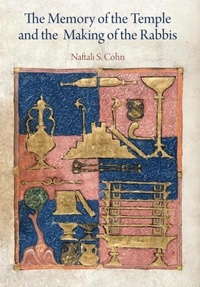
The Memory of the Temple and the Making of the Rabbis
Published on 6. November 2012
Book
Hardback
256 pages
978-0-8122-4457-1 (ISBN)
Description
When the rabbis composed the Mishnah in the late second or early third century C.E., the Jerusalem Temple had been destroyed for more then a century. Why, then, do the Temple and its ritual feature so prominently in the Mishnah? Against the view that the rabbis were reacting directly to the destruction and asserting that nothing had changed, Naftali S. Cohn argues that the memory of the Temple served a political function for the rabbis in their own time. They described the Temple and its ritual in a unique way that helped to establish their authority within the context of Roman dominance.
At the time the Mishnah was created, the rabbis were not the only ones talking extensively about the Temple: other Judaeans (including followers of Jesus), Christians, and even Roman emperors produced texts and other cultural artifacts centered on the Jerusalem Temple. Looking back at the procedures of Temple ritual, the rabbis created in the Mishnah a past and a Temple in their own image, which lent legitimacy to their claim to be the only authentic purveyors of Jewish tradition and the traditional Jewish way of life. Seizing on the Temple, they sought to establish and consolidate their own position of importance within the complex social and religious landscape of Jewish society in Roman Palestine.
At the time the Mishnah was created, the rabbis were not the only ones talking extensively about the Temple: other Judaeans (including followers of Jesus), Christians, and even Roman emperors produced texts and other cultural artifacts centered on the Jerusalem Temple. Looking back at the procedures of Temple ritual, the rabbis created in the Mishnah a past and a Temple in their own image, which lent legitimacy to their claim to be the only authentic purveyors of Jewish tradition and the traditional Jewish way of life. Seizing on the Temple, they sought to establish and consolidate their own position of importance within the complex social and religious landscape of Jewish society in Roman Palestine.
Reviews / Votes
"A learned, nuanced, and well-written study of an important theme in a foundational text of rabbinic Judaism. Cohn shows that we must look outside rabbinic literature if we are to place the Mishnah in a meaningful context. Well done." (Shaye J. D. Cohen, Harvard University)More details
Series
Language
English
Place of publication
Pennsylvania
United States
Target group
College/higher education
Professional and scholarly
Product notice
Paper over boards
Illustrations
5 illus.
Dimensions
Height: 234 mm
Width: 160 mm
Thickness: 26 mm
Weight
518 gr
ISBN-13
978-0-8122-4457-1 (9780812244571)
Copyright in bibliographic data and cover images is held by Nielsen Book Services Limited or by the publishers or by their respective licensors: all rights reserved.
Schweitzer Classification
Other editions
Additional editions
Naftali S. Cohn
The Memory of the Temple and the Making of the Rabbis
E-Book
01/2013
1st Edition
University of Pennsylvania Press
from
€67.69
Available for download
Person
Naftali S. Cohn teaches religion at Concordia University in Montreal.
Content
Notes on Usage
Introduction: The Narration of Temple Ritual as Rabbinic Memory in the Late Second or Early Third Century
Chapter 1. Rabbis as Jurists of Judaean Ritual Law and Competing Claims for Authority
Chapter 2. The Temple, the Great Court, and the Rabbinic Invention of the Past
Chapter 3. Narrative Form and Rabbinic Authority
Chapter 4. Constructing Sacred Space
Chapter 5. The Mishnah in the Context of a Wider Judaean, Christian, and Roman Temple Discourse
Conclusion: The Memory of the Temple and the Making of the Rabbis
Appendix A: The Mishnah's Temple Ritual Narratives and Court-Centered Ritual Narratives
Appendix B: Mishnaic Narratives in Which a Rabbi or Rabbis Issue an Opinion with Respect to a Case
Notes
Bibliography
Index
Acknowledgments
Introduction: The Narration of Temple Ritual as Rabbinic Memory in the Late Second or Early Third Century
Chapter 1. Rabbis as Jurists of Judaean Ritual Law and Competing Claims for Authority
Chapter 2. The Temple, the Great Court, and the Rabbinic Invention of the Past
Chapter 3. Narrative Form and Rabbinic Authority
Chapter 4. Constructing Sacred Space
Chapter 5. The Mishnah in the Context of a Wider Judaean, Christian, and Roman Temple Discourse
Conclusion: The Memory of the Temple and the Making of the Rabbis
Appendix A: The Mishnah's Temple Ritual Narratives and Court-Centered Ritual Narratives
Appendix B: Mishnaic Narratives in Which a Rabbi or Rabbis Issue an Opinion with Respect to a Case
Notes
Bibliography
Index
Acknowledgments