

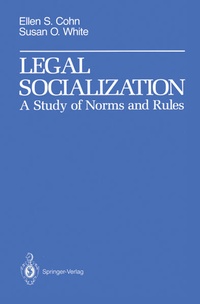
Legal Socialization
A Study of Norms and Rules
Published on 3. October 2011
Book
Paperback/Softback
XI, 224 pages
978-1-4612-7989-1 (ISBN)
Description
Legal Socialization - A Study of Norms and Rules
examines the varying responses, negative and positive, to rule enforcement, as well as the genesis of these responses and the conditions under which they occur. The book presents the results of a longitudinal, multi-methodological study of the dynamic interaction between norms of behavior and rule enforcement in a natural setting, specifically, a university residential community. This approach allowed for the testing of competing hypotheses drawn from social learning and cognitive developmental theory to determine which was more substantively predictive of legal socialization. The first major section discusses the vital issues involved in understanding legal socialization; the two major legal socialization theories; and the research design of the study carried out by the authors. The second part concentrates on empirically testing the predictions of legal development theory versus social learning theory. The final section explores the interaction between reasoning and rule-enforcing conditions and its importance for understanding legal socialization.
More details
Edition
Softcover reprint of the original 1st ed. 1990
Language
English
Place of publication
New York
United States
Target group
Professional and scholarly
Research
Illustrations
XI, 224 p.
Dimensions
Height: 235 mm
Width: 155 mm
Thickness: 14 mm
Weight
371 gr
ISBN-13
978-1-4612-7989-1 (9781461279891)
DOI
10.1007/978-1-4612-3378-7
Schweitzer Classification
Other editions
Additional editions
E-Book
12/2012
Springer
€96.29
Available for download

Book
06/1990
Springer
€85.55
Article exhausted; check different version
Content
I: Legal Socialization Theory.- 1 Studying Legal Socialization.- 2 Comparing Theories of Legal Socialization.- 3 Scope of the Study.- II: Testing Competing Hypotheses.- 4 Changes in Legal Socialization over Time.- 5 Testing Competing Hypotheses.- 6 Effects of the Interaction.- III: Exploring the Interaction.- 7 Legal Reasoning and Behaviors: The Mediating Model.- 8 Offender Status.- 9 A Comparison of Two Rule-Enforcing Experiences.- Conclusion.- Epilogue.- References.- Author List.