

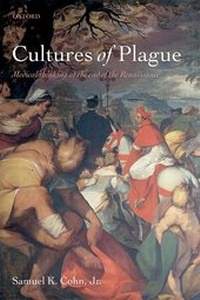
Cultures of Plague
Medical thinking at the end of the Renaissance
1st Edition
Published on 31. March 2011
Book
Paperback/Softback
360 pages
978-0-19-960509-5 (ISBN)
Description
Cultures of Plague opens a new chapter in the history of medicine. Neither the plague nor the ideas it stimulated were static, fixed in a timeless Galenic vacuum over five centuries, as historians and scientists commonly assume. As plague evolved in its pathology, modes of transmission, and the social characteristics of its victims, so too did medical thinking about plague develop.
This study of plague imprints, from academic medical treatises to plague poetry, highlights the most feared and devastating epidemic of the sixteenth-century, one that threatened Italy top to toe from 1575 to 1578 and unleashed an avalanche of plague writing. From erudite definitions, remote causes, cures and recipes, physicians now directed their plague writings to the prince and discovered their most 'valiant remedies' in public health: strict segregation of the healthy and ill, cleaning streets and latrines, addressing the long-term causes of plague-poverty. Those outside the medical profession joined the chorus.
In the heartland of Counter-Reformation Italy, physicians, along with those outside the profession, questioned the foundations of Galenic and Renaissance medicine, even the role of God. Assaults on medieval and Renaissance medicine did not need to await the Protestant-Paracelsian alliance of seventeenth-century in northern Europe. Instead, creative forces planted by the pandemic of 1575-8 sowed seeds of doubt and unveiled new concerns and ideas within that supposedly most conservative form of medical writing, the plague tract.
Relying on health board statistics and dramatized with eyewitness descriptions of bizarre happenings, human misery, and suffering, these writers created the structure for plague classics of the eighteenth century, and by tracking the contagion's complex and crooked paths, they anticipated trends of nineteenth-century epidemiology.
This study of plague imprints, from academic medical treatises to plague poetry, highlights the most feared and devastating epidemic of the sixteenth-century, one that threatened Italy top to toe from 1575 to 1578 and unleashed an avalanche of plague writing. From erudite definitions, remote causes, cures and recipes, physicians now directed their plague writings to the prince and discovered their most 'valiant remedies' in public health: strict segregation of the healthy and ill, cleaning streets and latrines, addressing the long-term causes of plague-poverty. Those outside the medical profession joined the chorus.
In the heartland of Counter-Reformation Italy, physicians, along with those outside the profession, questioned the foundations of Galenic and Renaissance medicine, even the role of God. Assaults on medieval and Renaissance medicine did not need to await the Protestant-Paracelsian alliance of seventeenth-century in northern Europe. Instead, creative forces planted by the pandemic of 1575-8 sowed seeds of doubt and unveiled new concerns and ideas within that supposedly most conservative form of medical writing, the plague tract.
Relying on health board statistics and dramatized with eyewitness descriptions of bizarre happenings, human misery, and suffering, these writers created the structure for plague classics of the eighteenth century, and by tracking the contagion's complex and crooked paths, they anticipated trends of nineteenth-century epidemiology.
Reviews / Votes
[A] brilliant study... Floating fascinating detail on relentless research, Samuel K. Cohn's Cultures of Plague is a tour de force. * Lauro Martines, Times Literary Supplement * A book of marvellous detail and range...superb * William Poole, Times Higher Education Supplement * [An] important contribution...This book is a model of scholarly endeavor: a significant and stimulating argument is informed by rich and detailed research and conveyed in energetic and engaging writing. An indispensable contribution to the field, it should be read by every scholar interested in early modern disease and health. * Bulletin of the History of Medicine * Cultures of the Plague offers an exhaustive and meticulous survey of plague writing in Renaissance Italy. The book's enduring value now surpassing that of Carlo Cipolla and earlier scholars of like eminence in the field. * Ernest B. Gilman, Social History of Medicine. * the book offers a stimulus to more research on the theme of plague, a fascinating topic already a very lively one among a broad range of historians of medicine, politics, religion, art, and literature. * Thomas Worcester, Renaissance Quarterly * with its careful reading of a great number of texts, this fascinating book lucidly demonstrates the need for a more nuanced approach to understanding the medical culture of the late sixteenth century and its response to change ... highly recommended * James E. Shaw, English Historical Review *More details
Language
English
Place of publication
Oxford
United Kingdom
Target group
College/higher education
Professional and scholarly
Students and scholars of the history of medicine; those interested in early modern history and literary studies
Illustrations
13 black and white halftones; 1 map
Dimensions
Height: 234 mm
Width: 156 mm
Thickness: 20 mm
Weight
550 gr
ISBN-13
978-0-19-960509-5 (9780199605095)
Copyright in bibliographic data and cover images is held by Nielsen Book Services Limited or by the publishers or by their respective licensors: all rights reserved.
Schweitzer Classification
Other editions
Additional editions
E-Book
03/2011
OUP eBook
€49.99
Available for download
E-Book
11/2009
OUP eBook
€49.99
Available for download
Book
11/2009
Oxford University Press
€89.00
Shipment within 15-20 days
Person
Samuel K. Cohn Jr. has specialized in the Italian Renaissance, the history of disease, and popular revolt in late medieval Europe. He is the author of eleven books, the most recent of which is Lust for Liberty (Harvard University Press, 2006) and had published essays in the American Historical Review, English Historical Review, Past & Present, Economic History Review, Medical History, Journal of Interdisciplinary History, Les Annales, and Studia Storici.
Content
Introduction ; 1. Sources and perspectives: A quantitative reckoning ; 2. Signs and symptoms ; 3. The impetus from Sicily ; 4. The Successo della peste ; 5. Liberation of the city and Plague poetry ; 6. Plague disputes and challenges to the old 'universals' ; 7. Plague and poverty ; 8. Towards a new public health consciousness in medicine ; 9. Plague psychology ; Epilogue ; Bibliography