

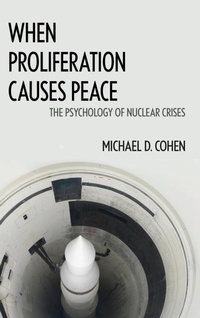
When Proliferation Causes Peace
The Psychology of Nuclear Crises
Published on 1. December 2017
Book
Hardback
280 pages
978-1-62616-494-9 (ISBN)
Description
Does state acquisition of nuclear weapons lead to stability and peace or instability and crises? This is one of the great debates in international relations scholarship. Michael D. Cohen argues that nuclear weapons acquisition often does dangerously embolden the acquiring state to undertake coercion and aggression, but that this behavior moderates over time as leaders learn the dangers and limitations of nuclear coercion. This book examines the historical cases of the Soviet Union and Pakistan in depth and also looks at mini-cases involving the United States, China, and India. This book broadens our understanding of how leaders and states behave when they acquire nuclear weapons and is important reading for scholars and students of international relations, security studies, and political psychology.
Reviews / Votes
Cohen's book has a number of admirable qualities. In addition to tackling a critically important question, the theory is refreshing in its focus on the experiences of individual leaders. . . . Cohen's book is an important step toward understanding the role of psychology and leader experiences in nuclear decision-making. * H-Diplo * An original, innovative contribution to security studies, and to contemporary attempts to develop leader-based theories of nuclear behavior. It charts a new path for scholars interested in pursuing application of cognitive biases in nuclear studies. * Perspectives on Politics * An original, innovative contribution to security studies, and to contemporary attempts to develop leader-based theories of nuclear behavior. It charts a new path for scholars interested in pursuing the application of cognitive biases in nuclear studies....an important book that contributes new insights to the field of nuclear studies. * Perspectives on Politics * Cohen analyzes how politicians learn from and adapt after crises and demonstrates just how sobering the prospect of war can be. * Foreign Affairs * Cohen provides a detailed, well-researched, and structured analysis of crucial questions regarding the dangers of nuclear proliferation. * Political Science Quarterly * When Proliferation Causes Peace is a lively, entertaining book with a provocative, interesting thesis. Cohen offers a nuanced assessment of the impact of proliferation on state behavior, with expectations based not upon fictional homo-economic states but realistic understandings of human psychology. * Political Psychology * It is useful, even vital, to use political-science methods to seek a better understanding of the general behavioral tendencies of top leaders in nuclear affairs. Cohen's book is a fine example of how to do it. * The Nonproliferation Review *More details
Language
English
Place of publication
Washington, DC
United States
Target group
Professional and scholarly
US School Grade: College Graduate Student and over
Illustrations
Not illustrated
Dimensions
Height: 229 mm
Width: 152 mm
Weight
612 gr
ISBN-13
978-1-62616-494-9 (9781626164949)
Copyright in bibliographic data and cover images is held by Nielsen Book Services Limited or by the publishers or by their respective licensors: all rights reserved.
Schweitzer Classification
Other editions
Additional editions
E-Book
12/2017
Georgetown University Press
€35.99
Available for download
Persons
Michael D. Cohen is a senior lecturer in security studies at Macquarie University in Australia. He is coeditor of North Korea and Nuclear Weapons. His articles have appeared in International Security, International Relations of the Asia-Pacific, The Non-Proliferation Review, and Strategic Studies Quarterly.
Content
1. Introduction2. Psychology, Nuclear Crisis, and Foreign Policy3. The Soviet Union, 1956-19624. Pakistan, 1998-20025. Further Tests: Kennedy, Vajpayee, Nixon, and Mao6. Conclusion: When Proliferation Causes PeaceBibliographyIndexAbout the Author