

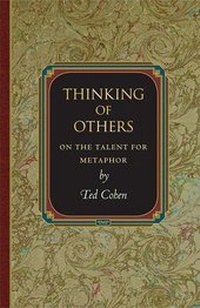
Thinking of Others
On the Talent for Metaphor
Published on 5. October 2008
Book
Hardback
104 pages
978-0-691-13746-9 (ISBN)
Description
In "Thinking of Others", Ted Cohen argues that the ability to imagine oneself as another person is an indispensable human capacity - as essential to moral awareness as it is to literary appreciation - and that this talent for identification is the same as the talent for metaphor. To be able to see oneself as someone else, whether the someone else is a real person or a fictional character, is to exercise the ability to deal with metaphor and other figurative language. The underlying faculty, Cohen argues, is the same - simply the ability to think of one thing as another when it plainly is not.In an engaging style, Cohen explores this idea by examining various occasions for identifying with others, including reading fiction, enjoying sports, making moral arguments, estimating one's future self, and imagining how one appears to others. Using many literary examples, Cohen argues that we can engage with fictional characters just as intensely as we do with real people, and he looks at some of the ways literature itself takes up the question of interpersonal identification and understanding.
An original meditation on the necessity of imagination to moral and aesthetic life, "Thinking of Others" is an important contribution to philosophy and literary theory.
An original meditation on the necessity of imagination to moral and aesthetic life, "Thinking of Others" is an important contribution to philosophy and literary theory.
Reviews / Votes
"Ted Cohen's little philosophical essay on how metaphor gets us to think of others was tremendous."--James Wood, NewYorker.com "This is really philosophy at its best: clearly written and free from jargon, sophisticated yet unpretentious, and highly engaging."--Jeanette Bicknell, Philosophy in Review "Cohen has given us, in wonderfully readable and analytically acute form, an unforgettable study of a complexly interwoven set of linguistic, perceptual, and imaginative abilities that not only make us who we are, but make us who we are together."--Garry L. Hagberg, Mind "Ted Cohen's work on metaphor is well known in the profession, so it comes as no surprise to us that he has now written a splendid book on the subject."--Peter Kivy, Journal of Aesthetics and Art Criticism "The important, intriguing subject of this small book by Cohen--one's capacity to understand others--is full of perplexing puzzles. Through careful analysis of interesting examples, Cohen makes readers wonder about some of the major impasses in mutual understanding between people with different religious perspectives, with different racial and social experiences, and even with allegiances to different baseball teams."--S.A. Mason, Choice "[W]hy not invest in Cohen's book? I assure you it will return handsome dividends, even in the present economy."--Peter Kivy, Journal of Aesthetics and Art CriticismMore details
Series
Language
English
Place of publication
New Jersey
United States
Target group
College/higher education
Professional and scholarly
Product notice
Trade binding
Dimensions
Height: 203 mm
Width: 127 mm
Weight
255 gr
ISBN-13
978-0-691-13746-9 (9780691137469)
Copyright in bibliographic data and cover images is held by Nielsen Book Services Limited or by the publishers or by their respective licensors: all rights reserved.
Schweitzer Classification
Other editions
Additional editions
Book
04/2012
Princeton University Press
€24.30
Shipment within 10-20 days
Person
Ted Cohen is professor of philosophy at the University of Chicago and the author of "Jokes: Philosophical Thoughts on Joking Matters".
Content
Acknowledgments ix CHAPTER ONE: The Talent for Metaphor 1 CHAPTER TWO: Being a Good Sport 13 CHAPTER THREE: From the Bible: Nathan and David 19 CHAPTER FOUR: Real Feelings, Unreal People 29 CHAPTER FIVE: More from the Bible: Abraham and God 53 CHAPTER SIX: More Lessons from Sports 57 CHAPTER SEVEN: Oneself Seen by Others 65 CHAPTER EIGHT: Oneself as Oneself 67 CHAPTER NINE: Lessons from Art 69 CHAPTER TEN: The Possibility of Conversation, Moral and Otherwise 79 CHAPTER ELEVEN Conclusion: In Praise of Metaphor 85 Index 87