

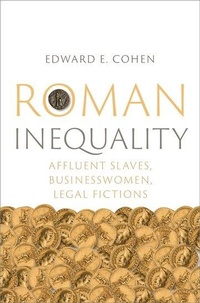
Roman Inequality
Affluent Slaves, Businesswomen, Legal Fictions
Published on 26. July 2023
Book
Hardback
280 pages
978-0-19-768734-5 (ISBN)
Description
Roman Inequality explores how in Rome in the first and second centuries CE a number of male and female slaves, and some free women, prospered in business amidst a population of generally impoverished free inhabitants and of impecunious enslaved residents. Edward E. Cohen focuses on two anomalies to which only minimal academic attention has been previously directed: (1) the paradox of a Roman economy dependent on enslaved entrepreneurs who functioned, and often achieved considerable personal affluence, within a legal system that supposedly deprived unfree persons of all legal capacity and human rights; (2) the incongruity of the importance and accomplishments of Roman businesswomen, both free and slave, successfully operating under legal rules that in many aspects discriminated against women, but in commercial matters were in principle gender-blind and in practice generated egalitarian juridical conditions that often trumped gender-discriminatory customs. This book also examines the casuistry through which Roman jurists created "legal fictions" facilitating a commercial reality utterly incompatible with the fundamental precepts--inherently discriminatory against women and slaves---that Roman legal experts ("jurisprudents") continued explicitly to insist upon. Moreover, slaves' acquisition of wealth was actually aided by a surprising preferential orientation of the legal system: Roman law--to modern Western eyes counter-intuitively--in reality privileged servile enterprise, to the detriment of free enterprise.
Beyond its anticipated audience of economic historians and students and scholars of classical antiquity, especially of Roman history and law, Roman Inequality will appeal to all persons working on or interested in gender and liberation issues.
Beyond its anticipated audience of economic historians and students and scholars of classical antiquity, especially of Roman history and law, Roman Inequality will appeal to all persons working on or interested in gender and liberation issues.
Reviews / Votes
This book is phenomenal, and delightfully well-documented * as I would expect.I'm deeply sympathetic with what the book seeks to do. This is true of its attempt to grant real historical salience to a feature of Roman law on agency that many probably knew at the level of doctrine but whose implications for the economy few had considered.Clifford Ando, Professor of Roman Law and Classics at the University of Chicago
* A must-read for any social and economic and legal historian of antiquity. Both the general overview of the subject matter and the points of detail are innovative and important. * Marco Maiuro, Professor of Roman History at the University of Rome ("La Sapienza") * Engaging with one of the most intriguing aspects of the way the Romans dealt with entrepreneurial matters, this book is a very illuminating piece of scholarship, proof that people with actual business experience can contribute decisively to the field of economic history. * Gilles Bransbourg, American Numismatic Society
* It is important to point out that, while this review may well present supporters of Classics for All with a new and, frankly, astonishing aspect of the ancient world, the importance of this book for academics, which cannot be overestimated, lies in the expertise with which C. selects from, and the crystal clarity with which he analyses, the mountains of evidence that the jurists and inscriptions have left on the topic. It all adds up to a fascinating and extremely important contribution to our understanding of the nature of slavery in the Roman world. * Peter Jones, Classics for All * Roman Inequality is an important analysis of the law surrounding slavery and a convincing explanation of the economic dominance of enslaved, freed, and, in some cases, female workers... The book advances our understanding of the real--world implications of Roman law and provides new insights that have much to contribute across multiple fields of study. * Jane Sancinito, Bryn Mawr Classical Review *
More details
Language
English
Place of publication
New York
United States
Target group
Professional and scholarly
Product notice
sewn/stitched
Cloth over boards
Dimensions
Height: 237 mm
Width: 163 mm
Thickness: 23 mm
Weight
553 gr
ISBN-13
978-0-19-768734-5 (9780197687345)
Copyright in bibliographic data and cover images is held by Nielsen Book Services Limited or by the publishers or by their respective licensors: all rights reserved.
Schweitzer Classification
Other editions
Additional editions
E-Book
05/2023
OUP eBook
€53.99
Available for download
E-Book
05/2023
OUP eBook
€53.99
Available for download
Person
Edward E. Cohen is Professor of Classics and Ancient History (Adjunct) at the University of Pennsylvania. He specializes in the economic and legal history of ancient Greece and Rome, and is the author of many books and articles on this subject, including Athenian Prostitution: The Business of Sex (also Oxford University Press).
Content
Acknowledgments
Introduction
Chapter 1 Inequality
Chapter 2 Fiction: Reconciling Economic Reality and Juridicial Principles
Chapter 3 Opportunity: From Freedom to Slavery-From Slavery to Freedom
Chapter 4 Businesswomen: In Servitude and in Freedom
Chapter 5 Servile Imperialism: In Power, In Servitude
Works Cited
General Index
Index of Passages Cited
Introduction
Chapter 1 Inequality
Chapter 2 Fiction: Reconciling Economic Reality and Juridicial Principles
Chapter 3 Opportunity: From Freedom to Slavery-From Slavery to Freedom
Chapter 4 Businesswomen: In Servitude and in Freedom
Chapter 5 Servile Imperialism: In Power, In Servitude
Works Cited
General Index
Index of Passages Cited