

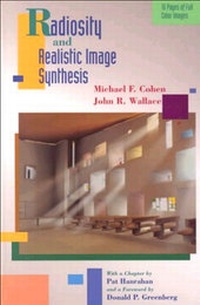
Radiosity and Realistic Image Synthesis
Published on 17. November 1993
Book
Hardback
381 pages
978-0-12-178270-2 (ISBN)
Description
The goal of image synthesis is to create, using the computer, a visual experience that is identical to what a viewer would experience when viewing a real environment. Radiosity and Realistic Image Synthesis offers the first comprehensive look at the radiosity method for image synthesis and the tools required to approach this elusive goal.
Basic concepts and mathematical fundamentals underlying image synthesis and radiosity algorithms are covered thoroughly. (A basic knowledge of undergraduate calculus is assumed). The algorithms that have been developed to implement the radiosity method ranging from environment subdivision to final display are discussed. Successes and difficulties in implementing and using these algorithms are highlighted. Extensions to the basic radiosity method to include glossy surfaces, fog or smoke, and realistic light sources are also described.
There are 16 pages of full colour images and over 100 illustrations to explain the development and show the results of the radiosity method. Results of applications of this new technology from a variety of fields are also included.
Michael Cohen has worked in the area of realistic image synthesis since 1983 and was instrumental in the development of the radiosity method. He is currently an assistant professor of computer science at Princeton University. John Wallace is a software engineer at 3D/EYE, Inc., where he is the project leader for the development of Hewlett-Packard's ATRCore radiosity and ray tracing library. A chapter on the basic concepts of image synthesis is contributed by Patrick Hanrahan. He has worked on the topic of image synthesis at Pixar, where he was instrumental in the development of the Renderman software. He has also led research on the hierarchical methods at Princeton University, where he is an associate professor of computer science. All three authors have written numerous articles on radiosity that have appeared in the SIGGAPH proceedings and elsewhere.
They have also taught the SIGGRAPH course on radiosity for 5 years.
Basic concepts and mathematical fundamentals underlying image synthesis and radiosity algorithms are covered thoroughly. (A basic knowledge of undergraduate calculus is assumed). The algorithms that have been developed to implement the radiosity method ranging from environment subdivision to final display are discussed. Successes and difficulties in implementing and using these algorithms are highlighted. Extensions to the basic radiosity method to include glossy surfaces, fog or smoke, and realistic light sources are also described.
There are 16 pages of full colour images and over 100 illustrations to explain the development and show the results of the radiosity method. Results of applications of this new technology from a variety of fields are also included.
Michael Cohen has worked in the area of realistic image synthesis since 1983 and was instrumental in the development of the radiosity method. He is currently an assistant professor of computer science at Princeton University. John Wallace is a software engineer at 3D/EYE, Inc., where he is the project leader for the development of Hewlett-Packard's ATRCore radiosity and ray tracing library. A chapter on the basic concepts of image synthesis is contributed by Patrick Hanrahan. He has worked on the topic of image synthesis at Pixar, where he was instrumental in the development of the Renderman software. He has also led research on the hierarchical methods at Princeton University, where he is an associate professor of computer science. All three authors have written numerous articles on radiosity that have appeared in the SIGGAPH proceedings and elsewhere.
They have also taught the SIGGRAPH course on radiosity for 5 years.
More details
Series
Language
English
Place of publication
San Francisco
United States
Publishing group
Elsevier Science & Technology
Target group
Professional and scholarly
AUDIENCE: Researchers, educators, practitioners, and students in the fields of computer graphics, image processing, image synthesis, animation, virtual reality, and scientific visualisation. This book is also a helpful reference tool for architects, interior designers, engineers, computer graphics practitioners, and medical imaging workers.
Dimensions
Height: 279 mm
Width: 216 mm
Weight
730 gr
ISBN-13
978-0-12-178270-2 (9780121782702)
Copyright in bibliographic data and cover images is held by Nielsen Book Services Limited or by the publishers or by their respective licensors: all rights reserved.
Schweitzer Classification
Other editions
Additional editions
Michael F. Cohen | John R. Wallace
Radiosity and Realistic Image Synthesis
E-Book
12/2012
Morgan Kaufmann
€54.95
Available for download
Persons
By Michael F. Cohen and John R. Wallace
Content
Introduction: Realistic Image Synthesis, Goals and Limitations. A Short Historical Perspective of Image Synthesis. Radiosity and Finite Element Methods. The Radiosity Algorithm and This Book. Rendering Concepts: Motivation. Basic Optics. Radiometry and Photometry. The Light Field. Reflection Functions. The Rendering Equation. Discretizing the Radiosity Equation: the Radiosity Function. Making Image Synthesis Tractable. The Radiosity Approach. Approximating the Radiosity Across a Surface. Error Metrics. Constant Element Radiosities. Higher Order Basic Functions. Parametric Mapping to a Master Element. Summary. The Form Factor, The Form Factor Integral: the Coefficients of K. The Differential Form Factor. Three Formulations of the Form Factor. Computing the Form Factor. Closed Form Solutions for the Form Factor: Formulae for Simple Shapes. Differential Area to Convex Polygon. General Polygon to Polygon. Numerical Solutions for the Form Factor: Numerical Integration in General. Evaluating the Inner Integral. Full Area to Area Quadrature. Contour Integral Formulation. A Simple Test Environment. Non-Constant Basis Functions. Acceleration Techniques. Radiosity Matrix Solutions: Qualities of the Matrix. Linear System Solution Methods. Relaxation Methods. Dynamic Environments. Parallel Implementations. Domain Subdivision: Error Metrics. Mesh Characteristics and Accuracy. Automatic Meshing Algorithms. Hierarchical and Importance Based Algorithms: Observations About K. Two Level Hierarchy. Multi-Level Hierarchy. Importance Meshing. Hierarchical Basis Functions. Summary of Hierarchical Radiosity Methods. Meshing: Basic Subdivision Techniques. Mesh Template Methods. Decomposition Methods. Mesh Smoothing. Discontinuity Meshing. Topological Data Structures and Operators. Alternatives to Meshing. Rendering: Reconstructing the Radiosity Functions. Interpolation Methods for Rendering. Two-Pass Methods. Incorporating Surface Detail. Mapping Radiosities to Pixel Colours. Colour. Summary. Extensions: Non-Diffuse Light Sources. Directional Reflection. Participating Media. Conclusion and Future Directions.