

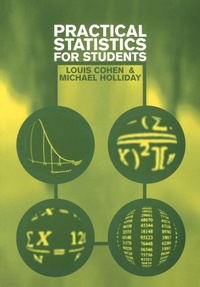
Practical Statistics for Students
An Introductory Text
1st Edition
Published on 28. September 1996
Book
Paperback/Softback
384 pages
978-1-85396-329-2 (ISBN)
Description
This bestselling textbook is designed to help students understand parametric and nonparametric statistical methods so that they can tackle research problems successfully. By working through this book carefully and systematically, those who may not have a strong background in mathematics will gain a thorough grasp of the most widely used statistical methods in the social sciences.
More details
Language
English
Place of publication
London
United Kingdom
Target group
Professional and scholarly
Dimensions
Height: 244 mm
Width: 170 mm
Thickness: 21 mm
Weight
668 gr
ISBN-13
978-1-85396-329-2 (9781853963292)
Copyright in bibliographic data and cover images is held by Nielsen Book Services Limited or by the publishers or by their respective licensors: all rights reserved.
Schweitzer Classification
Other editions
Additional editions
E-Book
09/1996
1st Edition
SAGE Publications Ltd
from
€57.19
Available for download
Persons
Research interests
Nineteenth and Twentieth Century architecture and urbanism in Germany,
France, Italy, Russia and North America. Contemporary issues in architecture,
town planning and landscape design.
Sample courses
Problems of Interpretation in Architectural History
The Architecture of Frank Lloyd Wright
Machine to Architecture (Architecture since 1945)
The Rise of the Skyscraper : one Century of Theories and Designs
Los Angeles: Urban Landscape and Architectural Creativity
Nineteenth and Twentieth Century architecture and urbanism in Germany,
France, Italy, Russia and North America. Contemporary issues in architecture,
town planning and landscape design.
Sample courses
Problems of Interpretation in Architectural History
The Architecture of Frank Lloyd Wright
Machine to Architecture (Architecture since 1945)
The Rise of the Skyscraper : one Century of Theories and Designs
Los Angeles: Urban Landscape and Architectural Creativity
Content
Introduction
Measurement Concepts
Classifying Data
Presenting Data
Measuring Typical Achievement
Measuring Variations in Achievement
Measuring Relative Achievement
Measuring Association
Regression Analysis
Inferential Statistics
Choosing an Appropriate Test
Design 1
One Group Design: Single Observations on One Variable
Design 2
One Group Design: One Observation per Subject on Each of Two or More Variables
Design 3
One Group Design: Repeated Observations on the Same Subjects under Two Conditions or before and after Treatment
Design 4
One Group - Multi-Treatment (trials): Treatments as Independent Variable
Design 5
Two Group Designs: Static Comparisons on One or More Variables
Design 6
Multi- Group Design: More than Two Groups, One Single Variable
Design 7
Multivariate Analysis. Factorial Designs - The Effect of Two Independent Variables on the Dependent Variable; (a) No Repeated Measures on Factors
Design 8
Factorial Designs - The Effect of Two Independent Variables on the Dependent Variable; (b) Repeated Measures on ONE Factor
Factorial Designs
The Effect of Two Independent Variables on the Dependent Variable; (c) Repeated Measures on BOTH Factors
Measurement Concepts
Classifying Data
Presenting Data
Measuring Typical Achievement
Measuring Variations in Achievement
Measuring Relative Achievement
Measuring Association
Regression Analysis
Inferential Statistics
Choosing an Appropriate Test
Design 1
One Group Design: Single Observations on One Variable
Design 2
One Group Design: One Observation per Subject on Each of Two or More Variables
Design 3
One Group Design: Repeated Observations on the Same Subjects under Two Conditions or before and after Treatment
Design 4
One Group - Multi-Treatment (trials): Treatments as Independent Variable
Design 5
Two Group Designs: Static Comparisons on One or More Variables
Design 6
Multi- Group Design: More than Two Groups, One Single Variable
Design 7
Multivariate Analysis. Factorial Designs - The Effect of Two Independent Variables on the Dependent Variable; (a) No Repeated Measures on Factors
Design 8
Factorial Designs - The Effect of Two Independent Variables on the Dependent Variable; (b) Repeated Measures on ONE Factor
Factorial Designs
The Effect of Two Independent Variables on the Dependent Variable; (c) Repeated Measures on BOTH Factors