

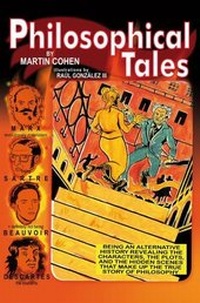
Philosophical Tales
Being an Alternative History Revealing the Characters, the Plots, and the Hidden Scenes That Make Up the True Story of Philosophy
Published on 4. April 2008
Book
Hardback
300 pages
978-1-4051-4036-2 (ISBN)
Description
Was Socrates really the saintly figure he became for later philosophy? Why is it doubtful that Descartes ever really uttered, "I think, therefore I am"? And what did Sartre ever have against waiters, anyway? The history of philosophy is filled with great tales - many of them fictions, misrepresentations, falsehoods, lies and fibs. Or are they just misstatements, prevarications, and narratives not entirely based on fact? In the true spirit of a broad philosophical debate, Philosophical Tales dips a toe into the great sea of philosophy to collect, deconstruct, and relate many of history's great - and not so great - philosophical tales.
Enlightening and entertaining, Philosophical Tales examines a few of the fascinating biographical details of history's greatest philosophers (alas, mostly men) and highlights their contributions to the field. By applying the true philosophical approach to philosophy itself, the text provides us with a refreshing "alternative history" of philosophy.
But why should someone want to know that Kant rolled himself three times in his sheets each night before sleeping, that Schopenhauer pushed a poor old lady down the stairs, or Marx spent as much time on beer and women as he did in the British Library? By examining the seeming trivialities of philosophers' lives - and skewering a few cherished myths along the way - Philosophical Tales provides us with illuminating insights that will encourage a more active, critical way of thinking. Blaise Pascal may have put it best when he said, "To make light of philosophy is to be a true philosopher."
Reviews / Votes
"We need more stories in philosophy, and Martin Cohen aims to fill this lacuna with Philosophical Tales. [This book] is intended for a general audience interested in a satirical introduction to overlooked aspects of Western philosophy and the lives of the great philosophers. Philosophical Tales does tell a number of interesting stories, and any instructor of philosophy will find it handy to have these stories available to enliven a class. Instructors will also find it valuable to use these philosophical tales to raise a compelling question: is a philosophy only as good as the philosopher who proposes it?" (Teaching Philosophy, December 2009) "Great philosophers only become well known after their deaths. Indeed, to speak of contemporary celebrity philosophers is oxymoronic. Still, one can't help wondering who amongst living philosophers will merit future Philosophical Tales. (The Philosopher, Autumn 2008)More details
Product info
gebunden
Edition
1. Auflage
Language
English
Place of publication
Hoboken
United Kingdom
Publishing group
John Wiley and Sons Ltd
Target group
Professional and scholarly
Primarily for introduction to philosophy courses at the undergraduate level, also for general readers and all serious students of philosophy desiring biographical information on the great philosophers, or simply a more entertaining account of philosophica
Product notice
sewn/stitched
Cloth over boards
With dust jacket
Dimensions
Height: 240 mm
Width: 161 mm
Thickness: 21 mm
Weight
619 gr
ISBN-13
978-1-4051-4036-2 (9781405140362)
Schweitzer Classification
Other editions
Additional editions
Martin Cohen
Philosophical Tales
Being an Alternative History Revealing the Characters, the Plots, and the Hidden Scenes That Make Up the True Story of Philosophy
E-Book
01/2009
Wiley-Blackwell
€74.99
Available for download
Martin Cohen
Philosophical Tales
Being an Alternative History Revealing the Characters, the Plots, and the Hidden Scenes That Make Up the True Story of Philosophy
Book
04/2008
Wiley
€24.50
Shipment within 3-4 weeks
Persons
Martin Cohen is a teacher and writer specializing in philosophy, ethics and education, with a special interest in computing. His books include 101 Philosophy Problems (2nd edn., 2001), Political Philosophy (2001), 101 Ethical Dilemmas (2003), and Wittgenstein's Beetle and Other Classic Thought Experiments (Blackwell, 2005). He has been editor of The Philosopher since 1995.
Content
Forward.
How to Use this Book.
[List of illustrations/ About the Pictures].
The Tales.
The Ancients.
1. Socrates the Sorcerer (469 BC E).
2. The Different Forms of Plato ( circa 427-347 BCE).
3. Aristotle the Aristocrat (384 - circa 322 BCE).
More Ancients.
4. Lao Tzu Changes into Nothing (sixth to fifth century BCE).
5. Heraclitus: the dark side of the river (c. fifth century BCE).
6. Pythagoras Counts Up to Ten (c570-495 BCE).
7. Hypatia, holds up half of the sky (circa 370-415 CE).
Medieval Philosophy.
7. Augustine the Hippocrite (354 - 430 C.E.).
8. Thomas Aquinas disputes the Existence of God ( 1225-74).
Modern Philosophy.
9. Descartes the Dilettante and More Des Cartes (1596-1650).
10. Hobbes Squares the Circle (1588-1679).
11. Spinoza grinds himself away. (1632-1677) Enlightened Philosophy.
12. John Locke invents the Slave Trade (1632-1704).
13. The Many Faces of David Hume 1711-1776.
14. Rousseau the Rogue (1712-78).
15. Kant, The Chinaman of Königsburg (and his rule-bound existence) (1724-1804).
The Idealists.
16. Gottfried Leibniz - the thinking machine (1646-1716).
17. Bishop Berkeley's Bermuda College (1685-1753).
18. Headmaster Hegel - and the dangerous lesson of history (1770-1831).
19. Arthur Schopenhauer and his Landlady (1788-1860).
The Romantics.
20. The Seduction of Søren Kierkegaard (1813- circa 1853).
21. Mill's Poetical Turn (1806-73).
22. Henry Thoreau and Life in the Shed (1817-1862).
23. Marx's revolutionary materialism (1818-83).
Recent Philosophy.
24. Russell denotes Domething (1872-1970).
25. The Ripping Yarn of Ludwig Wittgenstein (1889-1951).
26. Heidegger's Tale (and the Nazis) (1889-1976).
27. Sapir-Whorf and the colour Pinker (c.1900-1950).
28. Being Sartre and not definitely not being de Beauvoir (1905-80 and not 1908-86).
29. Deconstructing Derrida (1930-2005).
30. Appendix: Women in Philosophy, and Why There Aren't Many.
Sources and Further Reading