

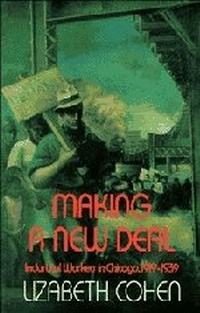
Making a New Deal
Industrial Workers in Chicago, 1919-1939
Published on 25. October 1991
Book
Paperback/Softback
544 pages
978-0-521-42838-5 (ISBN)
Description
This book examines how it was possible and what it meant for ordinary factory workers to become effective unionists and national political participants by the mid-1930s. We follow Chicago workers as they make choices about whether to attend ethnic benefit society meetings or to go to the movies, whether to shop in local neighborhood stores or patronize the new A & P. Although workers may not have been political in traditional terms during the '20s, as they made daily decisions like these, they declared their loyalty in ways that would ultimately have political significance. As the depression worsened in the 1930s, not only did workers find their pay and working hours cut or eliminated, but the survival strategies they had developed during the 1920s were undermined. Looking elsewhere for help, workers adopted new ideological perspectives and overcame longstanding divisions among themselves to mount new kinds of collective action. Chicago workers' experiences as citizens, ethnics and blacks, wage earners and consumers all converged to make them into New Deal Democrats and CIO unionists.
Reviews / Votes
'Based upon prodigious reseach, Making a New Deal carefully assesses the diversity of workers' social experience, examining African-American and Mexican workers as well as eastern and southern Europeans. At every step the argument is developed in a sophisticated way ... Making a New Deal constitutes a major achievement and deserves the central position in historians' discussions that it will probably receive.' Julia Greene, Journal of American History 'Like the best new labor historians, she studies working people outside their workplaces, but like the best old labor historians, she emphasizes the importance of workplace and union building in their lives.' David Nasaw, The Nation 'This is a terrific book. Cohen skillfully uses a mass of sources to paint a richly detailed portrait of working-class life in the 1920s and 1930s. Literally dozens of subjects ignored or inadequately treated in previous studies are discussed with care and subtlety here: workers and installment buying, ethnic records, chain stores, early radio, youth clubs, company-sponsored sports teams, and the collapse of ethnic institutions in the Great Depression, to name just a few. Cohen is really the first historian to look at twentieth-century consumption patterns 'from the bottom up'.' Roy Rosenzweig, George Mason UniversityMore details
Language
English
Place of publication
Cambridge
United Kingdom
Target group
College/higher education
Professional and scholarly
Product notice
Paperback (trade)
Illustrations
Worked examples or Exercises
Dimensions
Height: 229 mm
Width: 150 mm
Thickness: 26 mm
Weight
690 gr
ISBN-13
978-0-521-42838-5 (9780521428385)
Copyright in bibliographic data and cover images is held by Nielsen Book Services Limited or by the publishers or by their respective licensors: all rights reserved.
Schweitzer Classification
Other editions
New editions

Book
11/2014
2nd Edition
Cambridge University Press
€35.00
Shipment within 15-20 days
Book
01/2008
2nd Edition
Cambridge University Press
€28.46
Article exhausted; check for reprint
Content
List of illustrations; List of tables; Acknowledgments; Introduction; 1. Living and working in Chicago in 1919; 2. Ethnicity in teh new Era; 3. Encountering mass culture; 4. Contested loyalty at the workplace; 5. Adrift in the Great Depression; 6. Workers make a new deal; 7. Becoming a union rank and file; 8. Workers' common ground; Conclusion; Notes; Index.