

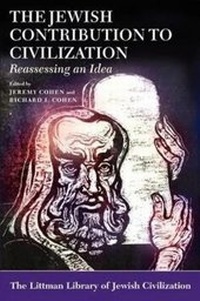
The Jewish Contribution to Civilization
Published on 27. December 2007
Book
Hardback
256 pages
978-1-904113-52-2 (ISBN)
Description
The biblical
idea of a distinct 'Jewish contribution to civilization' continues to engage
Jews and non-Jews alike. This book seeks neither to document nor to discredit
the notion, but rather to investigate the idea itself as it has been understood
from the seventeenth century to the present. It explores the role that the
concept has played in Jewish self-definition, how it has influenced the
political, social, and cultural history of the Jews and of others, and whether
discussion of the notion still has relevance in the world today.
The book
offers a broad spectrum of academic opinion: from tempered advocacy to reasoned
disavowal, with many variations on the theme in between. It attempts to
illustrate the centrality of the question in modern Jewish culture in general,
and its importance for modern Jewish studies in particular.
Part I
addresses the idea itself and considers its ramifications. Richard I. Cohen
focuses on the nexus between notions of 'Jewish contribution' and those of
'Jewish superiority'' David N. Myers shifts the focus from 'contribution' to
'civilization', arguing that the latter term often served the interests of
Jewish intellectuals far better, and Moshe Rosman shows how the current
emphasis on multiculturalism has given the idea of a 'Jewish contribution' new
life. Part II turns to the relationship between Judaism and other monotheistic
cultures. Elliott Horowitz's essay on the sabbath serves as an instructive
test-case for the dynamic and complexity of the 'contribution' debate and a
pointer to more general, theoretical issues. David Berger expands on these in
his account of how discussion of Christianity's Jewish legacy developed in the
late nineteenth and twentieth centuries, and Susannah Heschel shows how the
Jewish-Christian encounter has influenced the study of other non-Western
'others'. Daniel Schroeter raises revealing questions about the altogether
Eurocentric character of the 'contribution' discourse, which also bore heavily
on perceptions of Jews and Judaism in the world of Islam. Part III introduces
us to various applications and consequences of the debate. Yaacov Shavit probes
the delicate balance forged by nineteenth-century German Jewish intellectuals
in defining their identity. Mark Gelber moves the focus to the present and
considers the post-war renewal of German Jewish culture and the birth of
German-Jewish studies in the context of the 'contribution' discourse. Bringing
the volume to its conclusion, David Biale compares three overviews of Jewish
culture and civilization published in America in the twentieth and
twenty-first-centuries.
idea of a distinct 'Jewish contribution to civilization' continues to engage
Jews and non-Jews alike. This book seeks neither to document nor to discredit
the notion, but rather to investigate the idea itself as it has been understood
from the seventeenth century to the present. It explores the role that the
concept has played in Jewish self-definition, how it has influenced the
political, social, and cultural history of the Jews and of others, and whether
discussion of the notion still has relevance in the world today.
The book
offers a broad spectrum of academic opinion: from tempered advocacy to reasoned
disavowal, with many variations on the theme in between. It attempts to
illustrate the centrality of the question in modern Jewish culture in general,
and its importance for modern Jewish studies in particular.
Part I
addresses the idea itself and considers its ramifications. Richard I. Cohen
focuses on the nexus between notions of 'Jewish contribution' and those of
'Jewish superiority'' David N. Myers shifts the focus from 'contribution' to
'civilization', arguing that the latter term often served the interests of
Jewish intellectuals far better, and Moshe Rosman shows how the current
emphasis on multiculturalism has given the idea of a 'Jewish contribution' new
life. Part II turns to the relationship between Judaism and other monotheistic
cultures. Elliott Horowitz's essay on the sabbath serves as an instructive
test-case for the dynamic and complexity of the 'contribution' debate and a
pointer to more general, theoretical issues. David Berger expands on these in
his account of how discussion of Christianity's Jewish legacy developed in the
late nineteenth and twentieth centuries, and Susannah Heschel shows how the
Jewish-Christian encounter has influenced the study of other non-Western
'others'. Daniel Schroeter raises revealing questions about the altogether
Eurocentric character of the 'contribution' discourse, which also bore heavily
on perceptions of Jews and Judaism in the world of Islam. Part III introduces
us to various applications and consequences of the debate. Yaacov Shavit probes
the delicate balance forged by nineteenth-century German Jewish intellectuals
in defining their identity. Mark Gelber moves the focus to the present and
considers the post-war renewal of German Jewish culture and the birth of
German-Jewish studies in the context of the 'contribution' discourse. Bringing
the volume to its conclusion, David Biale compares three overviews of Jewish
culture and civilization published in America in the twentieth and
twenty-first-centuries.
More details
Series
Edition
New edition
Language
English
Place of publication
Oxford
United Kingdom
Publishing group
Liverpool University Press
Target group
Adult education
Dimensions
Height: 235 mm
Width: 155 mm
Thickness: 25 mm
Weight
522 gr
ISBN-13
978-1-904113-52-2 (9781904113522)
Copyright in bibliographic data and cover images is held by Nielsen Book Services Limited or by the publishers or by their respective licensors: all rights reserved.
Schweitzer Classification
Persons
Jeremy Cohen holds the Abraham and Edita Spiegel Family Foundation Chair for European Jewish History at Tel Aviv University, where he served as Director of the Goldstein-Goren Diaspora Research Center between 2002 and 2005. A specialist in the history of Jewish-Christian relations and three times a winner of the National Jewish Book Award, his various publications include The Friars and the Jews: The Evolution of Medieval Anti-Judaism (1982); Living Letters of the Law: Ideas of the Jew in Medieval Christianity (1999); and Christ Killers: The Jews and the Passion from the Bible to the Big Screen (2007). Richard I. Cohen is Emeritus Professor in the Department of Jewish History and Contemporary Jewry at the Hebrew University of Jerusalem. He has co-curated two major art-historical exhibitions, one in New York (From Court Jews to the Rothschilds) and one in Paris (Le Juif Errant: Un Temoin du Temps). He is the author of Jewish Icons: Art and Society in Modern Europe, which was the recipient of the Arnold Wischnitzer Prize for the best book in Jewish history (1999), and has edited and co-edited over fifteen books, many focusing on aspects of Jewish art and history. Two of his co-edited works are published by the Littman Library: The Jewish Contribution to Civilization: Reassessing an Idea (2007), and Insiders and Outsiders: Dilemmas of East European Jewry (2010).
Content
Note on Transliteration and Conventions Used in the Text
Introduction - Jeremy Cohen
Part I Formulating the Question
1 'Jewish Contribution to Civilization' and its Implications for Notions of 'Jewish Superiority' in the Modern Period - Richard I. Cohen
2 Discourses of Civilization: The Shifting Course of Modern Jewish Motif - David N. Myers
3 From Counterculture to Subculture to Multiculture: The 'Jewish Contribution Then and Now - Moshe Rosman
Part II Judaism and Other Cultures
4 Day of Gladness or Day of Madness? Modern Discussion of the Ancient Sabbath - Elliott Horowitz:
5 'The Jewish Contribution' to Christianity - David Berger
6 Judaism, Islam, and Hellenism: The Conflict in Germany over the Origins of Kultur - Susannah Heschel
7 From Sephardi to Oriental: The 'Decline' Theory of Jewish Civilization in the Middle East and North Africa - Daniel Schroeter
Part III Jews, Germans, Americans
8 From Admission Ticket to Contribution: Remarks on the History of an Apologetic Argument - Yaacov Shavit
9 German-Jewish Literature and the Field of German-Jewish Studies - Mark H. Gelber
10 Louis Finkelstein, Mordecai Kaplan, and American 'Jewish Contributions to Civilization - David Biale
Bibliography
Index
Introduction - Jeremy Cohen
Part I Formulating the Question
1 'Jewish Contribution to Civilization' and its Implications for Notions of 'Jewish Superiority' in the Modern Period - Richard I. Cohen
2 Discourses of Civilization: The Shifting Course of Modern Jewish Motif - David N. Myers
3 From Counterculture to Subculture to Multiculture: The 'Jewish Contribution Then and Now - Moshe Rosman
Part II Judaism and Other Cultures
4 Day of Gladness or Day of Madness? Modern Discussion of the Ancient Sabbath - Elliott Horowitz:
5 'The Jewish Contribution' to Christianity - David Berger
6 Judaism, Islam, and Hellenism: The Conflict in Germany over the Origins of Kultur - Susannah Heschel
7 From Sephardi to Oriental: The 'Decline' Theory of Jewish Civilization in the Middle East and North Africa - Daniel Schroeter
Part III Jews, Germans, Americans
8 From Admission Ticket to Contribution: Remarks on the History of an Apologetic Argument - Yaacov Shavit
9 German-Jewish Literature and the Field of German-Jewish Studies - Mark H. Gelber
10 Louis Finkelstein, Mordecai Kaplan, and American 'Jewish Contributions to Civilization - David Biale
Bibliography
Index