

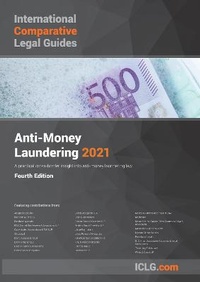
International Comparative Legal Guide - Anti-Money Laundering 2021
4th Edition
Published on 25. May 2021
Book
Paperback/Softback
252 pages
978-1-83918-117-7 (ISBN)
Description
It is hard to believe that this is already the fourth annual edition of ICLG - Anti-Money Laundering. As always, we hope that you will find the new edition useful and informative.
We hope that you and your family, friends, and colleagues have weathered the storm of the last year. When we wrote to you at this time last year, we never would have imagined that we would all still be dealing with the impact of the pandemic a year later. With COVID vaccines growing in supply in all our countries, the future is looking much brighter.
As predicted last year, the pandemic has brought out the best in many people and the worst in others. COVID-related fraud and cybercrime have skyrocketed, while other types of financial crime persist and sustain a wide range of criminal activity from drug trafficking, terrorism, fraud and human trafficking to illegal trafficking in antiquities and wildlife, and nuclear proliferation. The creativity of bad actors seems often limitless. At the same time, the financial crime functions of financial institutions by and large have shown impressive resilience in rising to the challenge, all while working remotely.
We have seen the importance of the AML, anti-fraud, and computer security functions at financial institutions working seamlessly together. Going forward, as many financial institutions face cost cutting, this coordination, efficiency in AML compliance, and proactive communication with government authorities has never been more important. Failure to sustain effective and efficient risk-based programs can have serious legal and reputational consequences for financial institutions and other businesses and their employees and immeasurable costs for the safety and well-being of society.
This was another active year for AML enforcement, legislation, and compliance efforts. There have been a number of high-profile money laundering prosecutions, investigations, and administrative enforcement actions. The FATF and governments around the world continue to deal with how best to apply AML controls to the digital currency industry and how best to apply the risk-based approach throughout the financial industry.
In the United States, the focus has been on the modernization of the AML regulatory regime, including how to apply the technology of today to AML compliance and how better to promote the public and private exchange of information. There is a growing consensus among financial institutions, law enforcement, regulatory authorities, and the U.S. Congress that the old approaches fall short in addressing today's money laundering methods. There also is common resolve that we can do better in preventing and detecting financial crime.
On January 1, 2021, comprehensive AML legislation known as the AML Act of 2020 became law. The AML Act of 2020 supports AML modernization efforts and increases AML enforcement authority. In addition, it calls for a national corporate registry with beneficial ownership information consistent with FATF's recommendation that law enforcement have access to current beneficial ownership information for legal entities. There is optimism that, as other countries take comparable measures, there finally will be progress against money laundering through anonymous shell corporations and similar legal structures.
Gibson, Dunn & Crutcher LLP is honored to join a group of distinguished colleagues to present several chapters on AML topics that we hope you will find of interest. Global Legal Group also has included chapters written by select law firms in 29 countries discussing local AML legal, regulatory, and enforcement requirements. Gibson Dunn is pleased to present the chapter on the United States AML regime and a chapter on the AML Act of 2020's national corporate registry requirement.
As with all ICLG guides, this guide is organized to help the reader understand the AML landscape globally and in specific countries. Global Legal Group, the editors, and the contributors intend this guide to be a reliable first source when approaching AML requirements and considerations. We encourage you to reach out to the contributors if we can be of further assistance.
We hope that you and your family, friends, and colleagues have weathered the storm of the last year. When we wrote to you at this time last year, we never would have imagined that we would all still be dealing with the impact of the pandemic a year later. With COVID vaccines growing in supply in all our countries, the future is looking much brighter.
As predicted last year, the pandemic has brought out the best in many people and the worst in others. COVID-related fraud and cybercrime have skyrocketed, while other types of financial crime persist and sustain a wide range of criminal activity from drug trafficking, terrorism, fraud and human trafficking to illegal trafficking in antiquities and wildlife, and nuclear proliferation. The creativity of bad actors seems often limitless. At the same time, the financial crime functions of financial institutions by and large have shown impressive resilience in rising to the challenge, all while working remotely.
We have seen the importance of the AML, anti-fraud, and computer security functions at financial institutions working seamlessly together. Going forward, as many financial institutions face cost cutting, this coordination, efficiency in AML compliance, and proactive communication with government authorities has never been more important. Failure to sustain effective and efficient risk-based programs can have serious legal and reputational consequences for financial institutions and other businesses and their employees and immeasurable costs for the safety and well-being of society.
This was another active year for AML enforcement, legislation, and compliance efforts. There have been a number of high-profile money laundering prosecutions, investigations, and administrative enforcement actions. The FATF and governments around the world continue to deal with how best to apply AML controls to the digital currency industry and how best to apply the risk-based approach throughout the financial industry.
In the United States, the focus has been on the modernization of the AML regulatory regime, including how to apply the technology of today to AML compliance and how better to promote the public and private exchange of information. There is a growing consensus among financial institutions, law enforcement, regulatory authorities, and the U.S. Congress that the old approaches fall short in addressing today's money laundering methods. There also is common resolve that we can do better in preventing and detecting financial crime.
On January 1, 2021, comprehensive AML legislation known as the AML Act of 2020 became law. The AML Act of 2020 supports AML modernization efforts and increases AML enforcement authority. In addition, it calls for a national corporate registry with beneficial ownership information consistent with FATF's recommendation that law enforcement have access to current beneficial ownership information for legal entities. There is optimism that, as other countries take comparable measures, there finally will be progress against money laundering through anonymous shell corporations and similar legal structures.
Gibson, Dunn & Crutcher LLP is honored to join a group of distinguished colleagues to present several chapters on AML topics that we hope you will find of interest. Global Legal Group also has included chapters written by select law firms in 29 countries discussing local AML legal, regulatory, and enforcement requirements. Gibson Dunn is pleased to present the chapter on the United States AML regime and a chapter on the AML Act of 2020's national corporate registry requirement.
As with all ICLG guides, this guide is organized to help the reader understand the AML landscape globally and in specific countries. Global Legal Group, the editors, and the contributors intend this guide to be a reliable first source when approaching AML requirements and considerations. We encourage you to reach out to the contributors if we can be of further assistance.
More details
Series
Edition
4th Revised edition
Language
English
Place of publication
London
United Kingdom
Target group
Professional and scholarly
Edition type
Revised edition
Dimensions
Height: 297 mm
Width: 210 mm
Thickness: 95 mm
ISBN-13
978-1-83918-117-7 (9781839181177)
Copyright in bibliographic data and cover images is held by Nielsen Book Services Limited or by the publishers or by their respective licensors: all rights reserved.
Schweitzer Classification
Other editions
New editions
Stephanie Brooker | Joel Cohen
International Comparative Legal Guide - Anti-Money Laundering 2022
Book
05/2022
5th Edition
Global Legal Group Ltd
€438.97
Article exhausted; check for reprint
Previous edition
Joel M. Cohen | Stephanie L. Brooker
International Comparative Legal Guide 2020: International Comparative Legal Guide - Anti-Money Laundering 3
Anti-Money Laundering
Book
05/2020
3rd Edition
Global Legal Group Ltd
€438.97
Article exhausted; check for reprint
Content
Expert Analysis Chapters 1 The Anti-Money Laundering Act of 2020's Corporate Transparency Act Stephanie L. Brooker & M. Kendall Day, Gibson, Dunn & Crutcher LLP 8 Anti-Money Laundering and Cryptocurrency: Legislative Reform and Enforcement Kevin Roberts, Duncan Grieve, Shruti Chandhok & Charlotte Glaser, Cadwalader, Wickersham & Taft LLP 14 EU Legislation in the Area of AML: Historical Perspective and Quo Vadis Stefaan Loosveld, Linklaters LLP 21 Anti-Money Laundering in the Asia-Pacific Region: An Overview of the International Law Enforcement and Regulatory Frameworks Dennis Miralis & Phillip Gibson, Nyman Gibson Miralis Q&A Chapters 33 Australia King & Wood Mallesons: Kate Jackson-Maynes 41 Belgium Linklaters LLP: Xavier Taton & Sacha Vanderveken 48 Brazil Joyce Roysen Advogados: Joyce Roysen & Veridiana Vianna 56 China King & Wood Mallesons: Stanley Zhou, Yu Leimin, Wang Rong & Liang Yixuan 63 Colombia Fabio Humar Abogados: Fabio Humar 70 France Bonifassi Avocats: Stephane Bonifassi 80 Germany Herbert Smith Freehills LLP: Dr. Dirk Seiler & Enno Appel 87 Greece Anagnostopoulos: Ilias G. Anagnostopoulos & Alexandros D. Tsagkalidis 95 Hong Kong King & Wood Mallesons: Urszula McCormack & Leonie Tear 102 Ireland Matheson: Joe Beashel & James O'Doherty 108 Isle of Man DQ Advocates Limited: Kathryn Sharman & Michael Nudd 115 Italy Portolano Cavallo: Ilaria Curti 121 Japan Nakasaki & Sato Law Firm: Ryu Nakasaki & Kei Nakamura 127 Korea Kobre & Kim LLP: Robin J. Baik & Daniel S. Lee Bae, Kim & Lee LLC: Jeena Kim & Daniel Joonwu Park 134 Liechtenstein Marxer & Partner Attorneys at Law: Laura NegeleVogt, Dr. Stefan Wenaweser & Dr. Sascha Brunner 142 Malta City Legal: Dr. Emma Grech & Dr. Christina M. Laudi 150 Mexico Galicia Abogados, S.C.: Humberto Perez-Rocha Ituarte & Luciano A. Jimenez Gomez Netherlands 158 JahaeRaymakers: Jurjan Geertsma & Madelon Stevens 166 Nigeria Threshing Fields Law: Frederick Festus Ntido 172 Pakistan S. U. Khan Associates Corporate & Legal Consultants: Saifullah Khan & Saeed Hasan Khan 179 Portugal Morais Leitao, Galvao Teles, Soares da Silva & Associados: Tiago Geraldo, Frederico Machado Simoes & Edgar da Silva Palma 186 Romania Enache Pirtea & Associates: Simona Pirtea & Madalin Enache 194 Singapore Drew & Napier LLC: Gary Low & Victor David Lau 201 Spain Geijo & Associates: Arantxa Geijo Jimenez & Elena Bescos Gracia 209 Switzerland Kellerhals Carrard: Dr. Omar Abo Youssef & Lea Ruckstuhl 218 United Arab Emirates BSA Ahmad Bin Hezeem & Associates LLP: Rima Mrad & Tala Azar 225 United Kingdom White & Case LLP: Jonah Anderson 234 USA Gibson, Dunn & Crutcher LLP: Joel M. Cohen & Linda Noonan