

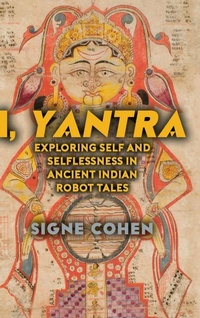
I, Yantra
Exploring Self and Selflessness in Ancient Indian Robot Tales
Published on 1. February 2024
Book
Hardback
296 pages
978-1-4384-9661-0 (ISBN)
Description
Argues that ancient yantra (robot) tales reveal how their Hindu, Buddhist, and Jain authors thought about the nature of humanity and our role in a cosmos filled with divine and natural forces.
Winner of the 2025 Award for Excellence in the Study of Religion: Textual Studies presented by the American Academy of Religion
What does it mean to be human? I, Yantra examines ancient Indian narratives about robots and mechanically constructed beings to explore how their Hindu, Jain, and Buddhist authors approached this question. Making translations of many of these texts available in English for the first time, author Signe Cohen argues that they shed considerable light on South Asian religious notions of humanity, self, and agency. She also documents connections between ancient and modern responses to the ethical problems of what precisely constitutes a sentient being and what rights such a being should have. Situated at the intersection of humanities and bioethics, this cross-disciplinary study will be of interest to scholars of South Asian languages and literature as well as specialists in religion and technology.
Winner of the 2025 Award for Excellence in the Study of Religion: Textual Studies presented by the American Academy of Religion
What does it mean to be human? I, Yantra examines ancient Indian narratives about robots and mechanically constructed beings to explore how their Hindu, Jain, and Buddhist authors approached this question. Making translations of many of these texts available in English for the first time, author Signe Cohen argues that they shed considerable light on South Asian religious notions of humanity, self, and agency. She also documents connections between ancient and modern responses to the ethical problems of what precisely constitutes a sentient being and what rights such a being should have. Situated at the intersection of humanities and bioethics, this cross-disciplinary study will be of interest to scholars of South Asian languages and literature as well as specialists in religion and technology.
Reviews / Votes
"Cohen's book reveals the fascinating story of androids and automata in ancient and medieval India through sources that are almost completely unknown today. Drawing connections between areas and times that most people consider unrelated, it presents a hidden history of the overlaps between the deep past and imagined futures, between religion and technology, and between Asian and Mediterranean civilizations." - Michael Slouber, Western Washington University"Cohen rightly points out the lacuna in current scholarship on the subject of androids in Indian literature. She also poses an enticing central research question: What does reading android stories in Indian literature tell us about South Asian conceptions of human personhood? This is a fascinating and novel approach to questions of humanness in South Asian religions." - Gregory M. Clines, Trinity University
More details
Language
English
Place of publication
Albany, NY
United States
Target group
Professional and scholarly
US School Grade: College Graduate Student and over
Illustrations
7 Figures
Dimensions
Height: 235 mm
Width: 157 mm
Thickness: 22 mm
Weight
634 gr
ISBN-13
978-1-4384-9661-0 (9781438496610)
Copyright in bibliographic data and cover images is held by Nielsen Book Services Limited or by the publishers or by their respective licensors: all rights reserved.
Schweitzer Classification
Other editions
Additional editions
E-Book
02/2024
1st Edition
De Gruyter
from
€84.99
Available for download
Person
Signe Cohen is Associate Professor of Religious Studies at the University of Missouri. She is the author of Textual Criticism and Sacred Texts and Text and Authority in the Older Upani?ads and the editor of The Upani?ads: A Complete Guide.