

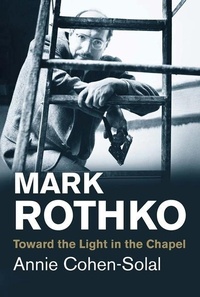
Mark Rothko
Toward the Light in the Chapel
Will be published approx. on 22. March 2016
Book
Paperback/Softback
296 pages
978-0-300-21968-5 (ISBN)
Description
A fascinating exploration of the life and work of one of America's most famous and enigmatic postwar visual artists
Mark Rothko, one of the greatest painters of the twentieth century, was born in the Jewish Pale of Settlement in 1903. He immigrated to the United States at age ten, taking with him his Talmudic education and his memories of pogroms and persecutions in Russia. His integration into American society began with a series of painful experiences, especially as a student at Yale, where he felt marginalized for his origins and ultimately left the school. The decision to become an artist led him to a new phase in his life. Early in his career, Annie Cohen-Solal writes, "he became a major player in the social struggle of American artists, and his own metamorphosis benefited from the unique transformation of the U.S. art world during this time." Within a few decades, he had forged his definitive artistic signature, and most critics hailed him as a pioneer. The numerous museum shows that followed in major U.S. and European institutions ensured his celebrity. But this was not enough for Rothko, who continued to innovate. Ever faithful to his habit of confronting the establishment, he devoted the last decade of his life to cultivating his new conception of art as an experience, thanks to the commission of a radical project, the Rothko Chapel in Houston, Texas.
Cohen-Solal's fascinating biography, based on considerable archival research, tells the unlikely story of how a young immigrant from Dvinsk became a crucial transforming agent of the art world-one whose legacy prevails to this day.
Mark Rothko, one of the greatest painters of the twentieth century, was born in the Jewish Pale of Settlement in 1903. He immigrated to the United States at age ten, taking with him his Talmudic education and his memories of pogroms and persecutions in Russia. His integration into American society began with a series of painful experiences, especially as a student at Yale, where he felt marginalized for his origins and ultimately left the school. The decision to become an artist led him to a new phase in his life. Early in his career, Annie Cohen-Solal writes, "he became a major player in the social struggle of American artists, and his own metamorphosis benefited from the unique transformation of the U.S. art world during this time." Within a few decades, he had forged his definitive artistic signature, and most critics hailed him as a pioneer. The numerous museum shows that followed in major U.S. and European institutions ensured his celebrity. But this was not enough for Rothko, who continued to innovate. Ever faithful to his habit of confronting the establishment, he devoted the last decade of his life to cultivating his new conception of art as an experience, thanks to the commission of a radical project, the Rothko Chapel in Houston, Texas.
Cohen-Solal's fascinating biography, based on considerable archival research, tells the unlikely story of how a young immigrant from Dvinsk became a crucial transforming agent of the art world-one whose legacy prevails to this day.
More details
Series
Language
English
Place of publication
United States
Product notice
Paperback (trade)
Illustrations
17 b-w + 16 color illus.
Dimensions
Height: 208 mm
Width: 139 mm
Thickness: 22 mm
Weight
354 gr
ISBN-13
978-0-300-21968-5 (9780300219685)
Copyright in bibliographic data and cover images is held by Nielsen Book Services Limited or by the publishers or by their respective licensors: all rights reserved.
Schweitzer Classification
Person
Annie Cohen-Solal's books include Sartre: A Life (a best-seller translated into sixteen languages), Painting American (Academie des Beaux arts Prize), and Leo & His Circle: The Life of Leo Castelli (ArtCurial Prize).