

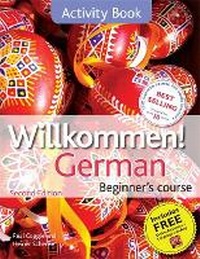
Willkommen! German Beginner's Course 2ED Revised
Activity Book
2nd Edition
Published on 27. April 2012
Book
Paperback/Softback
160 pages
978-1-4441-6518-0 (ISBN)
Description
Whether you are using the Willkommen! course in class or working through it on your own, this work book is for you. In 12 units, divided into three sections covering the general topics of First Contacts, Shopping and Going Out, Life in Germany, it provides:
* further practice on particular areas of difficulty
* varied activities to help you progress further with vocabulary, grammar, reading and writing
* additional, more demanding material for fast learners
* extended practice tasks which can be done in class or outside the classroom.
There is also a Key to the Exercises making the book suitable for self-checking.
* further practice on particular areas of difficulty
* varied activities to help you progress further with vocabulary, grammar, reading and writing
* additional, more demanding material for fast learners
* extended practice tasks which can be done in class or outside the classroom.
There is also a Key to the Exercises making the book suitable for self-checking.
More details
Edition
2nd edition
Language
English
Place of publication
United Kingdom
Publishing group
John Murray Press
Illustrations
30 black and white line
Dimensions
Height: 244 mm
Width: 188 mm
Thickness: 10 mm
Weight
360 gr
ISBN-13
978-1-4441-6518-0 (9781444165180)
Copyright in bibliographic data and cover images is held by Nielsen Book Services Limited or by the publishers or by their respective licensors: all rights reserved.
Schweitzer Classification
Other editions
New editions
Heiner Schenke | Paul Coggle | Paul Coggle Esq
Willkommen! 1 (Third edition) German Beginner's course
Coursebook
Book
06/2018
3rd Edition
John Murray Languages
€29.00
Available immediately
Persons
Paul Coggle is an experienced university teacher of German, who has taught courses from beginner to postgraduate level. He was a pioneer in the development and use of multimedia language learning materials at the University of Kent, and has acted as a Language Consultant for the BBC and the University of Cambridge Language Centre. He is series editor for the Teach Yourself language courses.
Heiner Schenke was born in Hannover and is a native speaker of German. He has taught German at university level for many years and is Director of the Institution-wide language programme at the University of Westminster.
Heiner Schenke was born in Hannover and is a native speaker of German. He has taught German at university level for many years and is Director of the Institution-wide language programme at the University of Westminster.
Content
: ERSTE KONTAKTE
: 1 Guten Tag
: Greetings and farewells. Saying who you are. Saying where you come from and where you live. Numbers 0-10. Alphabet.
: 2 Sprechen Sie Deutsch?
: Saying how you are. Talking about nationality and languages. Talking about personal details. Numbers 11-100.
: 3 Arbeit und Studium
: Towns and cities. Jobs and professions. Work and study. Numbers 101 upwards.
: 4 Familie und Freizeit
: Activities. Leisure pursuits. Stating likes and dislikes. Family relationships.
: EINKAUFEN
: 5 Essen und Einkaufen
: Asking the way. Ordering food and drink. Shopping: asking / giving prices. Saying how often you do things.
: 6 Uhrzeiten und Verabredungen
: Booking a hotel room. Telling the time. Talking about daily routines. Making appointments.
: IN DER STADT
: 7 Alltag in der Stadt
: Buying consumer goods. Talking about daily routines and work (cont.). Travelling around town.
: 8 Was haben Sie gemacht?
: Saying what happened at the weekend. Talking about recent events. Talking about the more distant past. Describing purchases.
: 9 Ich wohne lieber in der Stadt
: Saying where people live and what their homes are like. Making comparisons. Discussing the pros and cons of city vs. country life. Describing price and location of hotels.
: LEBEN IN DEUTSCHLAND
: 10 Ist Mode wichtig fuer Sie?
: Describing items of personal appearance. Saying what clothes you like wearing. Discussing appropriate clothes and gifts. Offering help and advice.
: 11 Urlaub, Wetter und Gesundheit
: Talking about past holidays. Reporting weather conditions. Discussing health. Reporting on aches and pains.
: 12 Das Leben in Deutschland
: Telephoning. Writing a CV. Talking about German-speaking countries. Expressing opinions on the German language.
: 1 Guten Tag
: Greetings and farewells. Saying who you are. Saying where you come from and where you live. Numbers 0-10. Alphabet.
: 2 Sprechen Sie Deutsch?
: Saying how you are. Talking about nationality and languages. Talking about personal details. Numbers 11-100.
: 3 Arbeit und Studium
: Towns and cities. Jobs and professions. Work and study. Numbers 101 upwards.
: 4 Familie und Freizeit
: Activities. Leisure pursuits. Stating likes and dislikes. Family relationships.
: EINKAUFEN
: 5 Essen und Einkaufen
: Asking the way. Ordering food and drink. Shopping: asking / giving prices. Saying how often you do things.
: 6 Uhrzeiten und Verabredungen
: Booking a hotel room. Telling the time. Talking about daily routines. Making appointments.
: IN DER STADT
: 7 Alltag in der Stadt
: Buying consumer goods. Talking about daily routines and work (cont.). Travelling around town.
: 8 Was haben Sie gemacht?
: Saying what happened at the weekend. Talking about recent events. Talking about the more distant past. Describing purchases.
: 9 Ich wohne lieber in der Stadt
: Saying where people live and what their homes are like. Making comparisons. Discussing the pros and cons of city vs. country life. Describing price and location of hotels.
: LEBEN IN DEUTSCHLAND
: 10 Ist Mode wichtig fuer Sie?
: Describing items of personal appearance. Saying what clothes you like wearing. Discussing appropriate clothes and gifts. Offering help and advice.
: 11 Urlaub, Wetter und Gesundheit
: Talking about past holidays. Reporting weather conditions. Discussing health. Reporting on aches and pains.
: 12 Das Leben in Deutschland
: Telephoning. Writing a CV. Talking about German-speaking countries. Expressing opinions on the German language.