

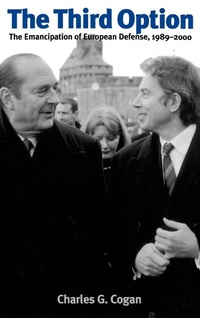
The Third Option
The Emancipation of European Defense, 1989 - 2000
Published on 30. September 2001
Book
Hardback
200 pages
978-0-275-96948-6 (ISBN)
Description
It was logical to expect that the European Economic and Monetary Union would lead ineluctably to an autonomous European defense; the very size of the European Union seems to demand it. The EU eventually will reach the point where its economic and demographic weight will far exceed that of the United States. Can it not be expected too that the EU will seek to make this weight felt internationally? Cogan tracks the halting creation of an independent European military structure, a third way between national armies and ATO, since the Iron Curtain's fall.
With the Cold War's end and subsequent western engagements in Central and Eastern Europe, it is no longer a question of whether NATO and the EU compare; they now must relate. They have to coordinate their planning and force postures so as to avoid duplication of resources and efforts. Although NATO's integrated command structure theoretically was an anomaly with the end of the Cold War, it nevertheless turned out to be the case in Bosnia, and later Kosovo, that nothing was possible until the Americans intervened. The virtue of integrated command -- American participation and know-how -- was once again seen as crucially important, despite the increasingly anachronistic deficit of sovereignty for Western Europe in defense matters. In the long run, Europe's economic power must be balanced by its military and diplomatic might.
With the Cold War's end and subsequent western engagements in Central and Eastern Europe, it is no longer a question of whether NATO and the EU compare; they now must relate. They have to coordinate their planning and force postures so as to avoid duplication of resources and efforts. Although NATO's integrated command structure theoretically was an anomaly with the end of the Cold War, it nevertheless turned out to be the case in Bosnia, and later Kosovo, that nothing was possible until the Americans intervened. The virtue of integrated command -- American participation and know-how -- was once again seen as crucially important, despite the increasingly anachronistic deficit of sovereignty for Western Europe in defense matters. In the long run, Europe's economic power must be balanced by its military and diplomatic might.
More details
Language
English
Place of publication
United States
Publishing group
Bloomsbury Publishing Plc
Target group
College/higher education
Professional and scholarly
Dimensions
Height: 235 mm
Width: 157 mm
Thickness: 15 mm
Weight
445 gr
ISBN-13
978-0-275-96948-6 (9780275969486)
Copyright in bibliographic data and cover images is held by Nielsen Book Services Limited or by the publishers or by their respective licensors: all rights reserved.
Schweitzer Classification
Other editions
Additional editions
E-Book
09/2001
1st Edition
Praeger Publishers Inc
€82.49
Available for download
Person
CHARLES G. COGAN is a Senior Research Associate at John F. Kennedy School of Government, Harvard University. Dr. Cogan is the author of Forced to Choose: France, the Atlantic Alliance, and NATO-Then and Now, and Oldest Allies, Guarded Friends: The United States and France Since 1940, both published by Praeger.
Content
Preface Introduction From the Fall of the Berlin Wall to the Change in the Nature of NATO (November 1989 - July 1990) From the Gulf War to the New Strategic Concept (July 1990 - December 1991) From the Bosnian War to France's Move Towards NATO (1992 - December 1995) From the AFSOUTH Imbroglio to the Madrid Summit (1996 - July 1997) The Turn Towards Autonomy (St. Malo to Kosovo to Cologne) The European Union Becomes a Defense Organization (July 1999 - December 2000) Epilogue Annex Bibliography Index