

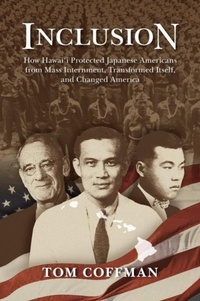
Inclusion
How Hawai'i Protected Japanese Americans from Mass Internment, Transformed Itself, and Changed America
Will be published approx. on 30. November 2021
Book
Paperback/Softback
384 pages
978-0-8248-8855-8 (ISBN)
Description
Following December 7, 1941, when the United States government interned 120,000 people of Japanese ancestry evicted from scattered settlements throughout the West Coast states, why was a much larger number concentrated in the Hawaiian Islands war zone not similarly incarcerated?
At the root of the story is an inclusive community that worked from the ground up to protect an embattled segment of its population. Where the onset of World War II surprised the American public, war with Japan arrived in Hawai'i in slow motion. Responding to numerous signs of impending conflict, a Council for Interracial Unity mapped two goals: Minimize internment and maximize inclusion in the war effort. The Council's aspirational work was expressed in a widely repeated saying: ""How we get along during the war will determine how we get along when the war is over."" The Army Command of Hawai'i, reassured by first-hand acquaintances, came to believe ""Trust breeds trust.""
Where most histories have shielded President Franklin D. Roosevelt from direct responsibility for the U.S. mainland internment, his relentless demands for a mass removal from Hawai'i-ultimately thwarted-reveal him as author and actor. In making sense of the disparity between Island and mainland, Inclusion unravels the deep history of the U.S. ""sabotage psychosis,"" dissecting why many continental Americans still believe Japan succeeded at Pearl Harbor because of the unseen hand of Japanese saboteurs. Contrary to the explanation of hysteria as the cause of the internment, Inclusion documents how a high-level plan of mass removal actually was pitched to Hawai'i prior to December 7, only to be rejected.
At the root of the story is an inclusive community that worked from the ground up to protect an embattled segment of its population. Where the onset of World War II surprised the American public, war with Japan arrived in Hawai'i in slow motion. Responding to numerous signs of impending conflict, a Council for Interracial Unity mapped two goals: Minimize internment and maximize inclusion in the war effort. The Council's aspirational work was expressed in a widely repeated saying: ""How we get along during the war will determine how we get along when the war is over."" The Army Command of Hawai'i, reassured by first-hand acquaintances, came to believe ""Trust breeds trust.""
Where most histories have shielded President Franklin D. Roosevelt from direct responsibility for the U.S. mainland internment, his relentless demands for a mass removal from Hawai'i-ultimately thwarted-reveal him as author and actor. In making sense of the disparity between Island and mainland, Inclusion unravels the deep history of the U.S. ""sabotage psychosis,"" dissecting why many continental Americans still believe Japan succeeded at Pearl Harbor because of the unseen hand of Japanese saboteurs. Contrary to the explanation of hysteria as the cause of the internment, Inclusion documents how a high-level plan of mass removal actually was pitched to Hawai'i prior to December 7, only to be rejected.
More details
Language
English
Place of publication
Honolulu, HI
United States
Target group
Professional and scholarly
Product notice
Paperback (trade)
Unsewn / adhesive bound
Illustrations
22 black & white illustrations
Dimensions
Height: 226 mm
Width: 152 mm
Thickness: 25 mm
Weight
635 gr
ISBN-13
978-0-8248-8855-8 (9780824888558)
Copyright in bibliographic data and cover images is held by Nielsen Book Services Limited or by the publishers or by their respective licensors: all rights reserved.
Schweitzer Classification
Person
Tom Coffman is a political reporter who evolved into writing books and directing historical documentaries. He is a three-time recipient of the Hawai'i Book Publishers Association's award for nonfiction writing, and for his cumulative work he received the Hawai'i Award for Literature.