

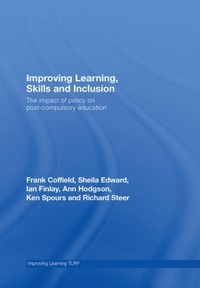
Improving Learning, Skills and Inclusion
The Impact of Policy on Post-Compulsory Education
1st Edition
Will be published approx. on 19. March 2008
Book
Hardback
248 pages
978-0-415-46180-1 (ISBN)
Description
How can opportunities for teaching and learning be improved to ensure that many more people participate, gain qualifications and obtain decent jobs? Will government policies enable us to achieve these goals? What new ideas do we need to ensure a more inclusive, equitable and efficient learning system? These are some of the main concerns which underlie this thought-provoking book coming from a major research project looking at how policies affect learners, tutors, managers and institutional leaders in Further Education Colleges, Adult and Community Learning centres and in Work Based Learning sites.
Post compulsory education in the UK has been constantly restructured by the New Labour government and has been subject to considerable policy turbulence over the last few years. This book attempts to understand this important but poorly understood sector by both talking to students and front-line staff and by interviewing the officials responsible for managing post-compulsory education and lifelong learning.
By examining the sector simultaneously from the 'bottom up' and from 'top down', the authors show how recent policy is affecting three disadvantaged groups - 16-19 year olds who have fared poorly in official tests at school; unemployed adults learning basic skills; and employees at work learning basic skills. The authors conclude that there are serious failings and suggest principles and features of a more equitable and effective learning system.
Post compulsory education in the UK has been constantly restructured by the New Labour government and has been subject to considerable policy turbulence over the last few years. This book attempts to understand this important but poorly understood sector by both talking to students and front-line staff and by interviewing the officials responsible for managing post-compulsory education and lifelong learning.
By examining the sector simultaneously from the 'bottom up' and from 'top down', the authors show how recent policy is affecting three disadvantaged groups - 16-19 year olds who have fared poorly in official tests at school; unemployed adults learning basic skills; and employees at work learning basic skills. The authors conclude that there are serious failings and suggest principles and features of a more equitable and effective learning system.
More details
Series
Language
English
Place of publication
London
United Kingdom
Publishing group
Taylor & Francis Ltd
Target group
College/higher education
Illustrations
39 s/w Tabellen
39 Tables, black and white
Dimensions
Height: 216 mm
Width: 138 mm
Weight
408 gr
ISBN-13
978-0-415-46180-1 (9780415461801)
Copyright in bibliographic data and cover images is held by Nielsen Book Services Limited or by the publishers or by their respective licensors: all rights reserved.
Schweitzer Classification
Other editions
Additional editions
Frank Coffield | Sheila Edward | Ian Finlay
Improving Learning, Skills and Inclusion
The Impact of Policy on Post-Compulsory Education
Book
03/2008
1st Edition
Routledge
€69.00
Shipment within 15-20 days
Frank Coffield | Sheila Edward | Ian Finlay
Improving Learning, Skills and Inclusion
The Impact of Policy on Post-Compulsory Education
E-Book
03/2008
Routledge
€62.99
Available for download
Frank Coffield | Sheila Edward | Ian Finlay
Improving Learning, Skills and Inclusion
The Impact of Policy on Post-Compulsory Education
E-Book
03/2008
Routledge
€62.99
Available for download
Persons
Frank Coffield is Professor at the Schoolo of Lifelong Education & International Development at the Institute of Education where Dr Ann Hodgson and Dr Ken Spours are also based. Dr Ian Finlay is at the University of Strathclyde.
Content
Section 1: What are the issues? 1. The main themes 2. The context and rationale of the research and the book Section 2: What does the research show? 3. The learners' story 4. The policy-makers' stories 5. The tutors' stories 6. The story of the sector in action 7 . How inclusive is the sector? Section 3: Overall implications 8. Alternative futures Methodological appendix: How we developed the stories