

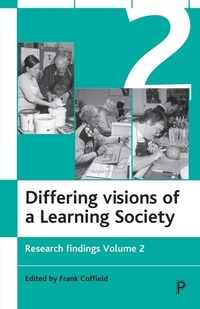
Differing visions of a Learning Society Vol 2
Research findings Volume 2
1st Edition
Will be published approx. on 6. November 2000
Book
Paperback/Softback
244 pages
978-1-86134-247-8 (ISBN)
Description
Is lifelong learning the big idea which will deliver economic prosperity and social justice? Or will it prove to be another transient phenomenon? Picture lifelong learning, the editor suggests, as making its way through three overlapping stages - romance, evidence and implementation. Lifelong learning is tentatively entering the second stage, where research evidence is beginning to challenge the vacuous rhetoric of the stage of romance.
The findings from the Economic and Social Research Council's programme of research into the Learning Society are presented in two volumes, of which this is the second. The editor, Frank Coffield, begins by surveying as a whole the findings of the 14 projects, and summarises them in a number of recurrent themes and policy recommendations. The chapters which follow present the aims, methods, findings and policy implications of six projects. Volume 1 contains similar chapters on the other projects. Taken together, the conclusions suggest very different ways of thinking about a Learning Society and very different policies from those in operation at present. The two volumes demonstrate from empirical evidence the continuing weaknesses of current policies and make proposals, based on hard evidence, for more effective structural changes.
This second volume presents findings from a national survey of the skills of British workers, and it discusses both the meaning of the Learning Society for adults with learning difficulties, and the use of social capital to explain patterns of lifelong learning. Other chapters present for the first time five different 'trajectories' of lifelong learning, explore the determinants of participation and non-participation in learning, and examine innovation in Higher Education.
Finally, two differing visions of a Learning Society are contrasted. The first extrapolates existing policies and practices into the next 5-10 years and finds them seriously wanting. The second option calls for more democracy rather than technocracy and develops a kaleidoscopic array of possible futures which find their source in the empirical work of the 14 projects. These volumes are essential reading for politicians, policy makers, practitioners, employers, and all teachers with responsibility for lifelong learning.
The findings from the Economic and Social Research Council's programme of research into the Learning Society are presented in two volumes, of which this is the second. The editor, Frank Coffield, begins by surveying as a whole the findings of the 14 projects, and summarises them in a number of recurrent themes and policy recommendations. The chapters which follow present the aims, methods, findings and policy implications of six projects. Volume 1 contains similar chapters on the other projects. Taken together, the conclusions suggest very different ways of thinking about a Learning Society and very different policies from those in operation at present. The two volumes demonstrate from empirical evidence the continuing weaknesses of current policies and make proposals, based on hard evidence, for more effective structural changes.
This second volume presents findings from a national survey of the skills of British workers, and it discusses both the meaning of the Learning Society for adults with learning difficulties, and the use of social capital to explain patterns of lifelong learning. Other chapters present for the first time five different 'trajectories' of lifelong learning, explore the determinants of participation and non-participation in learning, and examine innovation in Higher Education.
Finally, two differing visions of a Learning Society are contrasted. The first extrapolates existing policies and practices into the next 5-10 years and finds them seriously wanting. The second option calls for more democracy rather than technocracy and develops a kaleidoscopic array of possible futures which find their source in the empirical work of the 14 projects. These volumes are essential reading for politicians, policy makers, practitioners, employers, and all teachers with responsibility for lifelong learning.
Reviews / Votes
Volumes 1& 2 are "timely, important and definatly to be recommended". They are "invaluable reading for anyone with an interest in current educational and economic policy-making and the enduring social problems that policy-makers will continue to face long after the notion of the 'learning society' has faded from collective memory." British Educational Research Journal "... should be read by all social scientists as they show how a research programme can produce a body of knowledge which has clarified and extended our understanding of what are very common yet at the same time contested debates around lifelong learning and a learning society". Network "Volumes 1 & 2 are a most valuable resource, both for those who are already specialists in the field, as well as for a much wider readership." British Journal of Educational Studies"An Impressive, informative and substantial volume: highly recommended." Learning and Skills Research "An impressive, informative and substantial volume: highly recommended." Learning and Skills Research Journal "This book deserves a wide readership, for it provides compelling evidence about the immense challenges which the UK faces in its attempt to become a Learning Society."
More details
Series
Edition
First Edition
Language
English
Place of publication
Bristol
United Kingdom
Target group
College/higher education
Professional and scholarly
Dimensions
Height: 216 mm
Width: 140 mm
Thickness: 13 mm
Weight
315 gr
ISBN-13
978-1-86134-247-8 (9781861342478)
Copyright in bibliographic data and cover images is held by Nielsen Book Services Limited or by the publishers or by their respective licensors: all rights reserved.
Schweitzer Classification
Other editions
Additional editions

Coffield | Frank Coffield
Research Findings: Differing Visions of a Learning Society v.2
Book
11/2000
Policy Press
€91.79
Article exhausted; check different version
E-Book
11/2000
1st Edition
Policy Press
€116.09
Available for download
Person
Frank Coffield was Director of the ESRC's research programme into The Learning Society from 1994 to 2000.
Content
Contents: Introduction: The three stages of lifelong learning: romance, evidence and implementation Frank Coffield; The meaning of the Learning Society for adults with learning difficulties: bold rhetoric and limited opportunities Sheila Riddell, Stephen Baron and Alastair Wilson; Networks, norms and trust: explaining patterns of lifelong learning in Scotland and Northern Ireland John Field and Tom Schuller; Learning culture, learning age, learning society: turning aspirations into reality? Pat Davies and John Bynner; Teaching and learning in higher education: issues of motivation Andrew Hannan, Harold Silver and Susan English; Participating in the Learning Society: history, place and biography Gareth Rees, Stephen Gorard, Ralph Fevre and John Furlong; Skills in the British workplace David Ashton, Alan Felstead and Francis Green.