

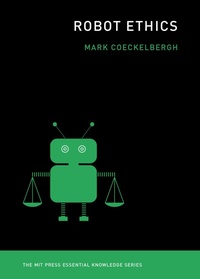
Robot Ethics
Published on 6. September 2022
Book
Paperback/Softback
272 pages
978-0-262-54409-2 (ISBN)
Description
A guide to the ethical questions that arise from our use of industrial robots, robot companions, self-driving cars, and other robotic devices.
Does a robot have moral agency? Can it be held responsible for its actions? Do humans owe robots anything? Will robots take our jobs? These are some of the ethical and moral quandaries that we should address now, as robots and other intelligent devices become more widely used and more technically sophisticated. In this volume in the MIT Press Essential Knowledge series, philosopher Mark Coeckelbergh does just that. He considers a variety of robotics technologies and applications-from robotic companions to military drones-and identifies the ethical implications of their use. Questions of robot ethics, he argues, are not just about robots but, crucially and importantly, are about humans as well.
Coeckelbergh examines industrial robots and their potential to take over tasks from humans; "social" robots and possible risks to privacy; and robots in health care and their effect on quality of care. He considers whether a machine can be moral, or have morality built in; how we ascribe moral status; and if machines should be allowed to make decisions about life and death. When we discuss robot ethics from a philosophical angle, Coeckelbergh argues, robots can function as mirrors for reflecting on the human. Robot ethics is more than applied ethics; it is a way of doing philosophy.
Does a robot have moral agency? Can it be held responsible for its actions? Do humans owe robots anything? Will robots take our jobs? These are some of the ethical and moral quandaries that we should address now, as robots and other intelligent devices become more widely used and more technically sophisticated. In this volume in the MIT Press Essential Knowledge series, philosopher Mark Coeckelbergh does just that. He considers a variety of robotics technologies and applications-from robotic companions to military drones-and identifies the ethical implications of their use. Questions of robot ethics, he argues, are not just about robots but, crucially and importantly, are about humans as well.
Coeckelbergh examines industrial robots and their potential to take over tasks from humans; "social" robots and possible risks to privacy; and robots in health care and their effect on quality of care. He considers whether a machine can be moral, or have morality built in; how we ascribe moral status; and if machines should be allowed to make decisions about life and death. When we discuss robot ethics from a philosophical angle, Coeckelbergh argues, robots can function as mirrors for reflecting on the human. Robot ethics is more than applied ethics; it is a way of doing philosophy.
More details
Series
Language
English
Place of publication
Cambridge (Massachusetts)
United States
Publishing group
MIT Press Ltd
Illustrations
7
Dimensions
Height: 177 mm
Width: 130 mm
Thickness: 20 mm
Weight
240 gr
ISBN-13
978-0-262-54409-2 (9780262544092)
Copyright in bibliographic data and cover images is held by Nielsen Book Services Limited or by the publishers or by their respective licensors: all rights reserved.
Schweitzer Classification
Other editions
Additional editions
Person
Mark Coeckelbergh is Professor of Philosophy of Media and Technology at the University of Vienna. He is the author of New Romantic Cyborgs: Romanticism, Information Technology, and the End of the Machine, AI Ethics (both published by the MIT Press), Introduction to Philosophy of Technology, and other books.
Content
Series Foreword vii
1 Introduction: What Is Robot Ethics About? 1
2 Industrial Robots, Safety, and the Future of Work 27
3 Robotic Home Companions, Privacy, and Deception 53
4 Care Robots, Expertise, and the Quality of Health Care 81
5 Self-Driving Cars, Moral Agency, and Responsibility 107
6 Uncanny Androids, Appearance, and Moral Patiency 135
7 Killer Drones, Distance, and Human Existence 163
8 Robotic Mirrors beyond the Human: Robot Ethics as an Environmental Ethics 191
Acknowledgments 215
Glossary 217
Notes 223
1 Introduction: What Is Robot Ethics About? 1
2 Industrial Robots, Safety, and the Future of Work 27
3 Robotic Home Companions, Privacy, and Deception 53
4 Care Robots, Expertise, and the Quality of Health Care 81
5 Self-Driving Cars, Moral Agency, and Responsibility 107
6 Uncanny Androids, Appearance, and Moral Patiency 135
7 Killer Drones, Distance, and Human Existence 163
8 Robotic Mirrors beyond the Human: Robot Ethics as an Environmental Ethics 191
Acknowledgments 215
Glossary 217
Notes 223