

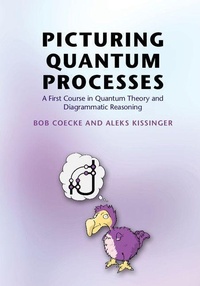
Picturing Quantum Processes
A First Course in Quantum Theory and Diagrammatic Reasoning
Published on 16. March 2017
Book
Hardback
844 pages
978-1-107-10422-8 (ISBN)
Description
The unique features of the quantum world are explained in this book through the language of diagrams, setting out an innovative visual method for presenting complex theories. Requiring only basic mathematical literacy, this book employs a unique formalism that builds an intuitive understanding of quantum features while eliminating the need for complex calculations. This entirely diagrammatic presentation of quantum theory represents the culmination of ten years of research, uniting classical techniques in linear algebra and Hilbert spaces with cutting-edge developments in quantum computation and foundations. Written in an entertaining and user-friendly style and including more than one hundred exercises, this book is an ideal first course in quantum theory, foundations, and computation for students from undergraduate to PhD level, as well as an opportunity for researchers from a broad range of fields, from physics to biology, linguistics, and cognitive science, to discover a new set of tools for studying processes and interaction.
Reviews / Votes
'Picturing Quantum Processes is a lively and refreshing romp through the authors diagrammatic and categorical approach to quantum processes. I recommend this book with no lower age limit required!' Louis Kauffman, University of Illinois 'This book develops from scratch the category theoretic, and diagrammatic, language for quantum theory, especially quantum processes. It is a remarkable achievement: vigorous, crystal-clear, complete - and a delight to read.' Jeremy Butterfield, University of Cambridge 'The book employs a unique formalism developed by the authors, which allows a more intuitive understanding of quantum features and eliminates complex calculations. As a result, knowledge of advanced mathematics is not required. ... An informal and entertaining style is adopted, which makes this book easily approachable by students at their first encounter with quantum theory. That said, it will probably appeal more to Ph.D. students and researchers who are already familiar with the subject and are interested in looking at different treatment of this matter. The text is also accompanied by a rich set of exercises.' CERN CourierMore details
Language
English
Place of publication
Cambridge
United Kingdom
Target group
Professional and scholarly
Illustrations
Worked examples or Exercises; 243 Halftones, black and white
Dimensions
Height: 250 mm
Width: 175 mm
Thickness: 49 mm
Weight
1610 gr
ISBN-13
978-1-107-10422-8 (9781107104228)
Copyright in bibliographic data and cover images is held by Nielsen Book Services Limited or by the publishers or by their respective licensors: all rights reserved.
Schweitzer Classification
Other editions
Additional editions
E-Book
03/2017
Cambridge University Press
€71.49
Available for download
Bob Coecke | Aleks Kissinger
Picturing Quantum Processes
A First Course in Quantum Theory and Diagrammatic Reasoning
E-Book
03/2017
Cambridge University Press
€84.49
Available for download
Persons
Bob Coecke is Professor of Quantum Foundations, Logic and Structures at the University of Oxford, where he also heads the multi-disciplinary Quantum Group. His pioneering research stretches from categorical quantum mechanics to the compositional structure of natural language meaning, and recent interests include causality and cognitive architecture. Aleks Kissinger is an Assistant Professor of Quantum Structures and Logic at Radboud University. His research focuses on diagrammatic language, rewrite theory, category theory, and applications to quantum computation and the foundations of physics.
Content
Preface; 1. Introduction; 2. Guide to reading this textbook; 3. Processes as diagrams; 4. String diagrams; 5. Hilbert space from diagrams; 6. Quantum processes; 7. Quantum measurement; 8. Picturing classical-quantum processes; 9. Picturing phases and complementarity; 10. Quantum theory: the full picture; 11. Quantum foundations; 12. Quantum computation; 13. Quantum resources; 14. Quantomatic; Appendix A. Some notations; References; Index.