

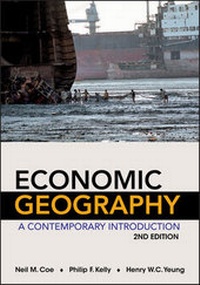
Economic Geography
A Contemporary Introduction
2nd Edition
Published on 13. August 2013
Book
Paperback/Softback
576 pages
978-0-470-94338-0 (ISBN)
Description
Economic Geography: A Contemporary Introduction, 2nd Edition tackles major questions of economic life, from the activities of transnational corporations and states, to places of work and consumption. In accessible but sophisticated terms, this book invites students to explore how geographies (location, territory, place and scale) shape both large-scale economic processes and our lived experiences. Throughout this comprehensive text, the authors present contemporary insights from the field of Economic Geography, drawing on examples from across the globe. As students engage with this readable account of the field, they will come away with an understanding of how economic processes are rooted in social, cultural and political realities.
More details
Other editions
New editions
Book
12/2019
3rd Edition
Wiley-Blackwell
€45.00
Shipment within 15-20 days
Previous edition
Book
05/2007
Wiley
€30.94
Article exhausted; check for reprint
Persons
Neil M. Coe is Professor of Economic Geography at the National University of Singapore.
Philip F. Kelly is Professor of Geography at York University, Canada.
Henry W.C. Yeung is Professor of Economic Geography at the National University of Singapore.
Philip F. Kelly is Professor of Geography at York University, Canada.
Henry W.C. Yeung is Professor of Economic Geography at the National University of Singapore.
Content
PART ONE: CONCEPTUAL FOUNDATIONS
1. Thinking geographically
2. The economy: what does it mean?
3. Capitalism in motion: why is economic growth so uneven?
PART TWO: MAKING THE (SPATIAL) ECONOMY
4. The state: who runs the economy?
5. Environment/economy: can nature be a commodity?
6. Labour power: can workers shape economic geographies?
7. Making money: why has finance become so powerful?
PART THREE: ORGANIZING ECONOMIC SPACE
8. Commodity chains: where does your breakfast come from?
9. Technological change: is the world getting smaller?
10. The transnational corporation: how does the global firm keep it all together?
11. Spaces of sale: how and where do we shop?
PART FOUR: PEOPLE, IDENTITIES, AND ECONOMIC LIFE
12. Clusters: why do proximity and place matter?
13. Gendered economies: does gender shape economic lives?
14. Ethnic economies: do cultures have economies?
15. Consumption: you are what you buy?
PART FIVE: CONCLUSION
16. Economic Geography: Intellectual Journeys and Future Horizons
1. Thinking geographically
2. The economy: what does it mean?
3. Capitalism in motion: why is economic growth so uneven?
PART TWO: MAKING THE (SPATIAL) ECONOMY
4. The state: who runs the economy?
5. Environment/economy: can nature be a commodity?
6. Labour power: can workers shape economic geographies?
7. Making money: why has finance become so powerful?
PART THREE: ORGANIZING ECONOMIC SPACE
8. Commodity chains: where does your breakfast come from?
9. Technological change: is the world getting smaller?
10. The transnational corporation: how does the global firm keep it all together?
11. Spaces of sale: how and where do we shop?
PART FOUR: PEOPLE, IDENTITIES, AND ECONOMIC LIFE
12. Clusters: why do proximity and place matter?
13. Gendered economies: does gender shape economic lives?
14. Ethnic economies: do cultures have economies?
15. Consumption: you are what you buy?
PART FIVE: CONCLUSION
16. Economic Geography: Intellectual Journeys and Future Horizons