

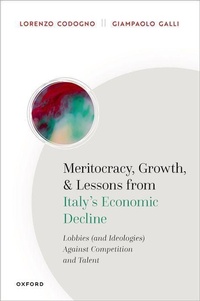
Meritocracy, Growth, and Lessons from Italy's Economic Decline
Lobbies (and Ideologies) Against Competition and Talent
Published on 27. September 2022
Book
Hardback
272 pages
978-0-19-286680-6 (ISBN)
Description
This book draws lessons on the importance of meritocracy for economic growth by analysing Italy's economic decline in the past few decades. Connections, rather than merit, are a long-standing feature of the Italian elites, even in the corporate sector. This became a significant problem when Italy's economy could no longer grow due to imitation, devaluation, and public debt, and faced the challenges of becoming a frontier knowledge-based open economy. This book uses international comparisons on social capital, governance, the role of the public sector, efficiency of the judiciary, education, gender and social inequality, social mobility, corporate standards, financial structures, and more to evaluate Italy's economic performance. It argues that the arrogance of mediocracy is more damaging than that of meritocracy.
Italy experienced an economic miracle after the Second World War, and it is still an advanced economy and a member of the G7. Until the 1960s it seemed destined to catch up with the best-performing countries. Then the growth engine stopped, its debt skyrocketed, and Italy became a weaker member of the Eurozone. Many other countries in the world have heavy historical legacies and low social capital, and many others have to make the jump from imitation led growth to endogenous growth. The lessons drawn from studying Italy's case can therefore have important international applications.
Italy experienced an economic miracle after the Second World War, and it is still an advanced economy and a member of the G7. Until the 1960s it seemed destined to catch up with the best-performing countries. Then the growth engine stopped, its debt skyrocketed, and Italy became a weaker member of the Eurozone. Many other countries in the world have heavy historical legacies and low social capital, and many others have to make the jump from imitation led growth to endogenous growth. The lessons drawn from studying Italy's case can therefore have important international applications.
Reviews / Votes
Recommended. Advanced undergraduates through faculty; professionals. * Choice *More details
Language
English
Place of publication
Oxford
United Kingdom
Product notice
sewn/stitched
Cloth over boards
Dimensions
Height: 236 mm
Width: 161 mm
Thickness: 24 mm
Weight
566 gr
ISBN-13
978-0-19-286680-6 (9780192866806)
Copyright in bibliographic data and cover images is held by Nielsen Book Services Limited or by the publishers or by their respective licensors: all rights reserved.
Schweitzer Classification
Other editions
Additional editions
Lorenzo Codogno | Giampaolo Galli
Meritocracy, Growth, and Lessons from Italy's Economic Decline
Lobbies (and Ideologies) Against Competition and Talent
E-Book
09/2022
1st Edition
OUP eBook
€80.49
Available for download
Lorenzo Codogno | Giampaolo Galli
Meritocracy, Growth, and Lessons from Italy's Economic Decline
Lobbies (and Ideologies) Against Competition and Talent
E-Book
09/2022
1st Edition
OUP eBook
€80.49
Available for download
Persons
Lorenzo Codogno is a Visiting Professor in Practice at the London School of Economics and Political Science, Visiting Professor at the College of Europe, Bruges, and Senior Fellow at the LUISS School of European Political Economy, Rome. He is also founder and chief economist of Lorenzo Codogno Macro Advisors Ltd. He was chief economist and director-general at the Italian Ministry of Economy and Finance 2006-2015. He joined the Ministry from Bank of America, where he was managing director, senior economist, and co-head of European Economics, based in London over the previous eleven years.
Giampaolo Galli is a senior fellow of the Observatory on Italian Public Accounts at Universita Cattolica del Sacro Cuore, where he teaches Macroeconomics. He is also senior fellow of LUISS School of European Political Economy. From 1979 to 1995 he worked at the Research Department of the Bank of Italy; he then became chief economist and general director of the Confederation of Italian Industry. From 2001 to 2009 he was general director of the Association of Insurance Companies. In 2013 he was elected a member of the Italian Parliament (independent in the lists of the Democratic Party). He has been a consultant to the President of the European Commission and to the Economic and Monetary Committee of the European Parliament.
Giampaolo Galli is a senior fellow of the Observatory on Italian Public Accounts at Universita Cattolica del Sacro Cuore, where he teaches Macroeconomics. He is also senior fellow of LUISS School of European Political Economy. From 1979 to 1995 he worked at the Research Department of the Bank of Italy; he then became chief economist and general director of the Confederation of Italian Industry. From 2001 to 2009 he was general director of the Association of Insurance Companies. In 2013 he was elected a member of the Italian Parliament (independent in the lists of the Democratic Party). He has been a consultant to the President of the European Commission and to the Economic and Monetary Committee of the European Parliament.
Content
- Introduction: Why a Book in English on Italy's Decline?
- Part I. Meritocracy and Decline
- 1: Meritocracy, Alternatives, and a Misguided Egalitarian Culture
- 2: Stylised Facts on Italy's Decline
- Part II. Comparative Evidence: Society
- 3: Legacies of a Troubled History
- 4: Lobbies in Government
- 5: Lobbies in Education
- Part III. Comparative Evidence: Economy
- 6: Key Problems and Inequities
- 7: At the Root of Italy's Competitiveness Problems
- 8: Egalitarianism and Messed-up Incentives in the Labour Market
- 9: Why Are Companies So Small?
- Part IV. Summing Up and Lessons
- 10: Summing up on Italy's Bright and Dark Spots
- 11: What Lessons for Other Countries?