

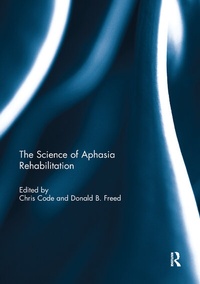
The Science of Aphasia Rehabilitation
1st Edition
Published on 10. September 2018
Book
Paperback/Softback
134 pages
978-1-138-38382-1 (ISBN)
Description
This book examines the rehabilitation of language disorders in adults, presenting new research, as well as expert insights and perspectives, into this area. The first chapter presents a study on personalised cueing to enhance word finding. Cynthia K. Thompson and her colleagues contribute a chapter describing The Northwestern Naming Battery and its use in examining for verb and noun deficits in stroke-induced and primary progressive aphasia. Heather Harris-Wright and Gilson J. Capilouto examine a multi-level approach to understanding the maintenance of global coherence in aphasia. Kathryn M. Yorkston and colleagues provide discussion on the training of healthcare professionals, and what speech and language pathology and medical education can learn from one another. Yorkston also presents a systematic review asking whether principles of motor learning can enhance retention and transfer of speech skills. Connie A. Tompkins present a single-participant experiment examining generalization of a novel treatment for coarse coding deficit in right hemisphere damage. Finally, Chris Code returns to the topic of apportioning time for aphasia treatment.
This book was originally published as a special issue of Aphasiology.
This book was originally published as a special issue of Aphasiology.
More details
Language
English
Place of publication
London
United Kingdom
Publishing group
Taylor & Francis Ltd
Target group
College/higher education
Professional and scholarly
Dimensions
Height: 246 mm
Width: 174 mm
Weight
250 gr
ISBN-13
978-1-138-38382-1 (9781138383821)
Copyright in bibliographic data and cover images is held by Nielsen Book Services Limited or by the publishers or by their respective licensors: all rights reserved.
Schweitzer Classification
Other editions
Additional editions
Chris Code | Donald Freed
The Science of Aphasia Rehabilitation
E-Book
02/2016
1st Edition
Routledge
€69.99
Available for download
Chris Code | Donald Freed
The Science of Aphasia Rehabilitation
E-Book
02/2016
1st Edition
Routledge
€69.99
Available for download
Chris Code | Donald Freed
The Science of Aphasia Rehabilitation
Book
09/2014
1st Edition
Routledge
€215.41
Shipment within 10-20 days
Persons
Chris Code, MA, PhD, FRCS, FBPsS, is Hon Professorial Research Fellow, Department of Psychology, University of Exeter, UK, (Past) Foundation Professor in Communication Sciences and Disorders, University of Sydney, Australia. He was awarded the 2010 Robin Tavistock Award for Services to Aphasia, is a Patron of AphasiaNow and is co-founding Editor of Aphasiology. Research interests include neuropsychology of language/speech, recovery and treatment of aphasia, psychosocial consequences of aphasia, public awareness and history of aphasia, apraxia and the evolution of language.
Donald B. Freed is a professor in the Department of Communicative Disorders and Deaf Studies at California State University, Fresno, USA. His research mostly has concentrated on the treatment of word-finding problems associated with aphasia. He has presented a number of papers at the Clinical Aphasiology Conference and similar conferences. He has authored a textbook on motor speech disorders, as well as articles in Aphasiology, AJSLP, JSHR, and other journals.
Donald B. Freed is a professor in the Department of Communicative Disorders and Deaf Studies at California State University, Fresno, USA. His research mostly has concentrated on the treatment of word-finding problems associated with aphasia. He has presented a number of papers at the Clinical Aphasiology Conference and similar conferences. He has authored a textbook on motor speech disorders, as well as articles in Aphasiology, AJSLP, JSHR, and other journals.
Content
1. Introduction: The clinical scientist Donald B. Freed and Chris Code 2. Generalisation of personalised cueing to enhance word finding in natural settings Ericka Olsen, Donald B. Freed, and Robert C. Marshall 3. Verb and noun deficits in stroke-induced and primary progressive aphasia: The Northwestern Naming Battery Cynthia K. Thompson, Sladjana Lukic, Monique C. King, M. Marsel Mesulam, and Sandra Weintraub 4. Considering a multi-level approach to understanding maintenance of global coherence in adults with aphasia Heather Harris Wright and Gilson J. Capilouto 5. Training healthcare providers in patient-provider communication: What speech-language pathology and medical education can learn from one another Michael I. Burns, Carolyn R. Baylor, Megan A. Morris, Thomas E. McNalley, and Kathryn M. Yorkston 6. Generalisation of a novel implicit treatment for coarse coding deficit in right hemisphere brain damage: A single-participant experiment Connie A. Tompkins, Victoria L. Scharp, Kimberly M. Meigh, Margaret Lehman Blake, and Julie Wambaugh 7. Do principles of motor learning enhance retention and transfer of speech skills? A systematic review Lauren P. Bislick, Phillip C. Weir, Kristie Spencer, Diane Kendall, and Kathryn M. Yorkston 8. Apportioning time for aphasia rehabilitation Chris Code