

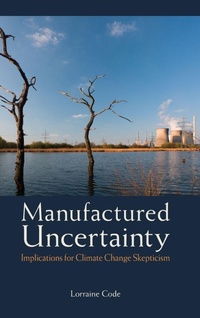
Manufactured Uncertainty
Implications for Climate Change Skepticism
Published on 1. November 2020
Book
Hardback
256 pages
978-1-4384-8053-4 (ISBN)
Description
Wide-ranging critique of the epistemological and ethical assumptions that underlie contemporary debates concerning climate change.
In this provocative work, Lorraine Code returns to the idea of "epistemic responsibility," as developed in her influential 1987 book of the same name, to confront the telling new challenges we now face to know the world with some sense of responsibility to other "knowers" and to the sustaining, nonhuman world. Manufactured Uncertainty focuses centrally on the environmental and cultural crises arising from postindustrial, man-made climate change, which have spawned new forms of passionately partisan social media that directly challenge all efforts to know with a sense of collective responsibility. How can we agree to act together, Code asks, even in the face of inevitable uncertainty, given the truly life-threatening stakes of today's social and political challenges? How can we engage responsibly with those who take every argument for an environmentally grounded epistemology as an unacceptable challenge to their assumed freedoms, comforts, and "rights?" Through searching critical dialogue with leading epistemologists, cultural theorists, and feminist scholars, this book poses a timely challenge to all thoughtful knowers who seek to articulate an expanded and deepened sense of epistemic responsibility-to a human society and a natural world embraced, together, in the most inclusive spirit.
In this provocative work, Lorraine Code returns to the idea of "epistemic responsibility," as developed in her influential 1987 book of the same name, to confront the telling new challenges we now face to know the world with some sense of responsibility to other "knowers" and to the sustaining, nonhuman world. Manufactured Uncertainty focuses centrally on the environmental and cultural crises arising from postindustrial, man-made climate change, which have spawned new forms of passionately partisan social media that directly challenge all efforts to know with a sense of collective responsibility. How can we agree to act together, Code asks, even in the face of inevitable uncertainty, given the truly life-threatening stakes of today's social and political challenges? How can we engage responsibly with those who take every argument for an environmentally grounded epistemology as an unacceptable challenge to their assumed freedoms, comforts, and "rights?" Through searching critical dialogue with leading epistemologists, cultural theorists, and feminist scholars, this book poses a timely challenge to all thoughtful knowers who seek to articulate an expanded and deepened sense of epistemic responsibility-to a human society and a natural world embraced, together, in the most inclusive spirit.
Reviews / Votes
"Highly recommended." - CHOICE"Code's incredibly rich analysis highlights the ethical and epistemological aspects of knowing while at the same time dealing with such important and pressing issues as climate change skepticism and the systems of power that produce and maintain ignorance." - Kristen Intemann, Montana State University
More details
Language
English
Place of publication
Albany, NY
United States
Target group
College/higher education
US School Grade: From College Freshman to College Graduate Student
Dimensions
Height: 235 mm
Width: 157 mm
Thickness: 20 mm
Weight
571 gr
ISBN-13
978-1-4384-8053-4 (9781438480534)
Copyright in bibliographic data and cover images is held by Nielsen Book Services Limited or by the publishers or by their respective licensors: all rights reserved.
Schweitzer Classification
Other editions
Additional editions

E-Book
11/2020
1st Edition
State University of New York Press
from
€84.99
Available for download
Person
Lorraine Code is Distinguished Research Professor Emerita of Philosophy at York University, Canada. She is the author of several books, including Epistemic Responsibility, also published by SUNY Press, and Ecological Thinking: The Politics of Epistemic Location.
Content
Foreword
Acknowledgments
Introduction
1. Epistemic Responsibility, Now
2. Doubt and Denial: Epistemic Responsibility Meets Climate Change Skepticism
3. Care, Concern, and Advocacy: Is There a Place for Epistemic Responsibility?
4. Particularity, Epistemic Responsibility, and the Ecological Imaginary
5. How to Think Globally, Revisited: Or, A Plea for Ignorance
Bibliography
Index
Acknowledgments
Introduction
1. Epistemic Responsibility, Now
2. Doubt and Denial: Epistemic Responsibility Meets Climate Change Skepticism
3. Care, Concern, and Advocacy: Is There a Place for Epistemic Responsibility?
4. Particularity, Epistemic Responsibility, and the Ecological Imaginary
5. How to Think Globally, Revisited: Or, A Plea for Ignorance
Bibliography
Index