

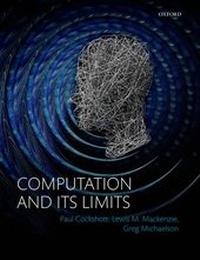
Computation and its Limits
Published on 23. April 2015
Book
Paperback/Softback
246 pages
978-0-19-872912-9 (ISBN)
Description
Computation and its Limits is an innovative cross-disciplinary investigation of the relationship between computing and physical reality. It begins by exploring the mystery of why mathematics is so effective in science and seeks to explain this in terms of the modelling of one part of physical reality by another. Going from the origins of counting to the most blue-skies proposals for novel methods of computation, the authors investigate the extent to which the laws of nature and of logic constrain what we can compute. In the process they examine formal computability, the thermodynamics of computation, and the promise of quantum computing.
Reviews / Votes
Mathematics, computer science, physics - and even biology - are now beginning to converge. This delightful book, beautifully illustrated, shows the physics of computation and the theory of computation as two sides of the same coin. We are witnessing a paradigm shift, the birth of a fruitful new interdisciplinary point of view. * Gregory Chaitin, author of Proving Darwin: Making Biology Mathematical * This book provides a unique and important presentation of the factors that have, do, and will limit the science of computation. A most stimulating, scholarly, and entertaining synthesis of history, logic, mathematics, and science. * Stephen Barnett, University of Strathclyde, Glasgow, UK *More details
Language
English
Place of publication
Oxford
United Kingdom
Target group
College/higher education
Illustrations
69 b/w line drawings, 17 b/w halftones
Dimensions
Height: 244 mm
Width: 188 mm
Thickness: 12 mm
Weight
550 gr
ISBN-13
978-0-19-872912-9 (9780198729129)
Copyright in bibliographic data and cover images is held by Nielsen Book Services Limited or by the publishers or by their respective licensors: all rights reserved.
Schweitzer Classification
Other editions
Additional editions
Paul Cockshott | Lewis M. Mackenzie | Gregory Michaelson
Computation and its Limits
Book
03/2012
1st Edition
Oxford University Press
€110.18
Shipment within 15-20 days
Persons
Paul Cockshott was educated at McMaster, Manchester, Heriot-Watt, and Edinburgh Universities. He trained originally as an economist and continues to be interested in the area. He later studied computer science, obtaining his PhD in the same from Edinburgh University. Dr Cockshott has worked in industry for ICL on hardware verification and for Memex on the design of database machines. He has also been a research worker and lecturer at the universities of Edinburgh, Heriot-Watt, Glasgow, and Strathclyde. He is currently Reader in Computer Science at the University of Glasgow.
Lewis M. Mackenzie is a Senior Lecturer in Computing Science at the University of Glasgow. His research interests are in machine architectures and the performance modelling of communication systems. Dr Mackenzie's recently published work has involved the modelling of traffic patterns in a variety of scenarios from regular wormhole-switched multi-computer interconnects to mobile ad-hoc wireless networks (MANETs).
Greg Michaelson studied Computer Science at the University of Essex and the University of St Andrews, working as a real-time programmer at Scottish Gas in between. He then taught at Napier College and the University of Glasgow, before joining Heriot-Watt University in 1983, where he gained his PhD. He was Head of Computer Science from 2003-8 and promoted to Professor in 2006. Dr Michaelson's research interests encompass formally motivated computing, in particular the design, implementation, and analysis of programming languages for multi-process systems. He published his first novel in 2008.
Lewis M. Mackenzie is a Senior Lecturer in Computing Science at the University of Glasgow. His research interests are in machine architectures and the performance modelling of communication systems. Dr Mackenzie's recently published work has involved the modelling of traffic patterns in a variety of scenarios from regular wormhole-switched multi-computer interconnects to mobile ad-hoc wireless networks (MANETs).
Greg Michaelson studied Computer Science at the University of Essex and the University of St Andrews, working as a real-time programmer at Scottish Gas in between. He then taught at Napier College and the University of Glasgow, before joining Heriot-Watt University in 1983, where he gained his PhD. He was Head of Computer Science from 2003-8 and promoted to Professor in 2006. Dr Michaelson's research interests encompass formally motivated computing, in particular the design, implementation, and analysis of programming languages for multi-process systems. He published his first novel in 2008.
Content
1. Introduction ; 2. What is computation? ; 3. Mechanical computers and their limits ; 4. Logical limits to computing ; 5. Heat, information, and geometry ; 6. Quantum computers ; 7. Beyond the logical limits of computing? ; 8. Hypercomputing proposals