

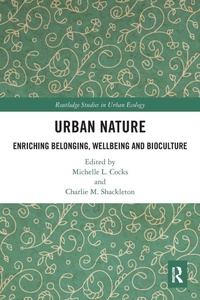
Urban Nature
Enriching Belonging, Wellbeing and Bioculture
1st Edition
Published on 30. May 2022
Book
Paperback/Softback
290 pages
978-0-367-61591-8 (ISBN)
Description
This book showcases the diversity of ways in which urban residents from varying cultural contexts view, interact, engage with and give meaning to urban nature, aiming to counterbalance the dominance of Western depictions and values of urban nature and design.
Urban nature has up to now largely been defined, planned and managed in a way that is heavily dominated by Western understandings, values and appreciations, which has spread through colonialism and globalisation. As cities increasingly represent a diversity of cultures, and urban nature is being increasingly recognised as contributing to residents' wellbeing, belonging and overall quality of life, it is important to consider the numerous ways in which urban nature is understood and appreciated. This collection of case studies includes examples from Africa, Asia, Europe, North and South America, and reflects on the multi-dimensional aspects of engagements with urban nature through a biocultural diversity lens. The chapters cover several themes such as how engagements with nature contribute to a sense of wellbeing and belonging; the implications that diversity has on the provision, design and management of urban environments; and the threats inhibiting residents' abilities to engage meaningfully with nature. The book challenges the dominant discourse, Western ideological understandings and meta-narratives of modernisation and unilineal urban transitions.
A timely addition to the literature, Urban Nature: Enriching Belonging, Wellbeing and Bioculture offers an alternative to Western ideological understandings of nature and values and will be of great interest to those working in human and environmental urban ecology. It will also be key reading for students in the relevant fields of anthropology, development studies, geography, social ecology and urban studies.
Urban nature has up to now largely been defined, planned and managed in a way that is heavily dominated by Western understandings, values and appreciations, which has spread through colonialism and globalisation. As cities increasingly represent a diversity of cultures, and urban nature is being increasingly recognised as contributing to residents' wellbeing, belonging and overall quality of life, it is important to consider the numerous ways in which urban nature is understood and appreciated. This collection of case studies includes examples from Africa, Asia, Europe, North and South America, and reflects on the multi-dimensional aspects of engagements with urban nature through a biocultural diversity lens. The chapters cover several themes such as how engagements with nature contribute to a sense of wellbeing and belonging; the implications that diversity has on the provision, design and management of urban environments; and the threats inhibiting residents' abilities to engage meaningfully with nature. The book challenges the dominant discourse, Western ideological understandings and meta-narratives of modernisation and unilineal urban transitions.
A timely addition to the literature, Urban Nature: Enriching Belonging, Wellbeing and Bioculture offers an alternative to Western ideological understandings of nature and values and will be of great interest to those working in human and environmental urban ecology. It will also be key reading for students in the relevant fields of anthropology, development studies, geography, social ecology and urban studies.
More details
Series
Language
English
Place of publication
London
United Kingdom
Publishing group
Taylor & Francis Ltd
Target group
College/higher education
Postgraduate and Undergraduate Advanced
Illustrations
49 s/w Abbildungen, 49 s/w Photographien bzw. Rasterbilder, 3 s/w Tabellen
3 Tables, black and white; 49 Halftones, black and white; 49 Illustrations, black and white
Dimensions
Height: 234 mm
Width: 156 mm
Thickness: 16 mm
Weight
447 gr
ISBN-13
978-0-367-61591-8 (9780367615918)
Copyright in bibliographic data and cover images is held by Nielsen Book Services Limited or by the publishers or by their respective licensors: all rights reserved.
Schweitzer Classification
Other editions
Additional editions
Book
11/2020
1st Edition
Routledge
€205.90
Shipment within 15-20 days
E-Book
11/2020
1st Edition
Routledge
€59.49
Available for download
E-Book
11/2020
1st Edition
Routledge
€59.49
Available for download
Persons
Michelle L. Cocks is Associate Professor in the Department of Anthropology, Rhodes University, South Africa.
Charlie M. Shackleton is Professor and DST/NRF Research Chair of Interdisciplinary Science in Land & Natural Resource Use for Sustainable Livelihoods in the Department of Environmental Science at Rhodes University, South Africa.
Charlie M. Shackleton is Professor and DST/NRF Research Chair of Interdisciplinary Science in Land & Natural Resource Use for Sustainable Livelihoods in the Department of Environmental Science at Rhodes University, South Africa.
Content
1. Urban Nature and Biocultural Realities 2. The Veil, the Clearing and the Flow: New Commons of Japanese Traditional Gardens in Kanazawa City 3. Urban Biocultural Identity of Yorubas: Intersection of Philosophy and Nature for Wellbeing at Osun Sacred Grove UNESCO Site, Osogbo, Nigeria 4. Troubled Paradise: The Persian Garden in Post-Islamic Revolution Iran 5. Designed and Engaged Urban Nature: Biocultural Values in Helsinki, Finland 6. Decolonisation of Nature in Towns and Cities of South Africa: Incorporation of Biocultural Value 7. Nature on the Border: The Reconfiguration of Biocultural Experiences by Migrant Women on the Southern Border of Mexico 8. Translating Spiritual Experience into Environmental Stewardship at Jamaica Bay, New York City 9. Biocultural Diversity at Rio de Janeiro's Urban Beaches: Wellbeing, Belonging and Conflict 10. Intercultural Learning in Contested Space: The Biocultural Realities of Global Cities through the Lens of Vancouver, Canada 11. Urban Realities of Engaging with Nature in Europe: Increasing Diversity and Consequences for Wellbeing and Social Cohesion 12. Living in Kinship within Urban Landscapes through Equitable, Multicultural, Collaborative Stewardship in New York City 13. Situating Biocultural Relations in City and Townscapes: Conclusion and Recommendations