

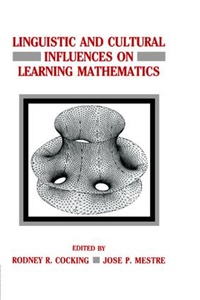
Linguistic and Cultural Influences on Learning Mathematics
Published on 1. January 1988
Book
Hardback
328 pages
978-0-89859-876-6 (ISBN)
Description
The combined impact of linguistic, cultural, educational and cognitive factors on mathematics learning is considered in this unique book. By uniting the diverse research models and perspectives of these fields, the contributors describe how language and cognitive factors can influence mathematical learning, thinking and problem solving. The authors contend that cognitive skills are heavily dependent upon linguistic skills and both are critical to the representational knowledge intimately linked to school achievement in mathematics.
Reviews / Votes
"The editors of this volume are to be congratulated for laying a foundation for this field of inquiry; it provides entry for members of many disciplines to a core problem in education."-Contemporary Psychology
"...an impressive collection of readings that address important linguistic and cultural influences on the teaching and learning of mathematics....a good resource for anyone interested in cultural and linguistic influences on mathematics education."
-Mathematics Teacher
"...this text makes a significant contribution to the growing literature on ESL and content area instruction....Cocking and Mestre have raised critical issues and provided useful insights into a wide range of factors relevant to the language-mathematics connection."
-TESOL Quarterly
"In a useful manner, the book manages to bring human values and caring to the problems while at the same time presenting solid, data-based work that explores the many complex issues."
-Science Books & Films
More details
Series
Language
English
Place of publication
Mahwah
United States
Publishing group
Taylor & Francis Inc
Target group
College/higher education
Professional and scholarly
Dimensions
Height: 229 mm
Width: 152 mm
Weight
770 gr
ISBN-13
978-0-89859-876-6 (9780898598766)
Copyright in bibliographic data and cover images is held by Nielsen Book Services Limited or by the publishers or by their respective licensors: all rights reserved.
Schweitzer Classification
Other editions
Additional editions
Rodney R. Cocking | Jose P. Mestre
Linguistic and Cultural Influences on Learning Mathematics
E-Book
03/2013
1st Edition
Routledge
€73.99
Available for download
Rodney R. Cocking | Jose P. Mestre
Linguistic and Cultural Influences on Learning Mathematics
E-Book
03/2013
1st Edition
Routledge
€73.99
Available for download
Persons
Rodney R. Cocking, Jose P. Mestre
Content
Contents: R. Cocking, J. Mestre, Introduction and Overview. R. Cocking, S. Chipman, Conceptual Issues Related to Mathematics Achievement of Language Minority Children. G.B. Saxe, Linking Language with Mathematics Achievement: Problems and Prospects. J.B. Stone, Intention and Convention in Mathematics Instruction: Reflections on the Learning of Deaf Students. E.K. Scholnick, Why Should Developmental Psychologists Be Interested in Studying the Acquisition of Arithmetic. M.F. Charbonneau, V. John-Steiner, Patterns of Experience and the Language of Mathematics. E.A. DeAvila, Bilingualism, Cognitive Function, and Language Minority Group Membership. S.L. Tsang, The Mathematics Achievement Characteristics of Asian American Students. P. MacCorquodale, Mexican-American Women and Mathematics: Participation, Aspirations, and Achievement. W.L. Leap, Assumptions and Strategies Guiding Mathematics Problem-Solving Among Ute Indian Students. K.J. Travers, Opportunity to Learn Mathematics in Eighth Grade Classrooms in the United States: Some Findings from the Second International Mathematics Study. J.P. Mestre, The Role of Language Comprehension in Mathematics and Problem Solving. Linguistic Features of Mathematical Problem Solving: Insights and Application. G. Spanos, N. Rhodes, T.C. Dale, J. Crandall, R.P. Duran, Bilinguals' Logical Reasoning Aptitudes: A Construct Validity Study. D.E. Myers, A.M. Milne, Effects of Home and Primary Language on Mathematics Achievement: A Model and Results for Secondary Analyses. J. Suina, Epilogue: And Then I Went to School.