

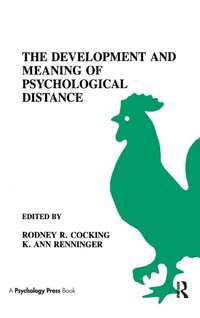
The Development and Meaning of Psychological Distance
Published on 1. March 1993
Book
Hardback
284 pages
978-0-8058-0747-9 (ISBN)
Description
One of the paradoxes in developmental theory is the child's simultaneous intrapsychic and interpsychic development. While the child is growing in mental capacity and struggling to define self, behaviors are also being learned whose function is to integrate self into a social network, which often means that egocentric behaviors are in conflict with sociocentric ones. This theory draws upon processes that promote both individual and social growth into a unified theory of development.
A construct pertinent to almost all dimensions of psychological research, psychological distance is conceptualized as either the distance between what the learner understands and what still has to be understood (intrapsychic), or ways in which others adjust information for the learner in order to be fully comprehended (interpsychic). Psychological distance appears to serve both organizing and explanatory functions across seemingly diverse sets of theoretical and research questions, such as differentiation of self in personality development; conceptual representation in cognitive development; dialogue in the development of communication skills; information processing in cognitive science; regulatory mechanisms in the growth of control processes; and concept formation in cross-over areas of cognition, learning and thinking skills.
This volume is based on papers presented as part of the Invitational Conference honoring Irving E. Sigel, Distinguished Research Scientist, at Educational Testing Service. In each of the chapters different models are utilized to account for the construct of psychological distance, and as such, to suggest extensions of Sigel's seminal work in this area. Together, these contributions form the basis of a discussion of psychological distance as a developmental construct -- a construct which permits serious consideration of individual differences as a function of both the process and the product of cognition and ecology.
A construct pertinent to almost all dimensions of psychological research, psychological distance is conceptualized as either the distance between what the learner understands and what still has to be understood (intrapsychic), or ways in which others adjust information for the learner in order to be fully comprehended (interpsychic). Psychological distance appears to serve both organizing and explanatory functions across seemingly diverse sets of theoretical and research questions, such as differentiation of self in personality development; conceptual representation in cognitive development; dialogue in the development of communication skills; information processing in cognitive science; regulatory mechanisms in the growth of control processes; and concept formation in cross-over areas of cognition, learning and thinking skills.
This volume is based on papers presented as part of the Invitational Conference honoring Irving E. Sigel, Distinguished Research Scientist, at Educational Testing Service. In each of the chapters different models are utilized to account for the construct of psychological distance, and as such, to suggest extensions of Sigel's seminal work in this area. Together, these contributions form the basis of a discussion of psychological distance as a developmental construct -- a construct which permits serious consideration of individual differences as a function of both the process and the product of cognition and ecology.
Reviews / Votes
"A useful addition for graduate-level libraries."-CHOICE
More details
Language
English
Place of publication
Philadelphia
United States
Publishing group
Taylor & Francis Inc
Target group
College/higher education
Professional and scholarly
Dimensions
Height: 235 mm
Width: 157 mm
Thickness: 20 mm
Weight
568 gr
ISBN-13
978-0-8058-0747-9 (9780805807479)
Copyright in bibliographic data and cover images is held by Nielsen Book Services Limited or by the publishers or by their respective licensors: all rights reserved.
Schweitzer Classification
Other editions
Additional editions
Rodney R. Cocking | K. Ann Renninger | Ann Renninger
The Development and Meaning of Psychological Distance
Book
04/2015
1st Edition
Psychology Press Ltd
€85.90
Shipment within 10-20 days
Rodney R. Cocking | K. Ann Renninger | Ann Renninger
The Development and Meaning of Psychological Distance
E-Book
06/2013
Psychology Press Ltd
€78.99
Available for download
Rodney R. Cocking | K. Ann Renninger | Ann Renninger
The Development and Meaning of Psychological Distance
E-Book
06/2013
Psychology Press Ltd
€78.99
Available for download
Persons
Cocking, Rodney R.; Renninger, K. Ann; Renninger, Ann
Content
Contents: W. Damon, Foreword. Part I:Psychologicl Distance and Developmental Theory.R.R. Cocking, K.A. Renninger, Psychological Distance as a Unifying Theory of Development. K.A. Renninger, R.R. Cocking, Psychological Distance and Behavioral Paradigms. J. Valsiner, R. van der Veer, The Encoding of Distance: The Concept of the Zone of Proximal Development and Its Interpretations. U. Bronfenbrenner, Distancing Theory From a Distance. Part II:Psychological Distance as a Cognitive Demand.J. Kagan, N. Snidman, Temperamental Contributions to Styles of Reactivity to Discrepancy. J.S. DeLoache, Distancing and Dual Representation. W. Mischel, M.L. Rodriguez, Psychological Distance in Self-Imposed Delay of Gratification. M.W. Watson, K.W. Fischer, Structural Changes in Children's Understanding of Family Roles and Divorce. I.E. Sigel, The Centrality of a Distancing Model for the Development of Representational Competence. Part III:Psychological Distance as an Ecological Demand.P.M. Greenfield, Representational Competence in Shared Symbol Systems: Electronic Media From Radio to Video Games. C.U. Shantz, Children's Conflicts: Representations and Lessons Learned. J.V. Wertsch, J.A. Bivens, The Social Origins of Individual Mental Functioning: Alternatives and Perspectives. R.B. McCall, L. Kratzer, Psychological Distance and Underachievement. L. Okagaki, R.J. Sternberg, Putting the Distance Into Students' Hands: Practical Intelligence for School.