

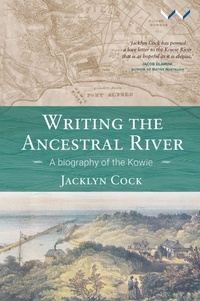
Writing the Ancestral River
A Biography of the Kowie
Published on 1. March 2018
Book
Paperback/Softback
204 pages
978-1-77614-187-6 (ISBN)
Description
Writing the Ancestral River is an illuminating and unusual biography of the Kowie River in the Eastern Cape
This tidal river runs through the centre of what used to be called the Zuurveld, a formative meeting ground of different peoples who have shaped our history: Khoikhoi herders, Xhosa pastoralists, Dutch trekboers and British settlers. Their direct descendants continue to live in the area and interact in ways that have been decisively shaped by their shared history. Besides being a social history, this is also a natural history of the river and its catchment area, where dinosaurs once roamed and cycads still grow. As the book shows, the natural world of the Kowie has felt the effects of human settlement, most strikingly through the establishment of a harbour at the mouth of the river in the 19th century and the development of a marina in the late 20th century. Both projects have had a decisive and deleterious impact on the Kowie. People are increasingly reconnecting with nature and justice through rivers. Acknowledging the past, and the inter-generational, racialised privileges, damages and denials it established and perpetuates, is necessary for any shared future. By focusing on this `little' river, the book raises larger questions about colonialism, capitalism, `development' and ecology, and asks us to consider the connections between social and environmental injustice.
This tidal river runs through the centre of what used to be called the Zuurveld, a formative meeting ground of different peoples who have shaped our history: Khoikhoi herders, Xhosa pastoralists, Dutch trekboers and British settlers. Their direct descendants continue to live in the area and interact in ways that have been decisively shaped by their shared history. Besides being a social history, this is also a natural history of the river and its catchment area, where dinosaurs once roamed and cycads still grow. As the book shows, the natural world of the Kowie has felt the effects of human settlement, most strikingly through the establishment of a harbour at the mouth of the river in the 19th century and the development of a marina in the late 20th century. Both projects have had a decisive and deleterious impact on the Kowie. People are increasingly reconnecting with nature and justice through rivers. Acknowledging the past, and the inter-generational, racialised privileges, damages and denials it established and perpetuates, is necessary for any shared future. By focusing on this `little' river, the book raises larger questions about colonialism, capitalism, `development' and ecology, and asks us to consider the connections between social and environmental injustice.
Reviews / Votes
Jacklyn Cock has penned a love letter that is as hopeful as it is elegiac. Drawing on family connections to the Kowie that go back to the 1820 settlers, Cock asks big questions about the relationship between nature and culture, between humans and other forms of life, and about the place of rivers in human history. It is only by rethinking our relationship to nature that we can save ourselves."" - Jacob Dlamini, Assistant Professor 0f History, Princeton University""Jacklyn Cock has made the story of a small and fairly insignificant river into a metonym of the biological glories of South Africa and the ecological devastation they have endured, and continue to endure. The result is at once lyrical and trenchant. As a history rooted in the landscape of South Africa, it has few peers, and no superiors."" - Robert Ross, Professor Emeritus of African Studies, Leiden University
""Jacklyn Cock has written an extraordinary work of engaged and imaginative scholarship. Writing the Ancestral River will become a South African classic, accessible to the public but at the cutting edge of international scholarship."" - Edward Webster, Professor Emeritus, University of The Witwatersrand
More details
Language
English
Place of publication
Johannesburg
South Africa
Target group
Professional and scholarly
Product notice
Paperback (trade)
Dimensions
Height: 229 mm
Width: 152 mm
Thickness: 13 mm
Weight
327 gr
ISBN-13
978-1-77614-187-6 (9781776141876)
Copyright in bibliographic data and cover images is held by Nielsen Book Services Limited or by the publishers or by their respective licensors: all rights reserved.
Schweitzer Classification
Other editions
Additional editions
E-Book
03/2018
Abingdon Press
€24.49
Available for download
Person
Jacklyn Cock is a professor emeritus in the Department of Sociology at Wits University and an Honorary Research Professor in the Society, Work and Development Research Unit (SWOP). She has written extensively on environment, gender and militarisation issues. Her most recent book is The War against Ourselves: Nature, Power and Justice. (2007). She is best known for Maids and Madams: A Study in the Politics of Exploitation (1980)
Content
Acknowledgements; Plates; Chapter 1: Motivations; Chapter 2: The River; Chapter 3: The Battle; Chapter 4: The Harbour; Chapter 5: The Marina; Chapter 6: Connecting nature and justice through rivers; Appendix; Glossary of isiXhosa terms; Notes; Bibliography; Index.