

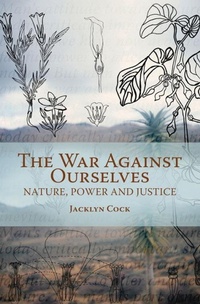
War Against Ourselves
Nature, Power and Justice
Will be published approx. on 1. October 2007
Book
Paperback/Softback
256 pages
978-1-86814-457-0 (ISBN)
Description
A look at nature and how to re-evaluate our relationship with it
For many people "nature" means wilderness and wild animals. It is experienced indirectly through magazines and television programs or through visiting the highly managed environments of national parks. Nature, however, is not external, separate from the world of people we live in nature and interact with it daily.
In this book, Jacklyn Cock describes how these intricate and complex interconnections, seen and unseen, are often ignored. Each of the ten chapters examines an aspect of our relationship with nature: ignoring, understanding, enjoying, imitating, privatizing, polluting, abusing, protecting as well as organizing for nature. The concluding chapter deals with the growing inequality between the North and the South.
The War Against Ourselves compels us to re-examine our relationship with nature, to change our practices and dissolve present binary divisions such as people vs. animals, economic growth vs environmental protection, "nature" vs "culture." It demonstrates the need for an inclusive politics which brings together peace, social and environmental justice activists who believe that another world is both possible and necessary.
For many people "nature" means wilderness and wild animals. It is experienced indirectly through magazines and television programs or through visiting the highly managed environments of national parks. Nature, however, is not external, separate from the world of people we live in nature and interact with it daily.
In this book, Jacklyn Cock describes how these intricate and complex interconnections, seen and unseen, are often ignored. Each of the ten chapters examines an aspect of our relationship with nature: ignoring, understanding, enjoying, imitating, privatizing, polluting, abusing, protecting as well as organizing for nature. The concluding chapter deals with the growing inequality between the North and the South.
The War Against Ourselves compels us to re-examine our relationship with nature, to change our practices and dissolve present binary divisions such as people vs. animals, economic growth vs environmental protection, "nature" vs "culture." It demonstrates the need for an inclusive politics which brings together peace, social and environmental justice activists who believe that another world is both possible and necessary.
Reviews / Votes
The future of the environment, and the destructive impact of unregulated market-led growth on it, has become the defining socio-political issue of the 21st century. This book, by taking a holistic approach to the subject, will attract readers who are interested in the section on the origin, growth and social composition of bird-watching through to those who see capitalism on a suicidal course in its drive to exploit nature for profit. Eddie Webster, Director of the Sociology of Work Unit, University of the WitwatersrandMore details
Language
English
Place of publication
Johannesburg
South Africa
Target group
College/higher education
Professional and scholarly
Product notice
Paperback (trade)
Dimensions
Height: 231 mm
Width: 155 mm
Thickness: 15 mm
Weight
386 gr
ISBN-13
978-1-86814-457-0 (9781868144570)
Copyright in bibliographic data and cover images is held by Nielsen Book Services Limited or by the publishers or by their respective licensors: all rights reserved.
Schweitzer Classification
Person
Jacklyn Cock is a professor emeritus in the Department of Sociology, University of the Witwatersrand, Johannesburg and a research associate of the university's Society, Work and Politics Institute.
Content
Acknowledgements
Abbreviations and Acronyms
Introduction
Chapter 1: Ignoring nature
Chapter 2: Understanding Nature
Chapter 3: Enjoying Nature
Chapter 4: Imitating Nature
Chapter 5: Privatising Nature
Chapter 6: Polluting Nature
Chapter 7: Abusing Nature
Chapter 8: Protecting Nature
Chapter 9: Organising Nature
Chapter 10: Rethinking Nature
Endnotes
Bibliography
Index
Abbreviations and Acronyms
Introduction
Chapter 1: Ignoring nature
Chapter 2: Understanding Nature
Chapter 3: Enjoying Nature
Chapter 4: Imitating Nature
Chapter 5: Privatising Nature
Chapter 6: Polluting Nature
Chapter 7: Abusing Nature
Chapter 8: Protecting Nature
Chapter 9: Organising Nature
Chapter 10: Rethinking Nature
Endnotes
Bibliography
Index