

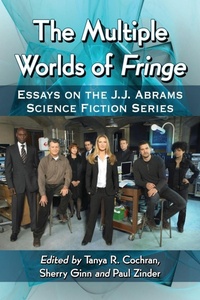
The Multiple Worlds of Fringe
Essays on the J.J. Abrams Science Fiction Series
Published on 12. August 2014
Book
Paperback/Softback
272 pages
978-0-7864-7567-4 (ISBN)
Description
With diverse contributions from scholars in English literature, psychology, and film and television studies, this collection of essays contextualizes Fringe as a postmodern investigation into what makes us human and as an examination of how technology transforms our humanity.
In compiling this collection, the editors sought material as multifaceted as the series itself, devoting sections to specific areas of interest explored by both the writers of Fringe and the writers of the essays: humanity, duality, genre and viewership.
In compiling this collection, the editors sought material as multifaceted as the series itself, devoting sections to specific areas of interest explored by both the writers of Fringe and the writers of the essays: humanity, duality, genre and viewership.
Reviews / Votes
"valuable work of television criticism...worth the attention of media scholars and the show's fans alike"-Psycho Drive In.More details
Language
English
Place of publication
Jefferson, NC
United States
Target group
College/higher education
Interest Age: From 18 years
Product notice
Paperback (trade)
Illustrations
notes, bibliographies, index
Dimensions
Height: 229 mm
Width: 152 mm
Thickness: 16 mm
Weight
446 gr
ISBN-13
978-0-7864-7567-4 (9780786475674)
Copyright in bibliographic data and cover images is held by Nielsen Book Services Limited or by the publishers or by their respective licensors: all rights reserved.
Schweitzer Classification
Persons
Tanya R. Cochran is an associate professor of English at Union College in Lincoln, Nebraska. Among other works, she has coedited collections on Firefly and Serenity as well as Reading Joss Whedon. Sherry Ginn is a retired educator currently living in North Carolina. She has authored books examining female characters on science fiction television series as well as the multiple television worlds of Joss Whedon. Edited collections have examined sex in science fiction, time travel, the apocalypse, and the award-winning series Farscape, Doctor Who, and Fringe. Paul Zinder is a senior lecturer of film production at the University of Gloucestershire. He has published essays on various cult and genre television series, including Alias, Deadwood, Justified and Veronica Mars.
Content
Table of Contents
Acknowledgments
Introduction
Part I: Humanity
"The Whole World Is Their Lab": The Scientist as Villain,
the Scientist as Hero (Val Nolan)
Nothing but Tech: Cyborgs and the Human Question (Paul Zinder)
Women with the Agency: Dana Scully, Temperance Brennan and Olivia Dunham (Rhonda V. Wilcox)
"We Were Trying to Make You More Than You Were": The Singularity, Transhumanism and Shapeshifting (Zak Bronson)
Part II: Duality
Same ... Yet Other: Interpersonal Communication Across Alternate Worlds (Eleanor Sandry)
"You're a Smart Boy. But There Is Much You Don't Know": A Quantitative Examination of Intelligence, Wisdom and Family Relationships (Heather M. Porter)
Myth(re)making and Border Crossings: Exploring the Classical
Predecessors (Scott Daley)
Nature vs. Nurture: The Psychology of the Twins at the Apple's
Core (Sherry Ginn)
Part III: Genre
"You Don't Even Need the Island to Be Weird": J. J. Abrams and the Weirding of the Small Screen (Stan Hunter Kranc)
Asking the Biopunk Questions: Opposition and Interrogation in Olivia Dunham and Walter Bishop (Jennifer McStotts)
The Television Musical: An Alternate Universe of Storytelling (Christopher M. Culp)
"This Means Bodies": Body Horror and the Influence of David Cronenberg (Bronwen Calvert)
Part IV: Viewership
Observation on the Fringe: September's Observation and Narrative
Participation as a Template for Viewer Agency (Julie L. Hawk)
Teasing the Audience: Construction of Meaning Through the
Opening Title Sequence (Victor Hernandez-Santaolalla and Javier Lozano Delmar)
Paratextual Mediation: Fox, Fandom and -Death-Slot Fridays (Tanya R. Cochran)
Appendix: Fringe Episode List
About the Contributors
Index
Acknowledgments
Introduction
Part I: Humanity
"The Whole World Is Their Lab": The Scientist as Villain,
the Scientist as Hero (Val Nolan)
Nothing but Tech: Cyborgs and the Human Question (Paul Zinder)
Women with the Agency: Dana Scully, Temperance Brennan and Olivia Dunham (Rhonda V. Wilcox)
"We Were Trying to Make You More Than You Were": The Singularity, Transhumanism and Shapeshifting (Zak Bronson)
Part II: Duality
Same ... Yet Other: Interpersonal Communication Across Alternate Worlds (Eleanor Sandry)
"You're a Smart Boy. But There Is Much You Don't Know": A Quantitative Examination of Intelligence, Wisdom and Family Relationships (Heather M. Porter)
Myth(re)making and Border Crossings: Exploring the Classical
Predecessors (Scott Daley)
Nature vs. Nurture: The Psychology of the Twins at the Apple's
Core (Sherry Ginn)
Part III: Genre
"You Don't Even Need the Island to Be Weird": J. J. Abrams and the Weirding of the Small Screen (Stan Hunter Kranc)
Asking the Biopunk Questions: Opposition and Interrogation in Olivia Dunham and Walter Bishop (Jennifer McStotts)
The Television Musical: An Alternate Universe of Storytelling (Christopher M. Culp)
"This Means Bodies": Body Horror and the Influence of David Cronenberg (Bronwen Calvert)
Part IV: Viewership
Observation on the Fringe: September's Observation and Narrative
Participation as a Template for Viewer Agency (Julie L. Hawk)
Teasing the Audience: Construction of Meaning Through the
Opening Title Sequence (Victor Hernandez-Santaolalla and Javier Lozano Delmar)
Paratextual Mediation: Fox, Fandom and -Death-Slot Fridays (Tanya R. Cochran)
Appendix: Fringe Episode List
About the Contributors
Index